
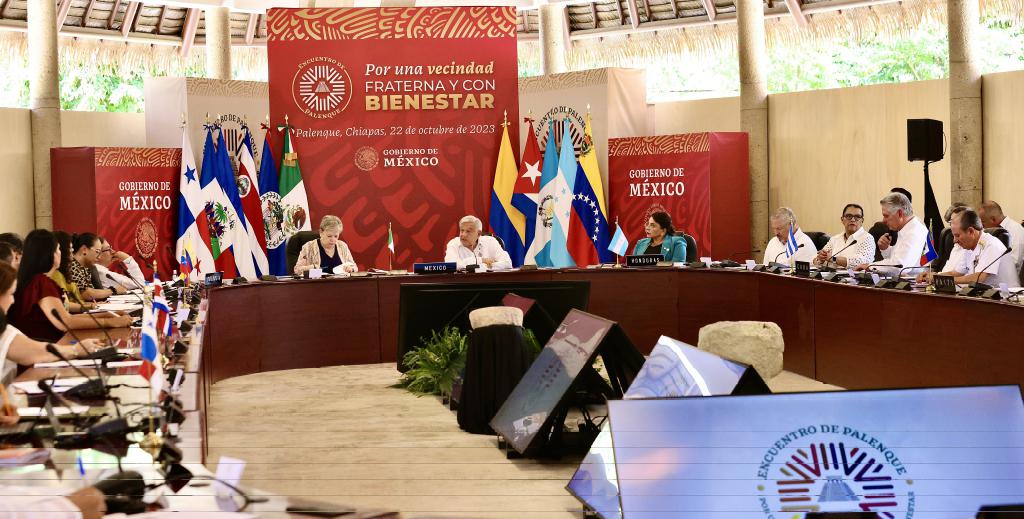
The President of the Republic of Cuba, Miguel Díaz-Canel Bermúdez, arrived in Mexico on Sunday morning to participate in the “Palenque Meeting: for a fraternal and well-being neighborhood”, a meeting convened by the Mexican president Andrés Manuel López Obrador with the aim of addressing the immigration issue.
In the speech given by the Cuban president he reflected that only "in a coordinated manner could we decipher the multiple causes and consequences of the problem and only then will we be able to advance in its possible solutions."
According to public figures, between 2022 and so far in 2023, more than 4 million migrants have transited irregularly through the countries of the region that are on the route to the United States.
For the Cuban President, "although other politically motivated versions are intended to be imposed, there is an unavoidable truth: the fundamental cause of irregular migration is the socioeconomic conditions of the countries of origin – which is accentuated after the impact of the pandemic – and the aspiration of migrants to settle and work in the United States, where the labor market offers attract those who dream of a more prosperous economic scenario than their surroundings and do not always find it. Family ties and the associated vulnerabilities can also be mentioned. to climate change."
In the Cuban case, said the First Secretary of the Communist Party of Cuba, "none of these motivations are foreign. However, the Cuban migratory potential is additionally stimulated, in a very significant way, by the hostile policy of the United States." towards our country. This hostile policy, which has a direct and extraordinary impact on the Cuban migratory flow and collaterally on the countries of the region through which this migration passes, is expressed in three fundamental components:
First of all, there is the economic blockade, reinforced in recent years in a criminal manner with a comprehensive and comprehensive system of coercive measures aimed, by definition, at depressing the standard of living of the Cuban population, reducing their real income and making them suffer from hunger. and misery. The unfair, absurd and arbitrary classification of Cuba as a State sponsor of terrorism has a significant weight in the economic effect of that policy.
Secondly, and for political reasons, the United States Government grants privileged treatment to Cubans who arrive at its southern border or its maritime borders in order to permanently establish themselves in that country. For the vast majority, these migrants are accepted regardless of the status with which they have arrived at the border or have managed to cross it. Consequently, many Cubans are confident that, unlike nationals of other countries, their chances of establishing themselves in the United States are very high if they can reach the border by any means.
Thirdly, and also for political reasons, there is a federal law in the United States called the Cuban Adjustment Act, according to which every Cuban who has entered that country after January 1, 1959 has the opportunity to obtain permanent residence by after a year of arriving. This is a unique privilege that is not enjoyed by the national of any other country. It is exclusive for Cubans and provides an extraordinary incentive for the migrant.
On the other hand, the impunity of the US authorities against migrants who have taken advantage of the theft of a fumigation aircraft, or others who travel as stowaways on civil aircraft, in addition to stimulating illegal emigration from Cuba, sets very dangerous precedents for security. of international civil aeronautics, which violates the immigration agreements signed between the two countries.
All of these practices respond to purely political motivations and lack any legitimacy or moral justification.
These regulations express very clearly how the United States Government puts the objectives of destabilization against Cuba before its national priorities in immigration matters.
Between Cuba and the United States there are several agreements, still in force, that were designed to ensure that migration between the two countries was orderly, regular and safe, and to promote the full normalization of bilateral migratory relations. However, the actions on which I have commented by the United States Government go in the opposite direction to such objectives and prevent their fulfillment.
It is impossible to understand the volume and nature of the migratory flows of Cubans who transit through countries in the region bound for the United States, without considering the weight of these factors that single out and reinforce it.
Modifying the structural causes of Cuban migration, both regular and irregular, and fundamentally influencing the reduction of the flows of Cuban migrants through various countries is in the hands of the North American authorities.
As I have said recently, in general Cuban men and women who leave Cuba legally become irregular migrants, subjected to all types of risks and dangers, including their lives, in transit to the United States.
When there is the will to act in that direction, I assure you that you will always have Cuba's commitment and cooperation.
Cuban immigration policy favors the trips of Cuban citizens abroad and their return to Cuba.
Cuba maintains bilateral migration cooperation mechanisms with several nations in the region, and exchange of migration alerts with others, with the aim of implementing the tools that allow achieving a regular, orderly and safe flow of travelers; and, at the same time, combat the trafficking of irregular migrants and human trafficking.