
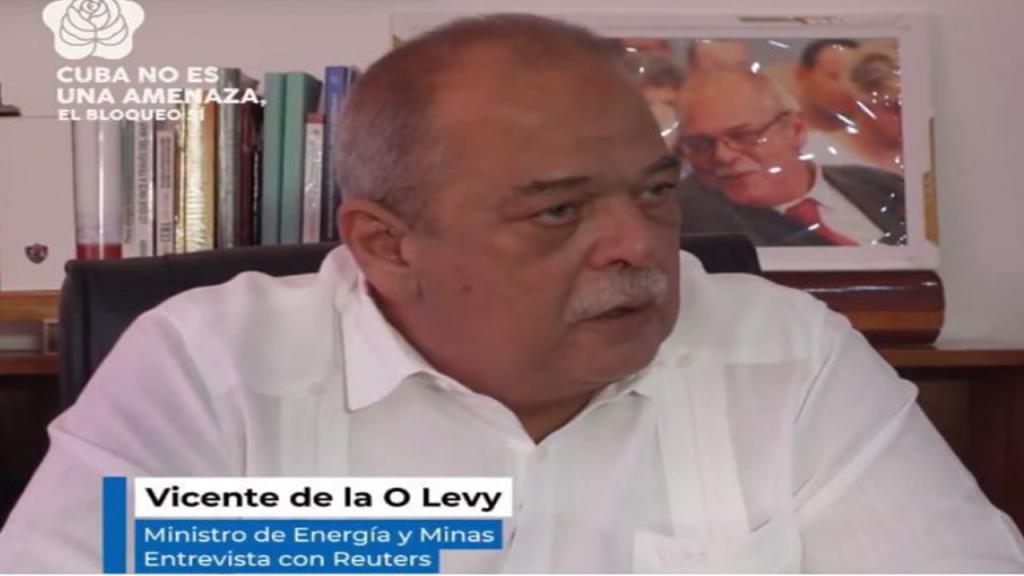
In an interview with Reuters, Minister of Energy and Mines Vicente de la O Levy explained that fuel imports by Cuba’s private sector account for only a small fraction of the country’s energy needs and are insufficient to meet the demands of electricity generation or the main activities of the state-run economy. He made these remarks while commenting on reports concerning the entry of these resources into Cuba.
Referring to figures cited by Reuters regarding fuel imports from the United States to Cuba in July, the minister clarified that the quantities entering the country through this channel are primarily intended to meet the needs of private businesses.
“The Cuban state does not benefit from this type of fuel. The fuel needs of Cuba’s state sector are not being met through these imports,” he stated. As a result, he noted, electricity generation shortfalls and fuel restrictions continue to affect the transportation of medicines, supplies, and raw materials, as well as agricultural production and irrigation.
“We know how much fuel enters the country. It has nothing to do with the quantities being discussed in those news reports, and I would venture to say—not just venture, but state with certainty—that it does not reach three percent of the country’s fuel needs,” he said.
As part of efforts to expand supply options, Cuba recently approved measures allowing the private sector to sell fuel both wholesale and retail. According to the minister, the provision covers products that private economic operators can import and sell, while also allowing them to use existing service stations or invest in building new ones. The authorization covers not only diesel and gasoline but also liquefied petroleum gas (LPG), greases, lubricants, and other products.
The minister emphasized the importance of this decision at a time when shortages of liquefied gas are also affecting food preparation in Cuban households.
“People have had to resort to practically artisanal methods of cooking, and as part of our energy transition, we have had to look for alternatives to liquefied gas,” he explained.
The measure is part of the 176 Transformations being implemented in the country and is linked to efforts to find alternatives for coping with restrictions on access to energy resources.
Commenting on reports of possible talks between the Cuban and U.S. governments, as well as conditions that might be proposed to ease sanctions—including the privatization of the state-owned oil company Unión Cuba-Petróleo (Cupet)—the minister said that U.S. pressure was intended to force the Cuban government and people into submission.
“The intention of the United States is to subdue the Cuban people and the Cuban Revolution, and that will never happen,” he declared.
In response to this situation, he said the country must improve production efficiency, strengthen international ties, facilitate access to financing, and promote the development of its productive forces.
“What we need to do is make our production much more efficient. To achieve greater efficiency, we also need much more international exchange, access to financing, opportunities for scientific cooperation, and the ability to develop our productive forces. This requires money and resources, and it requires an end to the blockade,” he stated.
The minister also explained that Cuba is pursuing a program to restore generating capacity at its thermoelectric power plants and within its distributed generation system, while continuing to install photovoltaic solar parks. He added that without the investments made in solar parks, electricity service interruptions would be even more severe.
Domestic oil extraction is also constrained by a lack of resources and supplies. Keeping wells operational and maintaining production require pipes, valves, pumps, surface equipment, transportation, and other materials.
Another goal of the energy sector is to promote the transition to electric mobility. To this end, Cuba is working to establish charging stations for electric vehicles, popularly known as solineras. The minister reported that the country already had 44 such facilities and that their expansion was continuing.
The minister stated that all polyclinics across the country have some installed energy capacity from renewable sources, sufficient to maintain essential services such as lighting, ventilation, and the refrigeration of medicines requiring special storage conditions.
He added that installed capacity at these institutions continues to increase and that progress is also being made at hospitals, whose energy requirements are greater.
Finally, he noted that the strategy aims to make use of the resources available in the country and gradually expand renewable energy generation, while acknowledging that implementation requires time, investment, and resources that are currently scarce.