
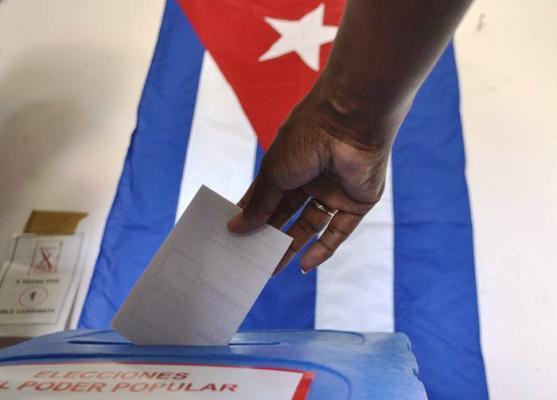
Cubans are summoned to elect next March 26 the 470 deputies to the National Assembly of People's Power (Parliament) in a democratic exercise that proposes voters to vote for all.
The united vote is not a choice for those who go to the polls, but one of the options, since by law, the voter can decide for one, two or all the candidates that appear in his constituency (basic level of the government system in the country).
But it is considered a demonstration of unity of the citizenry in support of the social and political model.
Although this may seem rhetoric to some, in reality, since January 1, 1959, the country has struggled against all odds to move forward under the pressures of all kinds of successive U.S. governments.
The ultimate expression of this hostility is the economic, commercial and financial blockade imposed by the United States and reinforced over the years in an attempt to overthrow the government.
Thus, since the first elections for the People's Power in October 1976, the united vote has been appreciated as a response to all external pressures, and in explaining this motivation, the historic leader of the Revolution, Fidel Castro, made it clear in February 1993 that "it is a political question: it is the strategy of the patriots, it is the strategy of the revolutionaries".
In so many years the harassment of the island has not changed, rather it has intensified, and at this moment, when the economic situation is extremely difficult, that strategy is still in force.
In addition, although the campaigns insist to exhaustion on the alleged absence of democracy, in contrast, elections in Cuba are characterized by a broad popular participation that goes beyond the possibility of voters to nominate and directly elect their representatives.
They also become on each occasion a true popular movement at all levels, since of the approximately 200,000 people involved in electoral work, less than one percent are professionals.
The rest are workers, students, retirees and housewives who voluntarily integrate the different bodies, form the voting tables and act as collaborators and supervisors.
Even children are active participants, as members of the pioneer organization guard the ballot boxes during voting, something that does not exist in the rest of the world.
The same happens with the work of the candidacy commissions, in charge of elaborating and presenting the draft candidacies of the deputies, as well as of the presidents and vice presidents of the municipal assemblies of the People's Power.
In a country where there is only one party, the Communist Party, it neither nominates nor elects, and this process takes place with the participation of the citizens, since the candidacy commissions are presided over by the Central de Trabajadores de Cuba (Cuban Workers' Union).
They are also made up of representatives of the main civil society organizations such as the Committees for the Defense of the Revolution, the Federation of Cuban Women, student organizations and the National Association of Small Farmers, to which 90 percent of the population belongs.
In addition, the commissions have functional independence and the power to consult as many institutions and entities as they deem appropriate, which is a guarantee of selecting those who truly deserve to occupy that responsibility.
These nominees may range from world-renowned personalities in their respective fields of action, to simple people of the people, including religious figures, private entrepreneurs and representatives of sexual diversity, which together form the closest thing to Cuban society today.
This is another important element, say the supporters of the united vote, so that when the voter is alone with his ballot, he can freely and safely exercise his choice for all.