
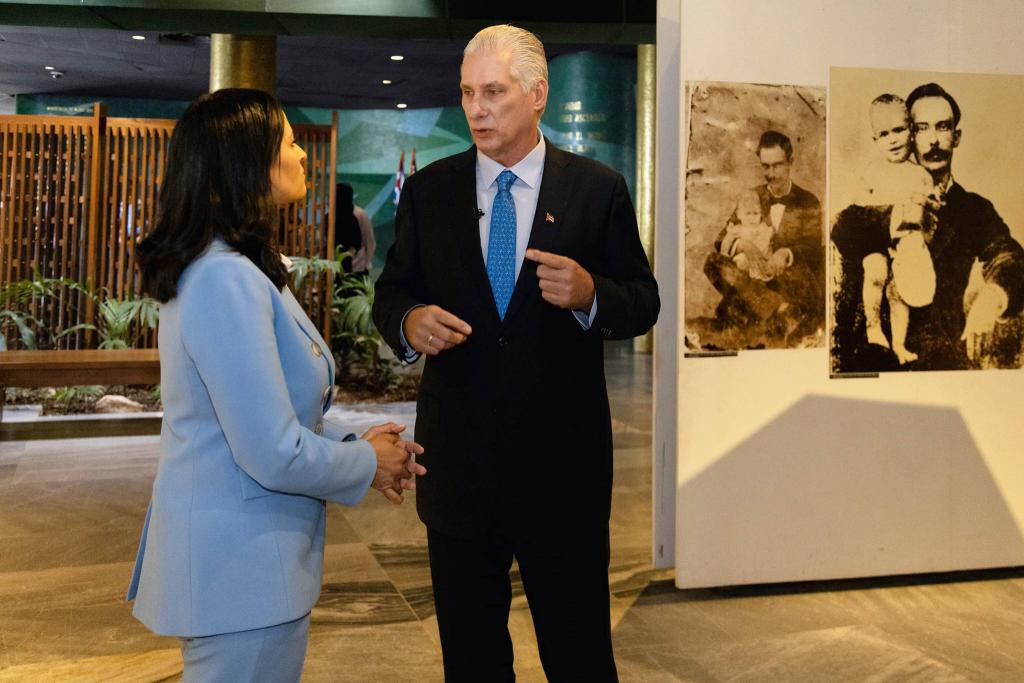
Key points expressed by President Miguel Díaz-Canel Bermúdez in an interview with Meet the Press:
“Cuba is a country whose identity is deeply rooted in the values of sovereignty and independence.”
“We are a country of peace. We do not promote war; we do not like war; we foster solidarity and cooperation among peoples, but we are prepared to defend the peace we desire.”
“We are not intimidated, and we do not want to be caught off guard or defeated.”
“Those of us who have assumed responsibilities within the Revolution are committed to the Revolution, above all to our heroic people.”
“We are willing to give our lives for the Revolution, for the cause we defend.”
“If an attack were to occur, there would be combat, there would be a fight. We will defend ourselves, and if we must die, we will die, because as our National Anthem says: ‘To die for the Fatherland is to live.’”
“We have a collective leadership in which there is unity, cohesion, ideological unity as well, and revolutionary discipline.”
“Eliminating one person from the leadership structure of the Revolution does not solve any problem; on the contrary, there are hundreds of people who are capable of assuming that responsibility.”
“I have no fear; I am willing to give my life for the Revolution.”
“I don't believe that the American people, who are a sensitive people, would allow or approve of their country, their government, invading a small island that poses no national security concern to the United States government.”
“An attack on Cuba would have costs; it would have costs for both countries in terms of unnecessary loss of human life, which could be avoided; it would have material costs; it would affect the security and stability of the United States, Cuba, and the region.”
“Before making a decision that is totally illogical and irrational, there is a logic that is fairer: that of dialogue, discussion, debate, and trying to reach agreements.”
“Cuba has done nothing to offend the United States. Cuba has never proposed to attack the United States, nor to interfere in the internal affairs of the United States.”
"It is constantly being said that Cuba is next, that Cuba is going to be attacked, that there are options for Cuba, that they are going to take over Cuba. Therefore, from the standpoint of responsibility in leading the country, this is a warning, and we must responsibly protect our people, protect our project, and protect our country. So, yes, we are preparing for defense."
“We have a defense doctrine that is entirely defensive, not aggressive, and poses no danger to anyone, known as the War of the Entire People.”
“It is based on popular participation: every Cuban man and woman has a mission, a purpose, a goal to defend, and a place and role to play in the defense.”
“Preparing to defend ourselves is the best way to avoid war and the best way to preserve peace.”
“Cuba has the right, like any country, to import oil. And all countries also have the right to export oil to Cuba.”
“This energy blockade, which further intensifies the U.S. blockade against Cuba, is very unjust.”
“Declaring an energy blockade against Cuba demonstrates once again that there is a full-scale, multidimensional aggression by the U.S. government against Cuba.”
“No country in the world can develop a thriving, prosperous economy without fuel.”
“There is an element of perversity, of evil, when a power that plays the role of aggressor subjects a small nation to a situation like this.”
“What country in the world would be capable, as Cuba has been, of withstanding 67 years of sustained aggression from the world’s most powerful nation, with more than 60 years of blockade, and not collapse?”
“We have not collapsed; we maintain an organized country, a country in harmony.”
“The U.S. government should reflect on how cruel it has been toward Cuba. It should not come here posing as a savior; it has neither the right nor the moral authority to do so.”
“Dialogue and agreements with the U.S. government are possible, but they are difficult.”
“Cuba has always had a historical willingness to maintain a civilized relationship with the United States as neighbors.”
“We have always insisted that such a relationship must be built on a foundation of respect and equality, without impositions or conditions.”
“For dialogue to take place, there must be a willingness and ability on both sides to engage in dialogue and listen, as well as respect, decency, and mutual recognition.”
“Internal order, the Cuban constitutional order, and respect for our political system are issues that are not subject to negotiation or discussion with the United States.”
“There is talk of political prisoners in Cuba. That image that in Cuba we imprison anyone who speaks out against the Revolution is a lie; it is slander.”
“The people who are in prison are not there for protesting; they are in prison—as they would be anywhere in the world that respects its Constitution—for committing acts of vandalism.”
“Often financed by terrorist organizations, by U.S. government agencies that encourage subversion against Cuba.”
"In Cuba, the people who lead the government are not chosen by the U.S. government. We are a sovereign, free state. We have self-determination, independence, and we do not submit to any dictates of the U.S. government."
“Cuban leaders do not come to power because we represent a power elite. It is the people who elect us.”
“Surrender is not part of the revolutionaries’ concept.”