
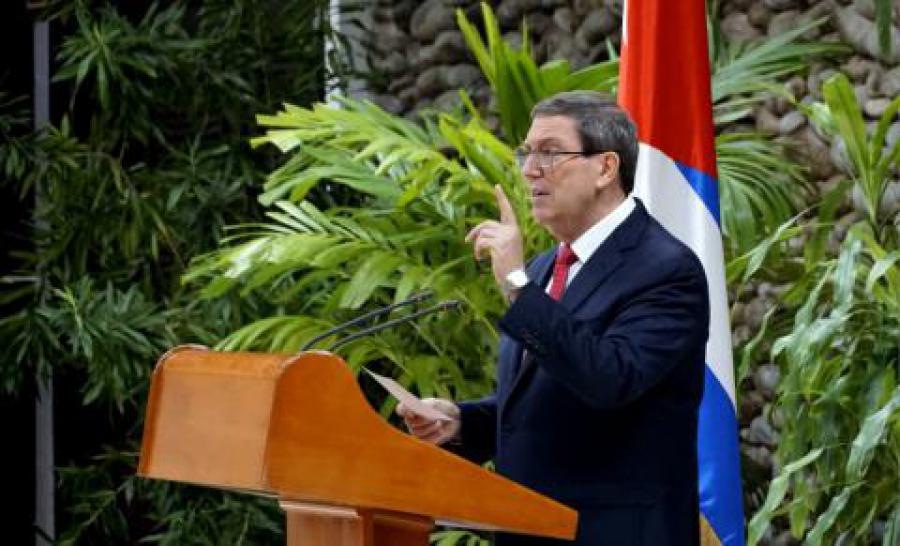
Full transcript of the press conference held by Foreign Minister Bruno Rodríguez Parrilla to present Cuba’s report on the impact of the U.S. blockade against Cuba.
Moderator: Greetings to all colleagues from the national press and the foreign press accredited in the country. Today, the Minister of Foreign Affairs of the Republic of Cuba, Bruno Rodríguez Parrilla, is holding a press conference to present the report on the impact of the United States blockade against our country. Minister, present in the room are 47 correspondents from 25 media outlets representing 12 countries. I also extend greetings to television viewers and internet users. This event is being broadcast live on Cuban television and radio, as well as on the digital platforms of the Foreign Ministry and the Presidency. You have the floor.
Foreign Minister: Thank you very much; greetings to all. I deeply appreciate you sharing this time with us.
The report that the Republic of Cuba traditionally submits to the United Nations Secretary-General, at his request, provides rigorous information regarding the economic, commercial, and financial damage caused by the United States government's blockade against Cuba.
On this occasion, I wish to emphasize the tremendous impact on individuals, on Cuban families—and, ultimately, on our entire people. For the blockade does not punish a government; it punishes the daily lives of a people in every sphere. It is an act of collective punishment, manifested in long months of living with only two or three hours of electricity a day—or less—with food spoiling, heat that prevents sleep, parents fanning their babies, children doing homework in semi-darkness, young people without connectivity or recreation, and grandparents without television or sometimes even radio; family life as a whole is damaged.
The United States President's executive order of January 29 decreed a blockade on fuel, preventing supplies—even those already paid for—due to the threat of sanctions; it intimidates the companies that own oil tankers and harasses them; Shipping companies are being threatened and prohibited from transporting even parts and components for thermoelectric plants or photovoltaic systems.
A 100,000-ton crude oil shipment would allow for a drastic reduction in blackouts for about two weeks. If fuel oil and diesel could be imported for the generator sets used in so-called "distributed generation," blackouts could be minimized; however, the fuel blockade prevents these imports. We have rapidly shifted our energy mix toward solar power. Now, shipping companies are being threatened to prevent them from bringing in solar panels or batteries for the new photovoltaic parks—facilities we have learned to install in just 45 days.
The punishment manifests in weeks without a water supply. Water supply sources rely on electric motor assemblies that—naturally—shut down during blackouts. Even a brief power interruption disconnects them, requiring several hours afterward to restore water pressure in the distribution mains. The same applies to pumping plants, booster stations, and pipeline booster pumps. These systems are protected by backup generator sets, but these, too, run on the fuel oil or diesel we are barred from importing.
The blockade deprives us of resources. It also prevents us from importing parts and components for those backup generators. Nevertheless, we are working tirelessly to mobilize functional generator sets and to secure photovoltaic power for the water supply.
The energy blockade punishes newborns who depend on the stable operation of medical equipment—such as an incubator—to survive. During a blackout, if the hospital's backup generator fails, doctors must save these infants using manual techniques—such as providing manual ventilation. The same applies to patients awaiting surgery—including children—who know that the generator protecting the operating room relies on a unit that may face mechanical issues or a lack of fuel; a generator that barely has enough fuel to operate. There have been dramatic incidents where major surgeries had to be completed using rechargeable lamps or, in some cases, the light from medical staff's mobile phones.
People awaiting surgery are aware that this service is restricted precisely due to power outages caused, above all, by fuel shortages. Significant efforts—yielding encouraging results—have been made to equip hospitals, polyclinics, and other health centers with photovoltaic systems. The blockade punishes those caring for a sick person at home who struggle to transport them to the hospital, or those with a family member requiring hemodialysis who are aware of the fuel-related limitations affecting ambulance services and other critical sectors. Despite these challenges, ambulances have been acquired, a minimum fuel supply for them is guaranteed, and transport for hemodialysis patients is ensured.
Parents and family members suffer as they anxiously search for essential medication—medicine that might be sitting in one of the more than seven thousand shipping containers blocked from reaching the Island due to U.S. government threats against shipping companies, or medicine produced in Cuba but lacking raw materials or supplies currently held up in another container.
Data show an increase in infant mortality from four per thousand live births in 2018 to 9.9 in 2025. These are children, not mere statistics. These are deaths that should never have occurred—deaths resulting from depriving Cuba and its robust, effective public health system of legitimate resources.
We are referring, for instance, to the system responsible for caring for pregnant women, treating sick children, and attending to those arriving with medical emergencies. Healthcare requires resources. Patients need timely treatments that the energy blockade and measures targeting shipping companies prevent from reaching Cuba.
The cruelty of this collective punishment is evident in the thousands of Cubans who struggle daily to get to work without public transport, as the vehicle fleet is virtually paralyzed by the lack of fuel. Children, adolescents, and teachers often walk long distances to reach their schools. Yet, we have acquired and are assembling electric motorcycles, tricycles, and vehicles. Despite so much damage, Cuba has achieved the feat of starting the current school year for its children with greater guarantees and better resources—ensuring universal access, equity, and quality—surpassing what is guaranteed by Latin American countries or even the United States itself in low-income communities.
Even under the extreme conditions facing our economy, essential annual funding is secured for the special education of children and young people with hearing, psychomotor, or intellectual disabilities. For a family, that funding means opportunities for their child to learn, communicate, and participate. Their future is more than just a figure on a statistical balance sheet.
The decline in real income and the rising cost of living for Cuban families—caused by the even more extreme intensification of the blockade following the Executive Order of May 1st—are causing immense suffering and anguish. Fuel blockades and threats against shipping companies lead to blackouts, disrupt water supplies, and affect all services provided to the population. Hostility and aggression permeate every aspect of life.
This is not a matter of "collateral damage"—an unacceptable term stemming from the United States' criminal war against Cuba. These are the victims of an aggressive design, of a coldly calculated plan. This is the very objective of the measures being applied. It is collective punishment inflicted upon Cubans to achieve political goals. The blockade punishes us, yet we want to live in peace. It punishes every family; we simply want to be left in peace.
On January 8, 2026, while answering a question about his administration's policy toward Cuba, President Donald Trump stated—and I quote: "I don't think much more pressure can be applied, short of going in and destroying the place." The Secretary of State—who had consistently lied by claiming the fuel blockade did not exist—declared on August 7—and I quote: "There are no escape valves. Every time they create a new mechanism to try to break free from the siege, we simply block it." This reflects the same ruthless sentiment and destructive spirit behind the genocide being committed in Gaza. In Cuba, it is silent—without bombs—yet it kills nonetheless.
The United States government can no longer sow confusion or mislead. Within that country, there is growing awareness and acknowledgment of the abuse, and voices demanding its immediate cessation are on the rise.
On October 27 and 28, the United Nations General Assembly will once again consider the agenda item titled: “Necessity of ending the economic, commercial and financial blockade imposed by the United States of America against Cuba.” Despite the extraordinary pressure and intimidation exerted by the United States government—through its State Department, embassies, and diplomatic missions—upon member states, our people are confident in the world's overwhelming support for the call to end the blockade during the vote scheduled for Wednesday, October 28, around midday.
The report we are presenting today—the full text of which is in your possession—details the damage caused by the economic war against Cuba between March 2025 and February 2026. It compiles compelling examples, harrowing testimonies, and irrefutable data regarding the blockade's impact on our economy, human rights, and people's daily lives.
Behind every figure lies a human face. Behind every blockade measure lies a tragedy or a family drama. The damages caused by the blockade between March 1, 2025, and February 28, 2026, are estimated at 8.083 billion dollars. This is a record figure, surpassing the previous year's record. During this period, the damage caused by the blockade increased by 7% over the record level registered a year ago. The cumulative damage over the decades the blockade has been in effect amounts to 178.7 billion dollars at current prices. This marks another record, 4.7% higher than previously reported. The report estimates that, were it not for the blockade, Cuba’s GDP at current prices would have grown significantly in 2025. This estimate reflects the lost opportunities—precisely due to the direct effects of this collective punishment—to revitalize the productive sector and export capabilities, recover the economy, and foster social development. It also highlights the diminished capacity of our government to continue developing and refining the social policies that form an integral part of our economic and social model.
The report details, through data and extensive explanation, the widespread, comprehensive, cross-cutting, and profound impact of the energy blockade on every aspect of national life. This is a reality that no one who is even minimally informed or possesses basic honesty could claim to be unaware of. One must consider what would happen to any other country facing—for over eight months—a total energy siege equivalent to a naval blockade, which constitutes an act of war under international law.
What country, under such conditions, could maintain peace, social consensus, stability, citizen participation in solving challenges, and public safety?
Faced with this cruel challenge, Cuba is working tirelessly; we will never yield to defeat. Today, we are making great efforts to address the population's most pressing needs and are maintaining—with the aim of further improving—social policies as a top priority, ensuring that no one is left behind.
We will move forward rapidly and resolutely with the implementation of the economic and social changes recently approved by the National Assembly of People's Power; we expect these measures to yield initial results in the short term and enable us to improve the well-being of our population.
It is necessary to recall the original design of U.S. policy toward Cuba—set forth in that infamous 1960 internal memorandum by Assistant Secretary of State Lester Mallory—which states, and I quote: “to employ rapidly all possible methods to weaken the economic life of Cuba, to bring about the denial of money and supplies, to reduce financial resources and real wages, and to cause hunger, desperation, and the overthrow of the government.” The current U.S. policy toward Cuba constitutes an act of genocide under international conventions; it replicates those same objectives and seeks to trigger a catastrophe akin to the holocaust suffered by the Cuban people in the final decade of the 19th century under the *reconcentración* policy of Captain General Valeriano Weyler.
The spirits of Weyler and Lester Mallory live on in certain U.S. politicians and State Department officials.
Appalling statements are made daily—not only by government officials but also by rabidly anti-Cuban members of Congress, by figures representing the extreme conservative and neo-fascist wings of U.S. politics, and by the heirs, henchmen, and thieves who profited from the dictatorship of Fulgencio Batista. These are the people who believe Cuba’s solution lies in U.S. tutelage, or who seek to hand the country over to the worst elements in Miami—those who have always made a living off the anti-Cuba industry.
These are politicians who call for violence, condone terrorist acts, instigate the destabilization of Cuba, and constantly urge the U.S. President to launch direct military aggression against our people.
Cutting off all economic avenues for a country means suffocating its entire population and attempting, in the process, to induce a humanitarian crisis through collective punishment. There will be no humanitarian crisis in Cuba because our people are deeply committed to solidarity; they understand and are keenly aware of the causes of the problems and hardships we face; they mobilize collectively in close unity and are the protagonists of the changes we are implementing to address past issues and the extremely harsh current situation—updating and transforming our economic and social model, always guided by social justice, equal opportunity, and the dignity of the Cuban people.
This is not an attack on a government with which the northern neighbor has political differences; it is by no means an act of legitimate self-defense by the planet's leading military, nuclear, technological, and economic power.
It protects no national interest—neither that of U.S. citizens nor that of business owners. It neither represents nor reflects the will, sentiments, or interests of that country's taxpayers or voters. Nor does it in any way reflect the sentiments and interests of the vast majority of Cubans living abroad—particularly those residing in the United States and their descendants—who want the best for their families, their nation, and their homeland.
With these genocidal policies, the United States government is not responding to any unusual or extraordinary threat. Yet, it bases both executive orders—those of January 29 and May 1—on that preposterous slander. It is not responding to any real threat whatsoever.
Cuba is not a threat; the blockade is. Cuba is by no means a threat. We are a peaceful country; we want and deserve peace.
Aligning with the overwhelming consensus of the international community, I reiterate now—and we will reiterate at the United Nations—that the blockade must be brought to an end.
Let us live in peace.
Moderator: Yes, Minister, we have received requests from three media outlets present in the room.
Cuban Television, the Cuban News Channel. Please introduce yourself.
Journalist: Roxana Arian, from the Cuban News Channel. Minister, the U.S. Secretary of State has repeatedly stated that his government has allocated $100 million in humanitarian aid for our country and that Cuba has rejected it. Could you tell me the reality regarding those funds and what amount of money has actually entered our country?
Minister: They lie constantly. The offer of the alleged $100 million in humanitarian aid to Cuba was made public—unusually—at the Holy See, before it was even known to Cuban churches or our government.
It should be noted that after our government had accepted and facilitated $3 million in humanitarian aid—delivered over a long period—in response to the damage caused by Hurricane Michelle, an offer of an additional $9 million was made. Some obscure arithmetic at the State Department reduced this figure to $6 million, a sum immediately accepted by international religious institutions that are highly respected by churches in Cuba and by our government. Of that amount—which started at $9 million and became $6 million—just over $1 million has actually been utilized.
Regarding that offer of $100 million—which credible sources at one point said excluded medicines and food, while others claimed delivery would be delayed until the end of the year—I can report that the only shipment actually carried out consisted of a package of food and hygiene products for 700 Cuban families. The price was likely calculated based on a different rate—I assume so, because it is hard to believe that 700 modules for a family would cost the $91,000 figure that has been cited.
I once again call upon the United States government—specifically the State Department—to state when the implementation of this humanitarian aid will begin; whether it will include medicines and food, which are true priorities for our people; why it is taking so many months to carry out; when it will start; and, above all, when it will end.
Of course, Cuba always accepts any humanitarian aid offered from any corner of the globe, provided it adheres to international practices and the norms of cooperation and humanitarian aid recognized by the United Nations—norms that strictly rule out any conditions or political manipulation, as no one should seek political gain from need or suffering, and that also, naturally, exclude any approach detrimental to national sovereignty.
I can state that the Cuban government is in close contact with the Cuban churches that will participate in distributing this aid and will provide them with full support to ensure the process is swift and effective. I hope the State Department takes action.
Moderator: We also have a question from the AP news agency.
Journalist: Good morning or good afternoon, Minister. Andrea Rodríguez, from the AP news agency.
Sir, in recent weeks we have heard a great deal about conversations and dialogues—meetings that did or didn't take place. Could you tell us, officially and precisely, what stage these conversations with the United States are at—or whether they are even real? Is there an agenda, or what would the roadmap be to break the deadlock in this situation, which has dragged on for so many months? In this regard, I would also like to know if U.S. authorities have conveyed any comments regarding the 176 measures—the approval of the 176 measures—some of which move toward opening up, regardless of Cuba's own motives or U.S. demands for liberalization.
And one clarification, if I may. You just mentioned losses of around 8 billion dollars in a year, but that figure covers the period up to February—meaning it includes one month of the current energy blockade. How many millions of dollars would be added to that total, and what proportion corresponds to these past six months—which have been the most dramatic and have seen the greatest intensification of the energy and financial blockade Cuba is facing? Thank you.
Minister: As has been stated, there have been conversations with the State Department. Communications in this regard are ongoing. However, these conversations show no headway or progress, due to a lack of political will on the part of the United States government.
Cuba reiterates its willingness to continue these conversations based on international law, without preconditions, and on the basis of sovereign equality—on a strictly equal footing—as well as mutual respect and reciprocal benefit for our peoples, and without interference in our internal affairs.
There have been no negotiations, nor are there any at this moment; there are no agendas and no roadmaps. I can state that we remain willing to continue those contacts, despite the lack of progress.
There has been no official statement from the United States government regarding the economic and social changes recently adopted by the National Assembly of People's Power. There have been no such statements—and, in truth, none are needed—because these changes concern the exercise of the sovereign powers of the Republic of Cuba, which reside solely and inalienably with the Cuban people.
However, we do constantly receive signals and inquiries from broad sectors of U.S. society—from individuals, Cubans residing in that country, entrepreneurs, companies, businesspeople, people of good will, members of the U.S. Congress, and politicians from various states. They are deeply interested in learning more and understanding how they might seize the opportunities opening up to expand ties regarding trade, cooperation, and investment. Above all, they contrast the scope of these transformations with the tightening energy blockade and the persecution of shipping companies that transport supplies to Cuba, and they ask us how they might proceed under such circumstances.
We find it striking that we are consistently asked what is inside those more than 7,000 containers, whether they have already been paid for, whether they are part of contractual arrangements—such as contracts signed with international shipping lines—and which entities in Cuba contracted for these shipments. People are astonished when we tell them that the majority of these cargoes were contracted by small and medium-sized private Cuban companies; that the bulk of the shipments consists of food, medicines, and medical devices; and that, obviously, these are shipments that were contracted and paid for in advance in accordance with universally accepted international trade rules. It is this policy of energy strangulation—inappropriate for a time of peace, as it constitutes an act of war affecting freedom of trade and freedom of navigation—that is the issue.
The calculation I have presented here is rigorous; it relies on a methodology based on international standards. Some years ago, it was audited by a U.S. Congressional commission, which declared it to be methodologically rigorous and in compliance with international accounting practices.
This figure does not include damages resulting from the energy blockade, nor does it include damages from secondary sanctions—even though the effects of the January 29th Order began to be felt as early as the following week.
Therefore, we will try to finalize this year's statistics as soon as possible, but we adhere to the rigorous methodology established by Cuban economic statistics regulatory bodies, as well as the methodology of the General Assembly Resolution. That Resolution requests the Secretary-General to report on the status of compliance—or non-compliance, one might say—and asks for information regarding these aspects. We have not wished to alter that methodology, but I anticipate that the damages incurred during these months will far exceed those of the previous period.
Moderator: Minister, one final question from Alma Plus.
Journalist: Thank you. Nora Becerril from Alma Plus TV. The recent executive orders issued by Washington designate Cuba as a national security threat and also intensify the energy blockade, as discussed in the report. How does Cuba respond to this designation? How does it respond to this? And how real do they consider the threat of direct military action to be?
Minister: They lie—they lie constantly. That is why the policy of aggression and blockade against Cuba brings such international isolation and loss of credibility upon the United States government.
If this were not a real threat—if it were not a threat to Cuba’s very existence, which we always take very seriously; if it were not a threat based not merely on rhetoric but on the testimony of numerous credible sources—analysts and U.S. non-governmental entities alike—presenting evidence that the U.S. government is making actual military preparations; when one hears everyone from the President to the Secretary of State, and very recently the Secretary of War, stating that direct military aggression against Cuba is among the options on the U.S. President's table—then naturally, one must take that threat seriously. This is compounded by Cuba’s own experience in this regard, as well as the experience of people across the globe who have suffered—and continue to suffer—not only the destruction of the international order but also a proliferation of acts of aggression extending beyond unilateral coercive measures to include the conflicts and wars the U.S. government has waged or is currently waging.
Therefore, our people and our State take these threats very seriously and are preparing to defend our independence, sovereignty, and territorial integrity with determination and at all costs.
We view this as a threat of that magnitude—one we hope never materializes, as it would trigger a veritable bloodbath and result in the loss of life not only for Cubans but also for young Americans sent to fight a war they do not want, a war that is not theirs and serves no national interest of the U.S. citizenry or people. Yet, it is clear that we will defend our independence, sovereignty, and territorial integrity with the same determination as in the past.
At the same time, however, our State and government are actively working on economic and social policies to address structural economic issues, problems accumulated over recent decades, and the strangling effect of the current energy blockade—which, I repeat, is tantamount to a naval blockade and constitutes an act of war. Consequently, our people are currently devoting their utmost effort to confronting and resolving these difficulties through the participation and collective contribution of all. Thank you very much. Moderator: Thank you very much. This concludes the press conference.
(Cubaminrex – Embassy of Cuba in Australia)