
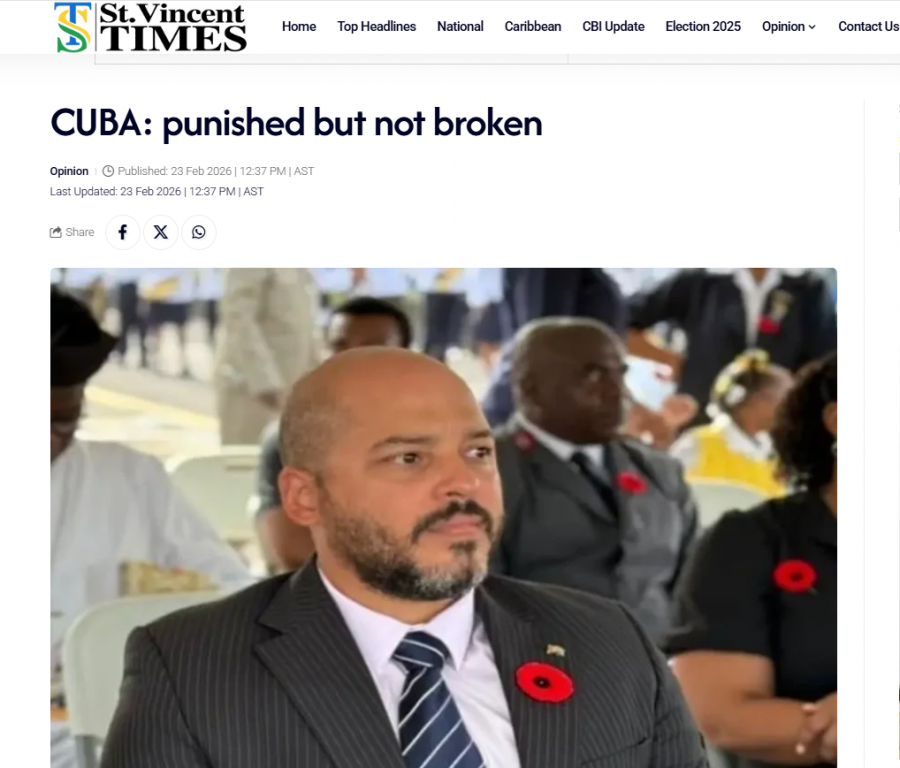
By Carlos Ernesto Rodríguez Etcheverry
Ambassador of Cuba to St. Vincent and the Grenadines
The tightening of the United States blockade against Cuba once again places the Island at the center of a confrontation that, far from offering solutions, deepens the suffering of millions of Cuban families. The recent executive order signed by President Donald Trump on January 29, 2026, marks a new chapter in this policy of economic asphyxiation that for more than six decades has sought to bend the will of a people.
The measure, presented under the argument of “pressuring for change,” in practice reinforces financial restrictions, further limits international transactions, and tightens sanctions against third countries and companies that maintain ties with Cuba. It is not an isolated action, but rather the continuation of a strategy aimed at intensifying shortages, hindering access to fuel, food, medicines, and essential technologies, and fostering despair.
The Real Impact: Cuban Families
Beyond political speeches, the tangible effect of these measures is felt in Cuban households. Each new sanction complicates the arrival of medical supplies, increases the cost of imported food, and undermines energy stability. Long hours without electricity, uncertainty in transportation, and limitations in access to certain goods are not statistics—they are daily realities.
The new provisions adopted by Washington, by further restricting financial and commercial flows, aggravate an already complex economic situation. The declared objective may be political, but the impact is profoundly human. Mothers, the elderly, children, and workers bear the immediate cost.
Threats and Confrontational Rhetoric
Alongside the executive order, President Trump has resumed a rhetoric of threats toward Cuba, conditioning any easing of measures on unilateral changes in the Island’s political system. This stance not only disregards the principle of non-intervention, but also insists on formulas that have historically failed.
Public pressure, warnings, and language of imposition do not contribute to building trust.
Rather, they reaffirm the coercive nature of a policy that has been condemned year after year by the international community in multilateral forums.
Cuba Reiterates Its Willingness to Engage in Dialogue
In this context, the Revolutionary Government and Cuba’s Ministry of Foreign Affairs have reiterated a clear position: Cuba is willing to engage in dialogue with Washington, but on the basis of sovereign equality, without conditions, without pressure, and with mutual respect. Sovereignty is not negotiable, nor can it be used as bargaining currency at the negotiating table.
This position is not new. Cuba has demonstrated on multiple occasions its willingness to move forward in areas of common interest when there is reciprocal respect. What it rejects is the logic of threats as a diplomatic tool.
Cuba Is Not Alone
Despite the tightening of the blockade, Cuba does not face this moment in isolation. Numerous governments, social organizations, and solidarity movements in Latin America, the Caribbean, Europe, and other regions have expressed their rejection of the new measures and their support for the Cuban people.
Expressions of solidarity have been both political and material: donations of food, medical supplies, energy cooperation, support in international organizations, and public statements defending Cuba’s right to develop without external interference.
This solidarity confirms that the isolation does not belong to Cuba, but rather to a policy that many consider obsolete and ineffective.
A Historical Crossroads
The executive order of January 29, 2026 does not bring solutions closer. It reaffirms a strategy of pressure that, far from promoting understanding, deepens tensions and multiplies hardships. Yet it also once again highlights the resilience of the Cuban people and their determination to defend their sovereignty.
The path toward a different relationship between Havana and Washington necessarily requires mutual respect. History shows that coercion has not broken Cuba’s will. Dialogue, however, could open a real opportunity. Meanwhile, Cuban families continue to face difficulties with dignity, sustained not only by their own strength, but also by international solidarity that reaffirms an essential truth: Cuba is not alone.