
Five key points about the US blockade against Cuba
• What did President Kennedy sign?
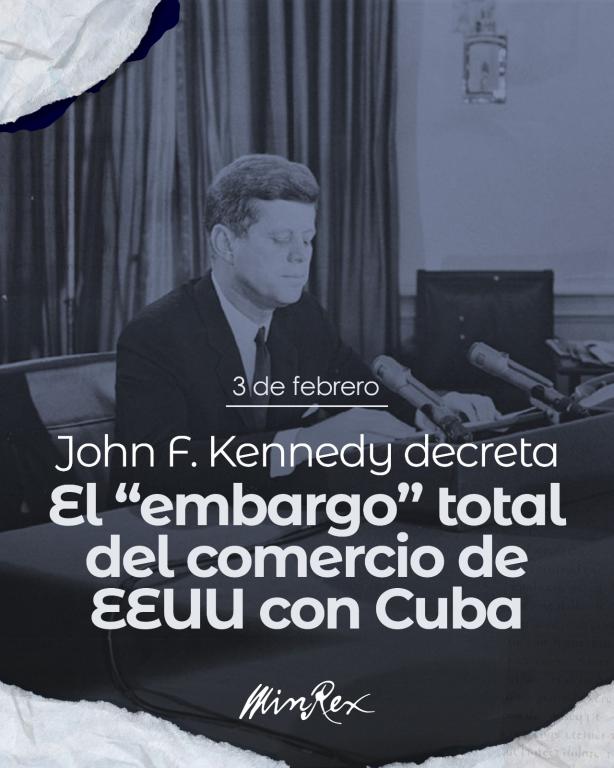
On February 3, 1962, Democrat President John F. Kennedy signed Executive Order 3447, establishing the economic, commercial, and financial blockade imposed by the United States against Cuba. This decision, designed to prevent the Cuban economy from functioning and undermine popular support for the Revolution, was based on the application of the Trading with the Enemy Act of 1917, originally passed in the context of World War I against the German Empire and its allies. Since then, the strategy of economic encirclement and suffocation has become a central component of US policy toward Cuba, with the aim of limiting the Cuban people's right to exercise their sovereignty and build an independent project, free from imperial subordination.
Although the total blockade was made official on that date, restrictive measures aimed at affecting strategic sectors of the country's economy and defense had already been in place since the triumph of the Cuban Revolution. The fundamental objectives of this policy were clearly expressed in the memorandum of Under Secretary of State Lester D. Mallory, dated April 6, 1960, which stated the need to generate discontent and despair by deteriorating economic conditions, depriving Cuba of resources and supplies to provoke a social crisis that would lead to the overthrow of the government. These objectives have essentially remained in place over time.
• Why is it a blockade and not an embargo?
The measures applied by the US government against Cuba do not strictly correspond to the definition of “embargo.” In legal terms, this term is usually understood as a precautionary measure intended to retain assets to ensure compliance with legitimate obligations, generally authorized by a competent authority. However, Cuba is not a debtor to the United States and has not engaged in acts that would justify, under international law, the confiscation or liquidation of its resources. Therefore, invoking alleged arguments of “legitimate defense” is incompatible with international norms.
Although the United States government insists on using the term “embargo,” the set of sanctions and restrictions imposed against Cuba constitutes, in practice, an economic, commercial, and financial blockade. These actions seek to isolate and economically suffocate the country, with the aim of weakening its population and forcing it to renounce its decision to remain sovereign and independent. All of this constitutes precisely the cardinal elements of the concept of “blockade,” understood as the act of isolating and cutting off communication with a State in order to force its surrender through coercion or deprivation. Its scope and severity reflect measures typical of an undeclared war against the Cuban people. In addition, the blockade has a broad and integrated extraterritorial component, so that we are not dealing with a simple prohibition of trade and investment between Cuba and the US. What we are seeing is a veritable economic war that includes obstacles, prohibitions, and coercive measures to prevent third countries from engaging with Cuba.
• Is the blockade still in place today?
The blockade imposed by the United States remains in force and has evolved into one of the most prolonged and complex forms of economic warfare ever waged against a sovereign state. Its essentially extraterritorial nature, in violation of international law, seeks to isolate Cuba and punish those who establish any economic, commercial, or financial ties with the country through pressure, blackmail, and penalties. The persistent goal is to deprive the island of necessary income, deteriorate the living conditions of its population, generate shortages of food, medicine, and other essential goods, and cause structural difficulties in its economic development. Between March 2024 and February 2025, the material damage caused to Cuba is estimated to have amounted to approximately $7.5561 billion, representing an increase of almost 50% over the previous cycle.
To justify these measures, US authorities have promoted a narrative aimed at minimizing or even denying the effects of the blockade, presenting it as a minor restriction with no significant impact on the Cuban economy. However, the empirical evidence and available figures contradict this position, reflecting profound and ongoing consequences for the island's productive and social fabric. Likewise, in recent months, US policy has taken a more openly coercive approach. The executive order announced on January 29 exemplifies this trend, publicly declaring the intention to deprive Cuba of any fuel supplies, thereby deepening the mechanisms of economic suffocation established by previous administrations.
• What does the international community say?
The US administration persists in ignoring the almost unanimous call from the international community to end this illegal and inhumane policy against Cuba. This demand has been reiterated in the 33 resolutions of the United Nations General Assembly entitled “Necessity of ending the economic, commercial, and financial embargo imposed by the United States of America against Cuba,” which have been approved since 1992 by an overwhelming majority.
The voices joining the Cuban people in demanding the immediate lifting of this policy have multiplied. Between March 2024 and February 2025, more than 2,000 international events and 1,703 statements condemned the blockade and the arbitrary inclusion of Cuba on the list of state sponsors of terrorism. Even within U.S. society itself, calls to end these measures grew, with initiatives from congressmen, academics, economic and religious sectors, and solidarity movements.
• What is Cuba's position?
Despite the persistent and hostile policy implemented by the United States, Cuba maintains a firm stance in defense of the construction of socialism. The Cuban state has consistently and unwaveringly called for the unconditional lifting of the blockade, considering it an inhumane measure incompatible with the principles of international law.
On numerous occasions, Cuba has expressed its willingness to establish a civilized and respectful relationship with the US government through serious, responsible dialogue based on international law, sovereign equality, mutual respect, reciprocal benefit, non-interference in internal affairs, and absolute respect for the independence and sovereignty of states. Our country poses no threat to US national security or to the well-being of its citizens, who have historically been welcomed with respect and hospitality when they have had the opportunity to visit the island.
In this context, we appeal to the legacy of Commander-in-Chief Fidel Castro and recall his words spoken in the Aula Magna of the Central University of Venezuela: “The United States government has given us the opportunity to fight to the fullest by blocking us, constantly harassing us, and excluding us from everything. We are even happy to be excluded in exchange for the freedom to speak without compromise in any forum in the world where there are so many just causes to defend.”
(Cubaminrex)