
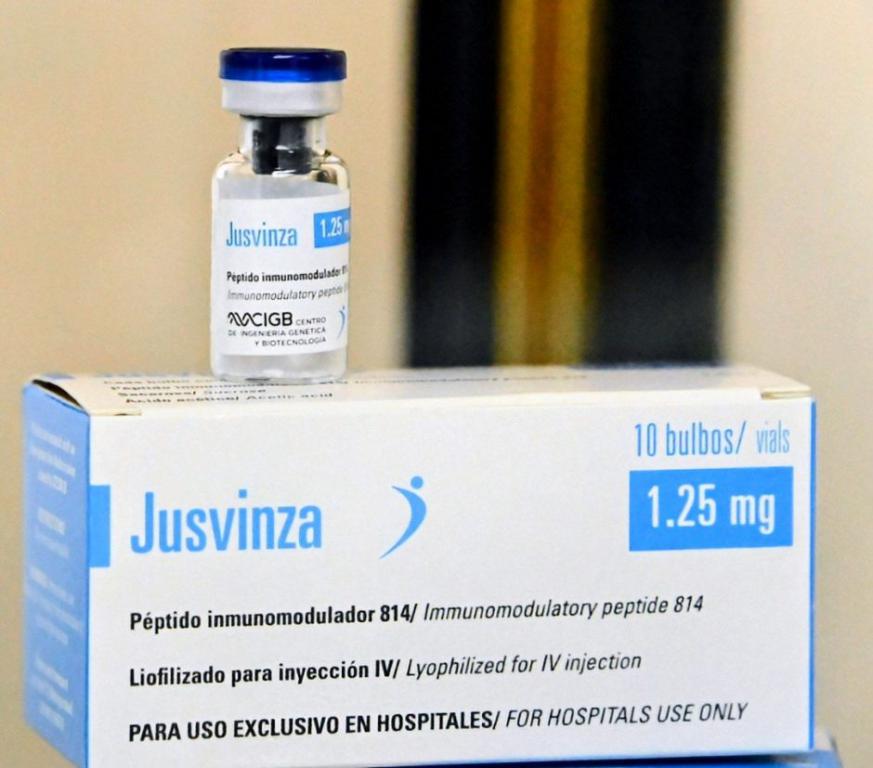
The final results of the Phase 2 clinical trials for Jusvinza treatment in patients recovering from Chikungunya, both in the post-acute and chronic stages of the disease, confirmed the hypothesis posed by the researchers: “It resolved the painful and inflammatory joint symptoms caused by this virus.”
This was stated by Doctor of Sciences Julio Baldomero Hernández, Director of Clinical Research at the Genetic Engineering and Biotechnology Center (CIGB), during this week’s meeting between the First Secretary of the Central Committee of the Party and President of the Republic, Miguel Díaz-Canel Bermúdez, and health experts and scientists at the Palace of the Revolution.
To observe the progress of the research firsthand, members of the Presidential press group visited CIGB, whose scientists have spent over two decades developing a molecule that has demonstrated effective results in treating diseases.
Baldomero Hernández explained that these findings were reached through two Phase 2 clinical trials initiated in early December to verify the therapeutic effect and safety of the product in this type of patient.
The trial conducted on patients in the post-acute stage took place at the Diez de Octubre Teaching Clinical-Surgical Hospital in Havana and included 174 participants. The study on patients in the chronic stage of the disease was carried out at the Faustino Pérez Provincial Teaching Clinical-Surgical Hospital in Matanzas, with 120 participants.
In both studies, the specialist reported, 70 percent of patients achieved the expected results, “demonstrating that we are dealing with a safe and highly effective medication for this type of pathology.”
With the results obtained up to April, he emphasized, “we can affirm that Cuba now has a drug capable of resolving painful and joint symptoms, as well as secondary inflammation, thereby providing our patients with a better quality of life.”
Another positive outcome was that, as anticipated, the drug not only proved effective in treating painful and inflammatory clinical manifestations but also maintained its effects over time.
For the study, Baldomero Hernández explained, two dosing schedules were used over eight weeks: six doses and nine doses, both of which were highly effective. An evaluation at week 12 confirmed the persistence of the drug’s effect.
He reiterated, “With the use of Jusvinza, we have shown that the drug is not only effective and capable of resolving joint symptoms, but also sustains the effect, preventing patients from progressing to the chronic form. This is undoubtedly an advantage, making the medication highly attractive and providing assurance first to medical personnel and second to the population that they have a highly effective treatment available.”
When discussing the details of the research, the specialist noted that the Jusvinza study also incorporated conventional therapies for Chikungunya—such as anti-inflammatories, analgesics, steroids, and other globally used treatments—and confirmed that the Cuban drug is a highly effective therapy.
Currently, with regulatory approval, a Phase 3 study involving 300 patients from medical institutions in Havana is in its second week, and “we are very optimistic about the results observed,” he said.
WITH THE LEADER OF THE JUSVINZA PROJECT
Doctor of Sciences María del Carmen Domínguez Horta, lead specialist of the Autoimmunity and Inflammation project in the Pharmaceutical Department of the Biomedical Research Directorate at CIGB, leads studies on a molecule that has become a symbol of pride in Cuban scientific development.
“Jusvinza,” she explains, “is a molecule originally designed to treat rheumatoid arthritis and other autoimmune diseases. Its active ingredient is a peptide—a fragment of a molecule involved in inflammation in the inflammatory processes of various autoimmune diseases.
“Our approach to designing Jusvinza was innovative. We initially used bioinformatics tools, which yielded excellent results in preclinical evaluations. At the same time, Jusvinza differs from other market drugs for autoimmune diseases, as its concept focuses on regulating the inflammatory response—that is, controlling inflammation without inducing immunosuppression.”
In biomedical research, the scientist recalls, developing a new drug takes many years. This project began in the early 2000s, was approved by our Scientific Council, followed by molecular design, preclinical evaluations in in vitro systems and animal models, which demonstrated the therapeutic effect. Subsequent studies, such as toxicology tests, confirmed the drug’s safety.
Jusvinza successfully passed these stages, and formulation development for patient use began, followed by clinical evaluations. Phase 1 clinical trials in rheumatoid arthritis confirmed safety and provided preliminary evidence of therapeutic effects.
Based on these results, Phase 2 clinical trials commenced, but then the COVID-19 pandemic emerged. “One of the alternatives used to treat severe and critical COVID-19 patients was Jusvinza, known at that time by its code CIGB-258,” she recounts.
The results were positive, and the molecule was incorporated into the national COVID-19 treatment protocol, helping reduce mortality before effective vaccines were available. Jusvinza was used for pregnant women, postpartum mothers, and children with severe disease, yielding satisfactory results.
Now, with the new Chikungunya outbreak, Jusvinza’s mechanism of action supports its use in treating post-viral sequelae in these patients, including arthritis, joint inflammation, and other systemic complications.
“From a basic research perspective,” she adds, “we continue to gather evidence on the molecule’s mechanism of action, which is very interesting because it regulates inflammation without causing immunosuppression, inducing regulatory cell clones while inhibiting other white blood cells involved in inflammatory processes.”
Asked what a product like Jusvinza represents in her life as a scientist, Domínguez Horta replied, “It is part of my life, like another child. I have dedicated many years of research, effort, study, and work to it, with a supportive team of researchers across various areas of our institution, the Genetic Engineering and Biotechnology Center. Jusvinza is a product of a great team effort.”
JUSVINZA CONTINUES TO ADVANCE
Doctor of Sciences Gillian Martínez Donato, project development manager for Jusvinza, discussed the future steps for this innovative CIGB molecule, which has been mainly studied for rheumatoid arthritis and is currently in a Phase 3 clinical trial.
The study is in the statistical analysis phase to prepare the final report for submission to CECMED, so that the national regulatory authority can grant definitive approval for this indication, both for use in Cuba and for international commercialization.
With the repositioning of the product for Chikungunya treatment, as previously done for COVID-19, researchers are pursuing this new line of investigation.
International Prospects
CIGB has actively studied Jusvinza’s mechanism of action and maintains robust international collaboration. These results have been published in prestigious scientific journals, attracting the interest of international companies. Negotiations are ongoing with institutions interested in developing the product.
In discussion with the Presidential press team, Politburo member and Doctor of Sciences Marta Ayala Ávila, General Director of CIGB, emphasized that Jusvinza represents a major hope for Cuban public health and that work is beginning with foreign counterparts to develop it as an exportable product.
As highlighted during this week’s meeting between President Miguel Díaz-Canel Bermúdez and health experts, Jusvinza is a prioritized project for CIGB and BioCubaFarma, with efforts ongoing on both regulatory and production fronts under the continuous guidance of CECMED.
The product is being manufactured at CIGB’s Mariel Special Development Zone facility, a newly completed plant built to high standards. In the first quarter of this year, 21,000 Jusvinza vials have been delivered to the National Health System, three times the amount distributed last year.
(Source: Presidency of Cuba)