
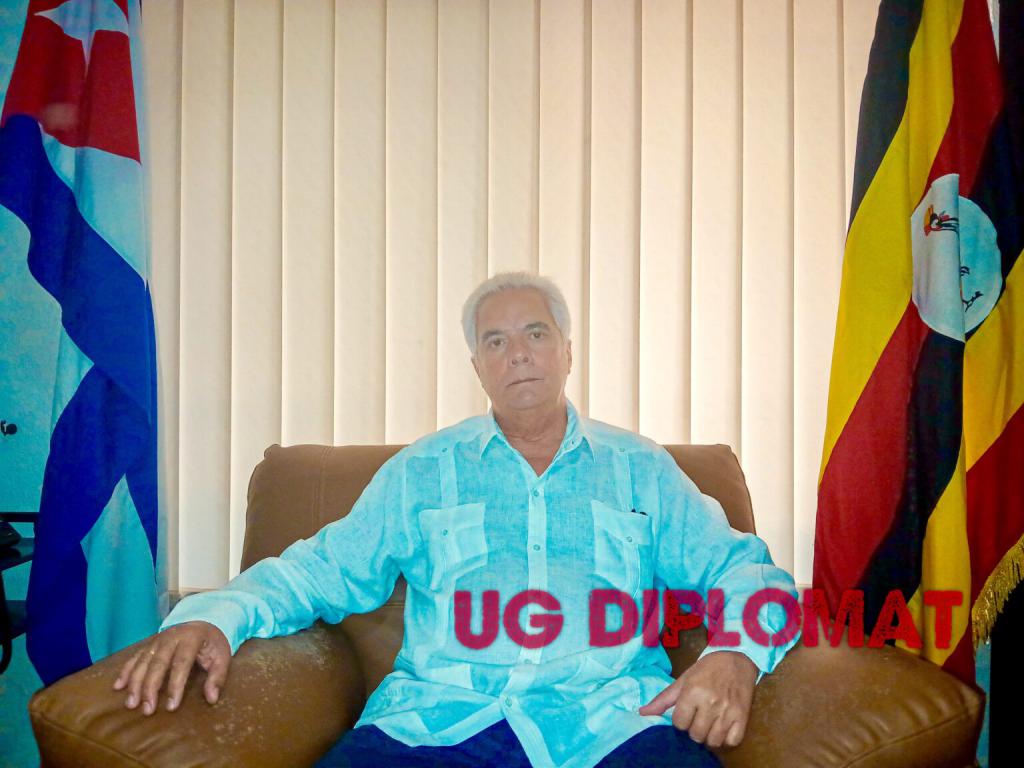
As tensions between Havana and Washington once again dominate hemispheric politics, Cuba’s Ambassador to Uganda, H.E. Juan Humberto Macías Pino, has spoken out in an exclusive interview with UG Diplomat.
Addressing recent U.S. measures, including Cuba’s designation as a threat to U.S. security and its continued listing as a state sponsor of terrorism, the Ambassador strongly criticized what he described as decades of economic strangulation and political aggression. He also reaffirmed Cuba’s solidarity with Venezuela and underscored the historical ties between Cuba and Africa.
Below is the full interview;
UG Diplomat: Your Excellency, how does Cuba view the latest measures taken by the United States government?
Amb. Juan Humberto Macías Pino:
In the face of this new aggression against the people of Cuba, we denounce the vile policy with which the United States government intends to trample on the sovereignty of Cuba, the peoples of Our America and the world.
UG Diplomat: The United States recently declared Cuba a threat to its security and foreign policy. What are the implications of this decision?
Amb. Juan Humberto Macías Pino:
The decision adopted by the United States on January 29 to declare Cuba a threat to its security and foreign policy was a new action to attack our country, and its objective was the implementation of a total blockade on the supply of oil to our country. This new act of aggression is part of a nearly 70-year history of blockades and sanctions against Cuba and as a flagrant violation of international law.
UG Diplomat: President Miguel Díaz-Canel has spoken about a “theory of collapse.” Could you elaborate on what that means?
Amb. Juan Humberto Macías Pino:
Cuban President Miguel Díaz-Canel Bermúdez recently stated that the theory of collapse is associated with one of the currents or approaches the United States government is pursuing to overthrow the Cuban Revolution: economic strangulation, a policy dating back to the 1960s with the Mallory Memorandum, (Lester D. Mallory, Assistant Secretary of State for Inter-American Affairs).
UG Diplomat: How does Cuba interpret its continued inclusion on the U.S. list of state sponsors of terrorism?
Amb. Juan Humberto Macías Pino:
This financial persecution had already been reinforced by the arbitrary inclusion of Cuba in the State Department’s unilateral list of alleged state sponsors of terrorism.
The current U.S. administration has implemented a double standard policy regarding terrorism, including Cuba on the list of state sponsors of terrorism to justify the blockade. However, it is well known that, since the triumph of our Revolution, the U.S. government has supported numerous terrorist actions against our country. Some of them are considered as terrorist attacks of significant magnitude including bombings against the civil population, airplanes, stores, hotels, offices and others places.
They also organized several actions to eliminate our Commander in Chief Fidel Castro and other revolutionary leaders. Most of these aggressions have been masterminded by the CIA, who has trained and financed the extreme right citizens of Cuban origin among others. Those actions have caused thousands of victims, (more than 3,400 compatriots have died as a result of US aggression).
UG Diplomat: You mentioned past terrorist attacks against Cuba. Could you cite a specific example?
Amb. Juan Humberto Macías Pino:
To give just one example: Posada Carriles and Orlando Bosch were the perpetrators of the Barbados bombing, which killed all the passengers and crew of the Cubana de Aviación plane that was transporting them to Cuba. We Cubans will never forget that abominable act of sabotage that plunged families and the Cuban people into mourning, along with the direct perpetrators, this mass murder bears the hallmarks of U.S. imperialism.
In the 90´s and inspired by the collapse of the European socialist countries, the counterrevolutionary organizations intensified these terrorists’ actions against the island, using the USA territory, and their Central American operation bases.
They include economic, military, biological, psychological, diplomatic, media and espionage aggressions, to which is added the opportunistic intensification of the blockade, even in the midst of the Covid-19 pandemic, which reinforces its genocidal character.
UG Diplomat: Despite these challenges, what is Cuba’s position moving forward?
Amb. Juan Humberto Macías Pino:
Despite these anti-Cuban actions, Cuba will continue defending the accomplishments of the Revolution, our national sovereignty and the development of our country, in the new conditions, and according to the history, and revolutionary legacy, with solidarity towards other peoples.
The Cuban people never forget the heroic sacrifices of the thousands of fighters who gave their lives over more than 150 years of struggle, for them and for our social project and for our independence and serenity, we are determined to die if necessary. We Cubans will always defend our principles, taking into consideration the many pages of solidarity, resistance, determination and freedom written by our People, together with one of the most important leaders of all times, Fidel Castro Ruz.
The first mission that we Cubans have, is to be prepared for defending our motherland and the solidarity, with other countries. Cubans are brave people; there are a lot of Cubans heroes who died fighting to defend the rights of the people, in different countries.
UG Diplomat: Turning to Venezuela, how does Cuba interpret recent developments there?
Amb. Juan Humberto Macías Pino:
Cuba has denounced the aggression against Venezuela as an aggression against all the nations that make up CELAC, involving the region in an existential dilemma regarding the preservation of its nation-states, cultures, and distinct identities, and an attack on the Proclamation of Latin America and the Caribbean as a Zone of Peace.
We denounce the aggression against the Bolivarian Republic of Venezuela, the kidnapping of President Nicolás Maduro and his wife, and the murder of approximately one hundred people, including military personnel and civilians.
We honor our brothers and sisters who died in this vile imperialist act, in defense of Venezuelan sovereignty and internationalist solidarity.
As Cuban President Miguel Díaz-Canel Bermúdez stated, invoking the example of the Cubans who fell in Venezuela: “We have shared that surrender is not Cuba’s option. There is much to defend. There are many honorable Cuban men and women who gave their lives for this country, for the independence of this country throughout history. And the most recent are the 32 comrades who died in Venezuela. Their deaths outraged our people. And that wound is still open. That wound will not heal.”
UG Diplomat: Is Cuba open to dialogue with the United States despite the current tensions?
Amb. Juan Humberto Macías Pino:
In the current complex international situation, we will continue to prioritize defense preparedness tasks to safeguard our independence, territorial integrity, sovereignty, self-determination, and peace, based on the strategic concept of the war of the entire people.
Cuba’s historical willingness to engage in serious and responsible dialogue with the United States government is well known, based on international law, sovereign equality, mutual respect and reciprocal benefit, without interference in internal affairs and with absolute respect for the independence and sovereignty of States.
UG Diplomat: Finally, what role does Africa play in Cuba’s struggle against the blockade?
Amb. Juan Humberto Macías Pino:
In this long struggle against the blockade, we have the valuable support of our brothers and sisters around the world, and especially in Africa.
We know we can count on solidarity and material support of Africa to confront this new imperialist aggression.
Africa and Cuba share a long history of fraternal ties. Africa’s contribution to our struggles for independence has been invaluable. The blood of the Cuban people, known for their solidarity and internationalism, also flows on African soil.
Every initiative counts and will be very important in facing this difficult task.