
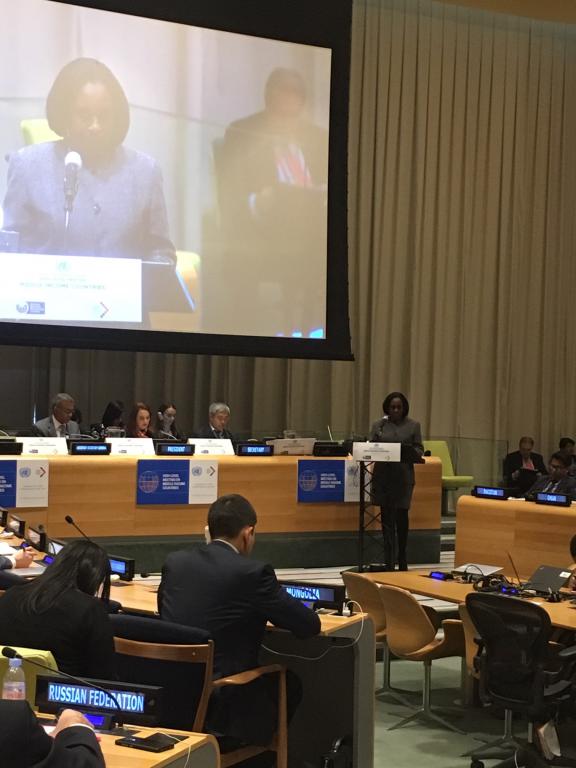
Excellencies, distinguished guests, Madam President,
There is a deep gap between the ambitious goals and targets agreed upon in the 2030 Agenda for Sustainable Development and the international commitments to support their implementation, especially in developing countries.
In this context, it is particularly important to support middle-income countries in achieving the sustainable development goals, bearing in mind that these countries account for more than 70% of the world's population, facing high levels of inequality and poverty and having multiple structural and development problems.
In implementing the 2030 Agenda and achieving the commitments undertaken, middle-income countries require access to international financing and preferential trade treatment.
Cuba considers that the income level, as a criterion to classify countries in order to access development cooperation flows, is a limited and insufficient approach. We therefore advocate a more comprehensive, multidimensional and complete methodology for classifying the level of development of countries that goes beyond income indicators and takes into account the special challenges, vulnerabilities, structural gaps and particularities of countries. Achieving higher income levels does not necessarily imply meeting the economic, social and environmental needs of our peoples.
The problems faced by the middle-income countries need to be addressed in a multilateral framework. We therefore reject attempts to weaken the existing multilateral mechanisms and the search for unilateral solutions, since only joint and global efforts will be able to resolve the serious problems afflicting our countries.
Cuba, a middle-income country, a small island developing state subject to a fierce economic, commercial and financial blockade imposed by the United States Government for nearly six decades, is working to develop a National Plan for Economic and Social Development until 2030, whose strategic pillars are intertwined with the Sustainable Development Goals, as part of the process to update our Economic and Social Model, started in 2011.
Our government is making tremendous efforts to implement the 2030 Agenda and to preserve, broaden and build upon the social achievements made with the inviolable premise of not rendering any citizen helpless.
For our country, South-South Cooperation is a valuable instrument for seeking solutions to the problems we share, bearing in mind at all times that it is not and cannot be a substitute for, but rather a complement to North-South Cooperation.
That is why, despite our limited resources, we have implemented cooperation programs in 157 countries, with hundreds of thousands of health, education, sports and other Cuban specialists and technicians working in a spirit of solidarity. Currently, more than 65,000 health workers are providing their services in 65 nations. Likewise, more than 70,000 foreign young people in middle and higher education from more than 100 countries, mainly from Africa, Asia and Latin America and the Caribbean, have graduated in Cuba from various specialties.
Madam President,
Cuba reiterates its commitment to cooperation in solidarity with other countries, based on mutual respect, disinterested aid and complementarity. Despite the shortcomings and difficulties, we will keep up this will, based on the principle of sharing what we have and not sharing what is left over.
Finally, I would like to reaffirm Cuba's full commitment to the implementation of the 2030 Agenda and the search for a more just, equitable and inclusive world that recognizes people as the center of sustainable development.
Thank you very much