
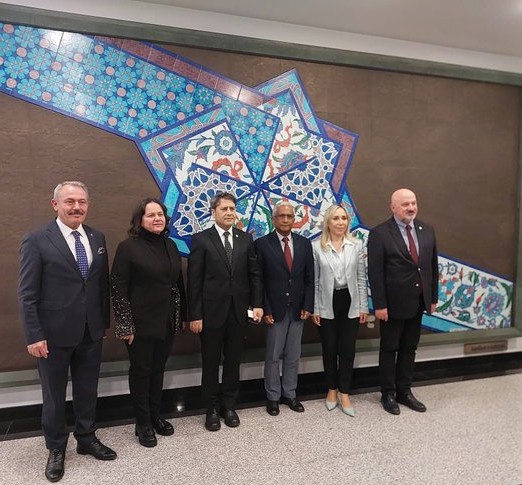
The Ambassador of the Republic of Cuba, Alejandro Díaz Palacios, held a meeting with members of the Cuba-Türkiye Parliamentary Friendship Group and PARLATINO of the Grand National Assembly of Türkiye.
During the meeting, the Ambassador outlined the complex economic and social situation facing Cuba as a result of the economic, commercial, and financial blockade imposed by the United States Government for more than six decades, recently intensified by an Executive Order from President Trump establishing an oil and energy blockade against the Cuban people.
The Ambassador emphasized the direct impact of this hostile policy on the daily lives of the Cuban people, pointing out how it hinders the country's socioeconomic development and restricts access to basic services. He highlighted the effects on essential sectors such as health, education, food, and transportation. He also condemned the Executive Order announced on January 29 by the U.S. government, which contemplates the application of punitive measures against countries that export fuel to Cuba.
In his speech, he highlighted the direct consequences of these measures and their significant impact on strategic sectors of the nation, with the stated aim of economically suffocating the Cuban people.
The Ambassador stressed that such measures qualify as an act of genocide and constitute a violation of international law. He also strongly condemned the extraterritorial nature of the US blockade, which harms third countries and companies interested in developing economic and cooperation ties with Cuba.
He further reaffirmed the Cuban people's firm determination to defend their independence, sovereignty, and right to development.
For their part, the Turkish parliamentarians expressed their solidarity with the Cuban people and agreed that the economic blockade measures against Cuba are unacceptable and contrary to international law.