
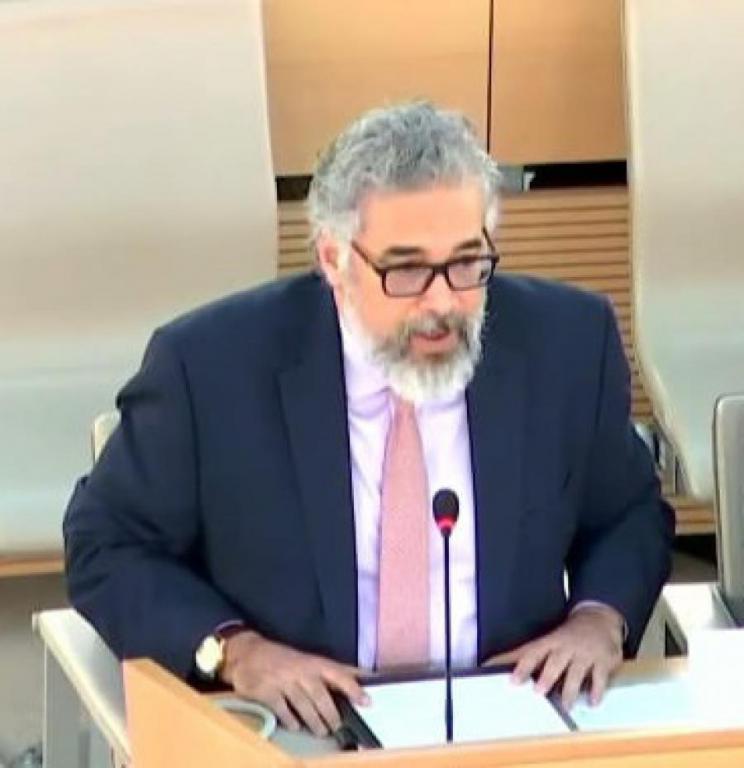
Mr. President,
The Cuban delegation acknowledges and appreciates the efforts made by you and your team, as well as the useful document presented to us, containing the fourth draft of the International Regulatory Framework for the Regulation, Monitoring, and Oversight of Private Military and Security Companies.
We face significant challenges within the remaining time –legal obstacles and technical discussions that must be undertaken to advance as swiftly as possible.
Cuba emphasizes the urgent need to regulate private military and security companies, which are rapidly increasing in number and becoming ever more involved in conflicts, violations of International Law and International Humanitarian Law, as well as human rights abuses.
Some States use these companies to evade International Law, conceal their responsibility for human rights violations, and operate without accountability.
Many of these entities effectively engage in a new form of mercenary activity. Cuba has been a victim of such actions on multiple occasions.
Private military and security companies must no longer operate with impunity and without accountability.
In this context, we reaffirm Cuba’s strong support for the adoption of a robust, legally binding international instrument for the regulation, monitoring, and oversight of the activities of private military and security companies.
The absence of such an instrument creates a substantial legal vacuum in efforts to hold private military and security companies, as well as the States from which they originate, accountable.
This new instrument would reinforce existing International Law, including International Humanitarian Law, International Human Rights Law, and International Criminal Law.
Mr. President,
The Cuban delegation does not agree with, and therefore does not support, the approach of first advancing towards a non-binding instrument as a transition towards an eventual legally binding instrument at some unspecified future date. We reject this approach for two main reasons.
Firstly, the adoption of a non-binding instrument after so many years of work would create a false impression of progress, when we all know that such an instrument would never provide a genuine solution to the reality we face.
The proof of this lies in the Montreux Document. It was concluded in 2008, and since then, instead of reducing violations, we have seen a continuous increase in violations of International Humanitarian Law and human rights associated with private military and security companies and their personnel, without any accountability.
Secondly, should this Working Group decide to proceed now –allegedly as part of a transitional period- only toward a non-binding instrument, in practice, this would mean we are delaying even further and indefinitely postponing the time when a binding instrument could finally be established.
Moreover, in the view of the Cuban delegation, such a decision would significantly reduce the likelihood of ever adopting the legally binding instrument that is so urgently needed.
Cuba considers it essential to move beyond voluntary guidelines and best practices. The existing non-binding regulatory frameworks, such as the Montreux Document, have proven wholly insufficient in preventing impunity in the actions of private military and security companies.
Additionally, these documents of a voluntary nature do not adequately reflect the positions of a large number of States and are not universal.
In conclusion, Mr. President, I reiterate our firm commitment to the work of this Working Group. We will continue to engage actively and constructively in its proceedings. You may always count on Cuba’s support.
Thank you.