
By: Ariel Terrero
June 15, 2021 | cubadebate
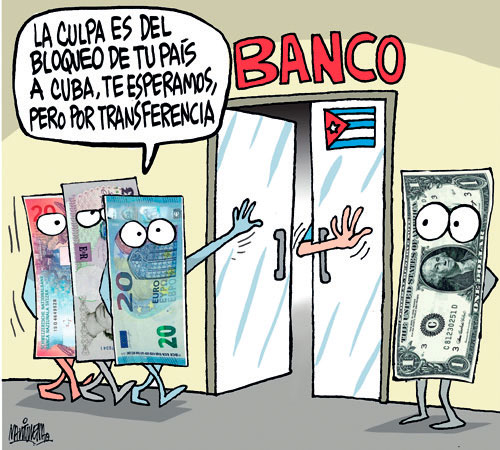
Doubts, concerns, speculations, memes and comments of all kinds have been unleashed, when the Government of Cuba temporarily suspends the receipt of cash dollars in the country's banks. There was no lack of a sensible European media outlet that reasoned that Cuba is trying to pressure the United States. Another joke? Certainly, we are witnessing a fierce economic skirmish at times, but the maneuvers of the Cuban side, with a forced defensive nuance, show an increasingly compromised situation. It is a fact.
The story began many decades ago, but entered a more turbulent stage when the United States government's predilection for sanctioning banks from third countries that dared to negotiate with Cuba grew. To give that turn to the economic blockade, Washington used US sovereignty over the dollar and the classic imperial arrogance with which that country legislates for the world.
To avoid or mitigate the blow, Cuba adopted in 2004 a 10% tax on dollars in cash that entered the country's banking and financial institutions. This surcharge meant that a large part of the cash expenses of foreign tourists and Cuban remittances were in euros or other convertible currencies exempt from US punishment.
Controversial for many reasons, the tax persisted until July 2020. That year, the Cuban government repealed it, amid a very critical financial situation that persists today. The recession associated with the pandemic - almost total contraction of tourism and other activities - was coupled with an ever-increasing cruelty of the persecution and sanctions of the economic blockade. The currencies were urgent in any denomination. And they still are.
But 11 months later, the Government has been forced to stop the free entry of dollars in cash. The greenbacks that entered Cuban banks threaten to remain stagnant in their vaults, without the country being able to use them to import food, medicine, raw materials and many other scarce resources.
Even the retail network in freely convertible currency faces the risk of running out of supply, if they cannot use abroad to stock up, the dollars that consumers have deposited in their bank accounts.
A national situation cannot be more complicated, paradoxically marked by an acute lack of financial liquidity. "With all that cash in dollars accumulated in the country, we cannot do anything if we do not place it in an account to carry out transactions," declared the first vice president of the Central Bank of Cuba (BCC), Francisco Mayobre.
They are the last shots that Donald Trump fired in this economic war. The measure that finished the cup was the inclusion of Cuba in the List of countries sponsoring terrorism, published by the United States. It was presented by the Trump administration in January of this year, a few days before leaving the White House.
"Financial institutions will have another reason to avoid operations with Cuba," predicted then John Kavulich, president of the United States-Cuba Economic and Trade Council, based in New York.
Access to foreign banks was undermined for Cuban banks when they try to approach with dollars in cash to deposit and exchange currencies, essential operations to later obtain the credits and other financial tools necessary in international trade.
According to the BCC, 24 banks from third countries closed their operations with Cuba during the four years of the Trump Administration and 12 foreign banks were penalized with multimillion-dollar fines for violating US regulations and negotiating with this small Caribbean country.
The situation became unsustainable as of the second half of 2020, due to the flurry of US actions against how many Cuban banking and business institutions sent signs of economic resistance in the midst of the pandemic storm.
The answer
In Resolution 176/2021, the BCC established that as of June 21, “Cuban banks and non-bank financial institutions (…) will not accept US dollars, in cash, from natural and legal persons, such as deposits in bank accounts and purchase and sale of currencies, until the conditions that give rise to this measure are reversed”.
Like any decision regarding money and personal income, the rule generated immediate uncertainty and nervousness among Cuban consumers. Logical. Conversion to other currencies of the remittances sent by the relatives of Cubans will have a cost and an irritating effect on people. This is what the US government has been looking for, if we take into account the successive steps that Trump took to limit the amounts of remittances or stop their shipments to Cuba. The current president, Joe Biden, has publicly stated that he is in no rush to review anti-Cuban policies.
But, beyond the initial shock, I do not believe that the measure will have major consequences for the domestic market as of June 21. Major elements of retail and banking are looking to remain flat.
In accordance with Resolution 176 of the BCC, natural and legal persons can keep their bank accounts in US dollars in Cuban banks, make withdrawals from those accounts, and receive funds in any convertible currency, and even dollars if it is through transfers between accounts. banking. The bank windows are only closed for the deposit of dollars in cash.
The rest of the operations, both income and authorized payments in the commercial network, can continue to be executed with the accounts and cards in MLC as of June 21. It does not seem that the veto against the dollar in cash is the conflict that will give more food for thought.
The impossibility of executing, who knows how many millions of USD stored today in bank vaults has put the Cuban economy against the wall, but greater are the rolls that have sown the crisis derived from COVID-19 and the profound process of transformations of the economic model, with the monetary system at the fore.
I also do not believe that the measure will achieve the anti-inflationary effect expected by some initial conjectures. The dollar is quoted in the informal market in values hat triple the official rate of 1 USD x 24 Cuban pesos, due to deficiencies in the trade of goods and services and severe weaknesses in the current economic situation, which are not resolved by the mere expulsion of a or other currency from the stage.
With this maneuver, the Cuban government barely takes up an old defensive resource that it had already resorted to with the levy against the dollar years ago, only that, if that time the banking spell against that currency was only a deterrent, now it is more drastic, an obvious symptom. of the greater drama of the open fire from the United States against Cuba and of the most serious economic difficulties that this small country faces both indoors and outdoors.
(Taken from newspaper Workers)