
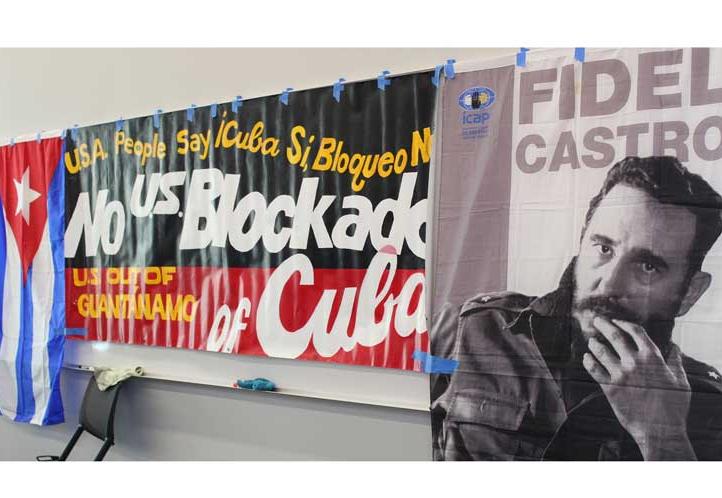
New York, October 22, 2018. The world has expressed its opposition to the genocidal U.S. blockade against Cuba in various ways and from all corners of the globe. But perhaps the most striking thing is that within the United States itself, there are many expressions of rejection faced by this country.
From April 2017 to March 2018, Americans of all social backgrounds rose up against this vile and absurd policy, whose recent upsurge is a sign of the setback in the progress made in bilateral relations between the two nations after December 2014.
Groups such as Engage Cuba and CubaNow, which aim to foster bilateral relations and promote the lifting of the blockade, maintained their work in that regard and further diversified their scope. These groups also reached various sectors of U.S. society like agriculture, culture and business and even worked to get support in the executive and legislative branches of government, both at federal and state levels.
On the other hand, Engage Cuba along with the company Morning Consult, published the results of a national survey related to Cuba, which revealed that most voters registered as Republicans support the lifting of trade and travel restrictions to the island. It also demonstrated that most U.S. citizens support maintaining bilateral relations. Similarly, Florida Atlantic University (FAU) announced the results of a survey on Cuba conducted in that State, which showed that only 34 percent of Florida residents support Trump's new policy.
On 6 June 2017, Michigan State Senate adopted a resolution to request the U.S. Congress to develop and improve trade relations with Cuba. On 12 June 2017, Senators Amy Klobuchar (D-MN), Chris Murphy (D-CT), Dick Durbin (D-IL), Debbie Stabenow (D-MI), Sheldon Whitehouse (D-RI), Elizabeth Warren (D-MA), Al Franken (D-MN), Brian Schatz (D-HI), Michael Bennet (D-CO), Jon Tester (D-MT), Patrick Leahy (D-VT), Rob Wyden (D-OR), Claire McCaskill (D-MO) and Jeanne Shaheen (D-NH) sent an open letter to the then Secretary of State, Rex Tillerson, advocating the maintenance and expansion of economic and political ties with Cuba, including the lifting of the blockade.
On 20 June 2017, Congressman Bobby Rush (D-IL) introduced to the House of Representatives bill H.R.2966 to lift the blockade against Cuba, among other purposes. Then, on 1 August 2017, Senator Ron Wyden (D-OR) introduced the United States-Cuba Trade Act of 2017 (S.1699) with the aim of repealing sanctions against Cuba and establishing normal trade relations between the two countries.
On 1 August 2017, a bipartisan group of political leaders and businessmen from Kentucky, led by State Commissioner of Agriculture Ryan Quarles and businessman Jonathan Blue, launched Engage Cuba State Council in Kentucky.
On 28 October 2017, the Fourth Meeting of Cuban Residents in the U.S. in defense of the national sovereignty and against the Blockade held at Howard University in Washington was concluded. Participants agreed to promote in city councils and local legislatures pronouncements favorable to the normalization of relations with Cuba, for the elimination of the blockade and freedom of travel.
On 21 February 2018, during a press conference in Havana with other U.S. congressmen visiting Cuba, Oregon Democratic Senator Ron Wyden mentioned the bipartisan support for the lifting of the blockade in the U.S. Congress and expressed his concerns about the regression of Trump's government to Cold War policies.
On 1 March 2018, a coalition of 28 tour operators and companies specialized in educational trips to Cuba called for the reduction of travel restrictions to Cuba for Americans in a communication addressed to President Donald Trump.
Permanent Mission of Cuba to the United Nations.