
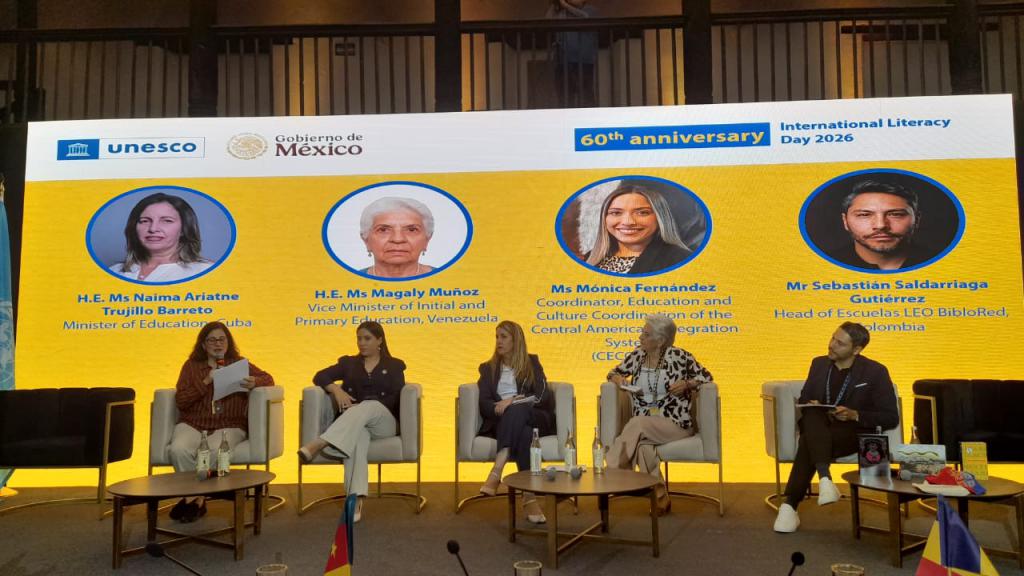
Chiapas, Mexico, September 9, 2026.- Cuba’s Minister of Education, Naima Ariatne Trujillo Barreto, participated this Wednesday in the session “Literacy for today and tomorrow in Latin America and the Caribbean,” held as part of the World Conference on “Literacy for People, the Planet and Prosperity,” taking place in Chiapas, Mexico, on September 8 and 9, convened by UNESCO and the Government of Mexico.
The panel focused on current and emerging literacy challenges in the region, as well as on the new competencies required in a context of technological and digital transformation. Cuba shared its vision of literacy and youth and adult education as a continuous lifelong learning process.
Within this approach, literacy skills are combined with digital and media literacy, education for sustainable development and global citizenship, as well as competencies needed for work and life. Digitalization, particularly the development of artificial intelligence, is creating new challenges and opportunities for education policies, systems and practices.
Cuba’s participation in this forum also provided an opportunity to highlight the relevance and results of the Cuban Literacy School, as well as the recognition achieved by the country in the field of education and its experience of cooperation and solidarity with other peoples in this area.
During its participation in the global event, the Cuban delegation denounced the reality facing the country in guaranteeing the continuity of its universal and free education system as a result of the brutal economic, commercial, financial and energy blockade imposed by the United States. The tightening of these measures over more than six decades, together with the current energy siege, has aggravated the country’s economic difficulties and directly affects the human, material, economic and financial resources required for the proper functioning of the education system.
Despite these exceptional circumstances, Cuba successfully concluded the 2025–2026 school year and ensured the start of the 2026–2027 school year on September 1, thanks to the commitment of educators, students, families and institutions.
Cuba’s participation in the World Conference reaffirms the country’s commitment to continuing to contribute to the international debate on inclusive, lifelong literacy adapted to the challenges of the present and the future, based on equity, solidarity and the right of all people to education.