
By: Yurina Piñeiro Jiménez
June 14th , 2021 Cubadebate
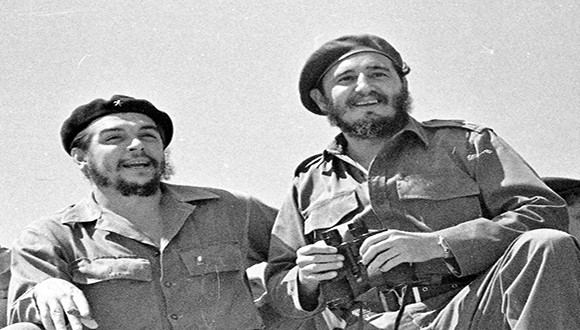
Che and Fidel. Photo: Perfecto Romero / Bohemia.
Fidel, a man attentive to the great events of history, but also to the simplest details of everyday life, expressed admiration for many people: heroes, martyrs, intellectuals, workers, peasants, housewives, children ... But one in particular he won their respect and approval; Che.
Aware of his actions and words as he was, he was not afraid to make public his appreciation for him, even before the Argentine comrade was assassinated on October 9, 1967. He accepted him among the Granma expeditionaries, he was the first to be promoted to Commander in the Sierra, he entrusted him with very important missions in the military, economic and political order of the nascent Revolution.
Upon learning of his death, as a leader he tried to contain his emotions and respect his own Guevarian philosophy of: welcome is death as long as that battle cry reaches a receptive ear and another hand reaches out to grasp the weapon. But on that solemn evening, it was fair to express, in some way, the feelings regarding who he considered: "without a doubt, the most extraordinary of our comrades in the Revolution."
How they met
The cold Mexican night of July 9, 1955, at the home of the Cuban María Antonia González, was “heated” with a discussion about politics between two young people with a restless soul for the homelands of the world and who had just met. The talk lasted hours. But there was total understanding; At dawn, Ernesto Guevara de la Serna was already one of the Granma expeditionaries.
The Argentine waiter had come to Fidel Castro through Raúl Castro, and this, thanks to Ñico López, one of the Moncada assailants, who was able to escape the country and settle in Guatemala, where he met Che, a man with dreams of justice for all the peoples of the world.
There, both experienced the overthrow of the progressive government of Jacobo Arbenz, which led to an extremely difficult situation for Latin American exiles. And to Mexico they left; Only to take refuge, and Che to continue quenching his thirst for Social Revolution. There they would meet again and contact members of the Movement.
Che and Fidel, affinity from the beginning
The 27-year-old Argentine young man was not a member of any political party, but he was already a convinced Marxist at that time. According to Fidel, the coincidence of ideas was one of the factors that most helped his affinity with him.
“From a theoretical point of view, he was more educated; he was a more advanced revolutionary than me. But in those days, these were not issues that we dealt with. We talked about the fight against Batista, the plans to land in Cuba and to start the guerrilla war. "
“He was imbued with a deep spirit of hatred and contempt for imperialism (…) very recently he had had the opportunity to witness in Guatemala the criminal imperialist intervention through the mercenary soldiers who ruined the revolution in that country. ”.
“For a man like him, many arguments were not necessary. It was enough for him to know that Cuba lived in a similar situation, it was enough for him to know that there were men determined to fight this situation with arms in hand, it was enough for him to know that those men were inspired by genuinely revolutionary and patriotic sentiments. And that was more than enough”.
The convergence of thought was joined by his sympathy. According to the Commander, he was one of those people to whom everyone took immediate affection, for his naturalness, his simplicity, his companionship and his virtues.
Che created "problems" for Fidel
From the beginning, Fidel trusts in his abilities and puts him in charge of a camp there in Mexico, but there were some of the future expedition members who began to complain that he was Argentine. "They got into a big fight with me," he narrated, and at the same time, in a humorous way, he assured that the "real" problem Che had created while in prison in the Aztec country.
“When they go to interrogate Che, and they ask him: -Are you a communist? -Yes, I am a communist, he answers. And the newspapers, there in Mexico, talking about the fact that they were communists who were conspiring to liquidate democracy on the continent, and it is not known how many other things.
Che is taken before a prosecutor, they are questioning him, and he even began to discuss the cult of personality and criticism of Stalin (...) This happened in July 1956, and in February of that same year there had been Khrushchev's criticism of Stalin. Of course, the official versions of the Congress of the Soviet Party were used.
Che tells them: -Yes, they made mistakes in this and that, defending their theory and their communist ideas. Imagine! He, who was Argentine, at that time had more risks. I sincerely believe that in situations like the one in which the entire project could be in jeopardy, the most convenient thing was to misinform the enemy. But Che, strongly influenced by the epic of communist literature, could not be reproached for that tactical entanglement, which did not prevent him from traveling with us to Cuba.
"Very original: motorcyclist, leper doctor, mountaineer ...
In addition to the daring and firmness of principles that he demonstrated in that interrogation, in that first stage, the leader of the Cuban Movement learned about other details of Che's life, which shed light on the exceptional personality of the newly appointed chief of health.
“Che, young like so many young students, graduated from the university of his country, like so many graduates, in this case as a doctor, with special curiosity and interest in things on the continent, with a special spirit of study, knowledge, with a special vocation. towards the scope of all our homelands, he began a tour of different countries. But he had nothing but the title.
“Sometimes walking, sometimes on a motorcycle, he would go from country to country. Even when we were in Chuquicamata they pointed out to us the point where on one occasion, on that first departure from his country, he had stopped one day. He did not have money. He was not a tourist. He visited work centers, visited hospitals, visited historical places. He crossed the mountain range, took a boat or a raft, reached a hospital for lepers in the Amazon, and there he worked for a time as a doctor ”.
“He had suffered from asthma since he was a child (…) he had an obsession to climb Popocatepetl, so almost every Sunday he started climbing Popo, as he used to say. He had gotten himself some mountaineering gear, coats, boots, and so on. And at least twice a month - I imagine him - he tried to get there ”.

Che with Fidel and other colleagues in the Sierra Maestra. Photo: Archive.
Memories of Fidel about Che
But the exceptional conditions, as a human being and a guerrilla, of that young Argentine with dreams of homeland and social justice, Fidel would know, -this time closely, not only by hearsay-, during the crossing of the Granma and the struggles that would take place in the Sierra, the plain and after the revolutionary triumph.
***
“I remember that that journey (that of Granma) was very hard for him since, given the circumstances in which it was necessary to organize the departure, he could not even provide himself with the medicines he needed and the entire journey was under a severe asthma attack. , without a single relief, but also without a single complaint ”.
Linked to this health condition, which frequently played a trick on Che, is one of the most witty anecdotes of our Commander, which shows the affection he felt for his South American comrade.
“I introduce myself to the two peasants, and gathering serenity and cold blood, I pretend to be a Batista colonel (…) I spoke for hours there with those two men. I'm not going to mention the last name of one who was a real Batista, and he said: -Hey, greetings to my general, tell him this and that. How he entertained me! The other spoke to me more calmly.
I realize that this was the man I needed (…) I told him: -Isaac, I am not a colonel, I am Fidel Castro. His eyes widened expressing colossal joy. I explained: -We have a very difficult situation, a colleague in this situation, you have to go to Manzanillo to look for the medicine and you have to find a place to shelter it and not discover it (…) And it was. In a well-guarded place we left Che with his rifle ”.
***
“We arrived, we undertook the first marches, we suffered the first setback (Alegría de Pío), and after a few weeks we met again (...) Che continued to be our troop's doctor. The first victorious combat occurred (La Plata) and Che was already a soldier in our troop and, at the same time, he was still the doctor; The second victorious combat ensued and Che was not only a soldier, but he was the most distinguished of the soldiers in that combat (Uvero).
The situation was difficult. The information was in many ways erroneous (…) in the midst of that situation of confusion in which it was necessary to ask the men for a supreme effort (…) one of the flanks was left without an attacking force that could endanger the operation. And at that moment Che, who was still a doctor, asked for three or four men, and in a matter of seconds he quickly set off to take on the attack mission from that direction.
And on that occasion, not only was he a distinguished combatant, but he was also a distinguished physician, assisting wounded comrades while assisting wounded enemy soldiers. And when it was necessary to abandon that position, once all the weapons had been occupied and to undertake a long march, harassed by different enemy forces, it was necessary for someone to remain with the wounded, and Che remained with the wounded ”.
***
“He had also done this on an unmentioned occasion when in the early days, thanks to a betrayal (he refers to the peasant Eutimio Guerra), our small troop was surprisingly attacked by numerous planes and when we retired, we remembered some rifles (... .).
We remember how the problem was only raised, and under the bombardment, Che volunteered, and offering himself he quickly went out to retrieve those rifles (...) That was one of the essential characteristics: the immediate, instantaneous disposition, to offer himself to carry out the mission more dangerous. And that, naturally, aroused admiration, double admiration for that comrade who fought alongside us, who had not been born on this earth ...
This is how he earned the degrees of Commander and Chief of the second column that was organized in the Sierra Maestra; this is how his prestige began to grow, as he began to acquire his reputation as a magnificent combatant that he had to take to the highest ranks in the course of the war ”.
***
“Che was a master of war, Che was an artist of the guerrilla struggle! And he demonstrated it countless times, but he demonstrated it above all in two extraordinary feats, such as the invasion at the head of a column, pursued by that column by thousands of soldiers, through absolutely flat and unknown territory, carrying out - together with Camilo - a formidable military feat.
But, in addition, he demonstrated it in his withering campaign in Las Villas; and he demonstrated it, above all, in his audacious attack on the city of Santa Clara, penetrating with a column of just 300 men in a city defended by tanks, artillery and several thousand infantrymen.
Many were the times when it was necessary to act to prevent him from losing his life in minor actions (…) That is where it is difficult to agree with him, since we understand that his life, his experience, his capacity as a fierce boss , his prestige and all that he meant in life, was much more, incomparably more, than the evaluation that perhaps he made of himself.
The idea that men have a relative value in history, the idea that causes are not defeated when men fall, may have profoundly influenced their behavior ... And that is true, that cannot be doubted ... . However, we would have wholeheartedly wished to see him as a forger of victories (rather than a precursor of those victories)

Che during a volunteer work day. Photo: Archive.
“A tireless worker, in the years that he was at the service of our country he did not know a single day of rest. There were many responsibilities assigned to him: as President of the National Bank, as Director of the Planning Board, as Minister of Industries, as Commander of military regions, as Head of political delegations, or of economic type, or of type fraternal.
(…) And if we looked at the windows of his offices, the lights stayed on until late at night, studying. Because he was a student of all problems, he was an indefatigable reader. His thirst for human knowledge was almost insatiable. The statutory days of rest he dedicated to volunteer work
Che every Sunday he went to some workplace. Sometimes he would go to the docks to load sacks with the stevedores. Sometimes he went to the mines, to work as a miner. Sometimes he went to the cane fields to cut cane; others he met with construction workers. He never reserved a Sunday for himself.
Plus all this and his previous exploits, they must be seen within the framework of his own health situation, since he suffered from certain allergic problems that produced acute asthmatic states. And even in these conditions he fought the entire campaign. Under these conditions he works day and night. In these conditions he writes. Under these conditions he travels the country, he travels the world ”.

Che and Fidel. Photo: Archive.
The leader of the Cuban Revolution told many anecdotes about his partner and friend Ernesto (Che) Guevara de la Serna, because as Fidel told the Italian journalist, Gianni Miná, although they were not effusive in their interpersonal relationships, they were united by a endearing affection.
After the Heroic Guerrilla decided to march to other lands of the world and support the liberation processes, he supported him as much as possible. Especially when he considered it wise for him to return from Eastern Europe to Cuba.
Che did not want to return because he felt very sorry for him after his farewell letter was published. So, as a good friend, who cares about the physical and mental integrity of the loved one above all else, he persuasively asks (by letter) to return, which is the most convenient for all practical purposes of what he wanted to do.
Fidel was his friend. He felt that way. And he came back, clandestinely, but he came back. The mountains of the San Andrés valley, in the province of Pinar del Río, would be the preparation stage for the conflict in Bolivia. There the Commander would visit him repeatedly, taking Che's wife and his children with him many times.
Guevara marched for the Andean nation. Through the Bolivian Communist Party, the leader of the Cuban Revolution managed care for his friend and other guerrilla comrades. But the entire network, both official and clandestine, disintegrated for various reasons, and it proved impossible to provide further aid in the last few moments.
October 1967. Photos and news agency cables announce the death of his comrade. Fidel refuses to accept that this was Che. Hopefully it's one more lie from the CIA and its allies, he thinks. But no, he knows him very well, after days of analyzing the information that reaches Cuba, on October 15, 1967, he informs the Cuban people: "The news regarding the death of Commander Ernesto Guevara is painfully true, bitterly true."

Fidel holds Aleida, one of Che's daughters, in his arms. Photo: Archive.
The night that Fidel asked "Be like Che"
They say that that night of October 18, 1867, in the Plaza of the Cuban Revolution, pain and silence reigned, while the Commander-in-Chief paid honor to his companion and friend, Ernesto Che Guevara.
Words came from the heart.
"One of the most familiar, one of the most admired, one of the most beloved and, without a doubt, the most extraordinary of our comrades in the revolution."
"I would say that he is one of those types of men difficult to match and practically impossible to beat."
"Che's death is a tremendous blow to the revolutionary movement, inasmuch as it deprives it, without a doubt of any class, of its most experienced and capable leader."
“Because Che brought together, in his extraordinary personality, virtues that rarely appear together… he brought together in his person the man of ideas and the man of action.
“Che gathered as a revolutionary the virtues that can be defined as the most complete expression of the virtues of a revolutionary: a man of complete integrity, a man of supreme honesty, of absolute sincerity, a man of stoic and Spartan life, a man whom practically in his behavior you cannot find a single stain ”.
“He constituted, by his virtues, what can be called a true model of a revolutionary (…) a true example of revolutionary virtues!
"But, in addition, he added another quality, a quality of the heart, because he was an extraordinarily human man, extraordinarily sensitive!"
"It pains us to think that he was only 39 at the time of his death."
"It is true that we will not see new writings, it is true that we will not hear his voice again."
"Che's example should be the ideal model for our people."
If we want to express how we want our revolutionary fighters, our militants, our men to be, we must say without hesitation of any kind: let them be like Che! If we want to express how we want the men of future generations to be, we must say: let them be like Che! (…) If we want to express how we want our children to be, we must say with all the heart of vehement revolutionaries: we want them to be like Che!

Fidel and Che. Photo: Archive.
Perhaps because he did not meet other great men personally and he did, or because Guevara never disappointed his confidence. There could be many reasons, but the truth is that it was in this man and not in another that Fidel found the ideal model of a revolutionary, a new man, a soldier, a human being ... And he asked us to be like him, "the most extraordinary of our comrades in the Revolution”.
On video, Fidel's words at the evening of tribute to Che
https://youtu.be/3cntqQPUdnM