
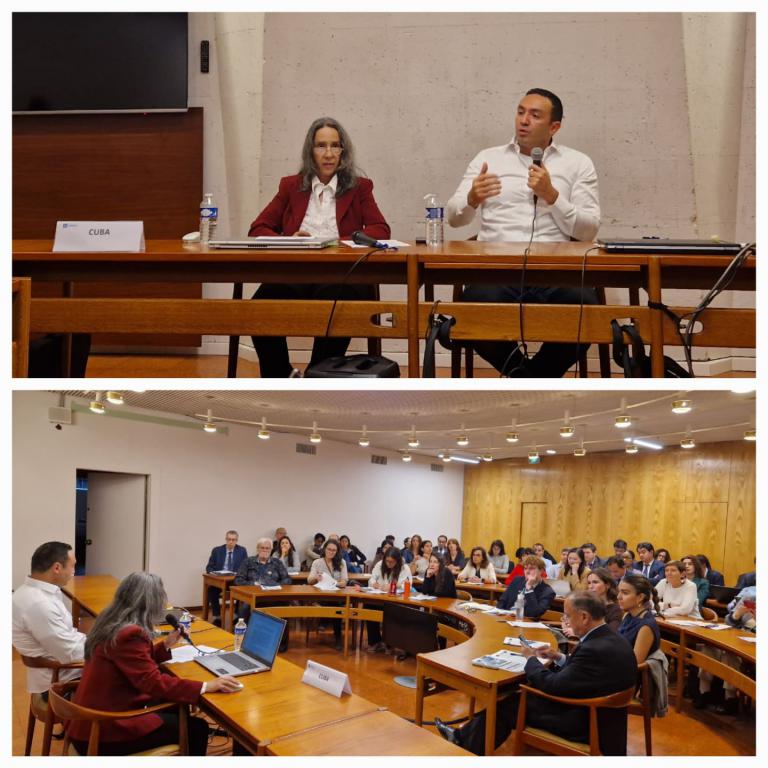
Paris, 4 June 2026 – Within the framework of UNESCO’s Latin America and the Caribbean Week 2026, the Permanent Delegation of the Republic of Cuba to UNESCO organized on Thursday the colloquium “Cuba for Peace: Defending the Values of UNESCO”, delivered by the Franco-Algerian professor, researcher and essayist Salim Lamrani.
The event brought together a large audience of representatives of Permanent Delegations accredited to UNESCO, members of the Organization’s Secretariat, academics, students and friends of Cuba, who filled Room III at UNESCO Headquarters to take part in this space for reflection and exchange.
In her opening remarks, Ambassador and Permanent Representative of Cuba to UNESCO, María del Carmen Herrera Caseiro, highlighted the historic and deeply rooted relationship between Cuba and the Organization, based on the convergence between UNESCO’s founding principles and the social project promoted by the Cuban Revolution, which placed education, science, culture, equality, peace and international cooperation at the center of the country’s public policies.
The Ambassador recalled that Cuba’s achievements in areas within UNESCO’s mandate have received international recognition and have benefited numerous peoples through Cuban cooperation and solidarity. At the same time, she denounced the fact that these advances have been achieved despite more than six decades of the United States economic, commercial and financial blockade, which has been further intensified in recent years through measures aimed at preventing Cuba’s access to fuel, financing and legitimate international economic relations.
During his lecture, Professor Salim Lamrani offered a detailed presentation on Cuba’s contributions to the promotion of peace, education, science, culture and international cooperation, as well as on the severe effects of the policy of maximum pressure imposed by the United States government against the Island.
Drawing on the history of Cuba’s struggles for independence and the social project developed after the triumph of the Revolution in 1959, Dr. Lamrani emphasized that the Cuban Revolution placed human beings at the center of its policies. According to him, this profound humanism transcended national borders and was translated into an international policy based on solidarity and cooperation, departing from the traditional postulates of realpolitik.
In this context, he highlighted Cuba’s social and internationalist achievements despite more than six decades of unilateral coercive measures imposed by successive U.S. administrations and the current intensification of the policy of maximum pressure against the country.
The scholar underscored that Cuban solidarity has reached numerous peoples around the world in fields such as health, education, the struggle against apartheid, disaster response and peacebuilding efforts. He also denounced that the United States has for decades carried out what he described as a genuine economic crime against Cuba through a policy aimed at suffocating the nation’s development and inflicting suffering on the Cuban people.
Lamrani characterized these actions as contrary to international law and called on the international community to strengthen its solidarity with Cuba in the face of a policy designed to provoke the country’s economic collapse and restrict its development prospects.
Among the participants, Ambassador and Permanent Representative of Vietnam to UNESCO, Nguyen Thi Van Anh, recalled the historic solidarity extended by Cuba to the Vietnamese people and reaffirmed the deep bonds of friendship and brotherhood uniting both nations, particularly at a time when the Cuban people face major challenges.
At the conclusion of the exchange, Ambassador María del Carmen Herrera Caseiro thanked Professor Lamrani for his presentation and stressed that the coercive measures imposed on Cuba directly affect the functioning of schools, universities, scientific and research centers, cultural institutions, media outlets, transportation systems and other essential services.
She also highlighted UNESCO’s continued support for the Cuban people. She recalled that the Organization contributes annually to the United Nations Secretary-General’s report on the necessity of ending the blockade against Cuba by documenting its effects in UNESCO’s fields of competence. She further noted UNESCO’s cooperation in emergency situations and the efforts currently under way to mobilize resources to help mitigate the impact of the difficult situation facing Cuba’s education sector.
The colloquium provided a valuable opportunity to learn more about Cuba’s contributions to peace, solidarity and international cooperation, while also denouncing the grave human, economic and social consequences of the United States policy of maximum pressure against the Cuban people.