
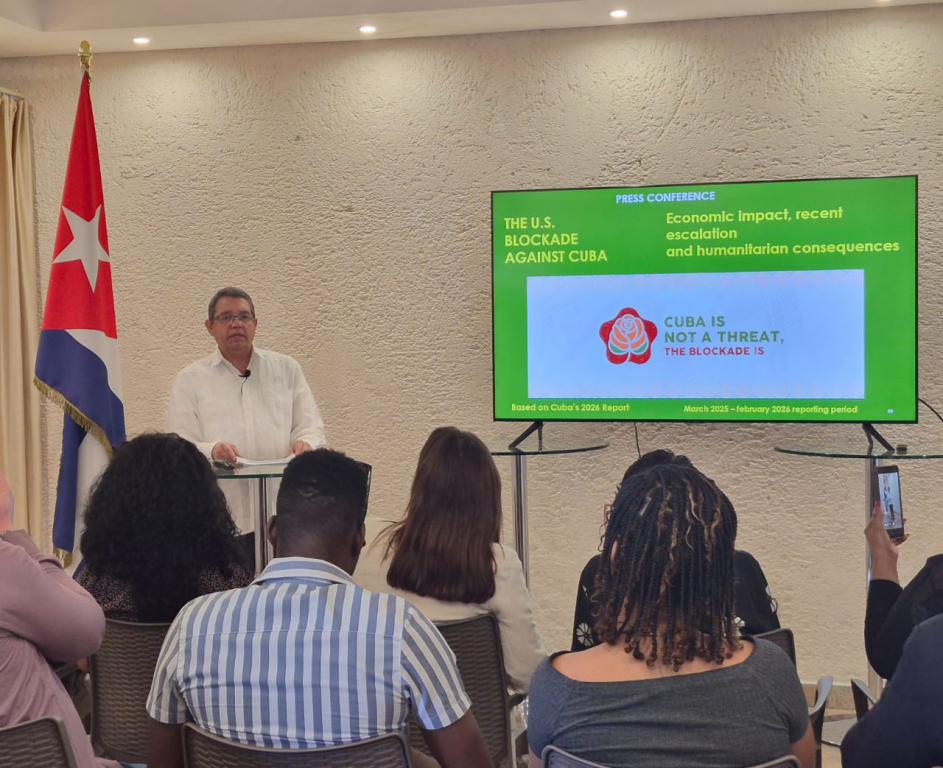
The Cuban Ambassador to Namibia, Sergio Vigoa de la Uz, held a press conference for representatives of the country’s major media outlets, in which he denounced the grave consequences of the economic, commercial, and financial blockade imposed by the United States on Cuba. He also reiterated the call for the international community to support the demand to put an end to this genocidal policy.
During the meeting, the diplomat presented the key points of a report prepared by Cuba pursuant to United Nations General Assembly Resolution A/RES/80/4, titled “Necessity of ending the economic, commercial and financial blockade imposed by the United States of America against Cuba.” The document outlines the damage caused by this policy and its repercussions for the national economy and the living conditions of the Cuban people.
Vigoa de la Uz explained that the sectors most severely affected include healthcare, food, energy, trade, investment, and financial services. The blockade hinders the procurement of medicines, medical equipment, food, fuel, and raw materials, while also obstructing banking transactions and increasing the costs of commercial operations for the Caribbean nation.

According to the report—covering the period from March 1, 2025, to February 28, 2026—the material damages and losses resulting from the blockade amounted to $8,083.3 million, a record figure representing a 7% increase over the previous period. The cumulative damage since the inception of this policy exceeds $178.7 billion in current prices.
The ambassador explained that the effects of this policy extend beyond the bilateral relationship between Cuba and the United States, due to its extraterritorial reach. Sanctions and threats of retaliation against financial institutions, companies, and suppliers from third countries create obstacles for those wishing to maintain legitimate economic relations with the island.
Under these circumstances, restrictions on fuel supplies and difficulties in accessing international markets exacerbate the problems facing the country, with consequences for electricity generation, transportation, food production, and the operation of essential services.
The diplomat emphasized that the blockade is not merely a bilateral dispute, but rather a policy of economic pressure that directly affects millions of Cubans and limits the country’s development potential.
The world will once again make its voice heard at the United Nations.
Vigoa de la Uz took the opportunity during the meeting with the press to highlight the presentation of the Cuban report and the vote scheduled for October 27 and 28 at the United Nations General Assembly, when member states will once again express their stance on the need to end the blockade against Cuba.
The ambassador underscored the significance of this upcoming session, during which the international community will have the chance to reaffirm its rejection of a policy that has persisted for more than six decades and continues to cause serious harm to the Cuban people.
Furthermore, the vote will take place against a backdrop of reports regarding pressure exerted by the U.S. government to influence the positions of UN member states. In the face of these maneuvers, Cuba defends the sovereign right of every state to freely express its will, without threats or conditions.
In the vote held in 2025, the General Assembly approved the resolution against the blockade with 165 votes in favor, seven against, and 12 abstentions—a reflection of the broad international support for Cuba’s demand.
The diplomat expressed Cuba’s confidence that the world will once again raise its voice in defense of the island, despite pressure from the United States. The upcoming vote represents a new opportunity for justice, solidarity, and respect for the principles of the United Nations Charter to prevail.
The truth about Cuba before the Namibian public
Cuba’s presence in Namibian public discourse holds special significance, given the historic ties of friendship and solidarity between the two peoples—forged during the struggle for Namibia’s independence and strengthened through decades of cooperation.

Cuba appreciates Namibia’s sustained support in the fight against the blockade. The solidarity between the two nations continues to be expressed in international forums, in defense of sovereignty, self-determination, and the right of all peoples to shape their own destiny.
On October 27 and 28, the world will once again have its say. The international community will again speak out—by an overwhelming majority—against the blockade, demonstrating that pressure from Washington cannot silence the sovereign will of nations, nor can it suppress the demand for justice for Cuba.
#CubaIsNotAThreat; the blockade is.