
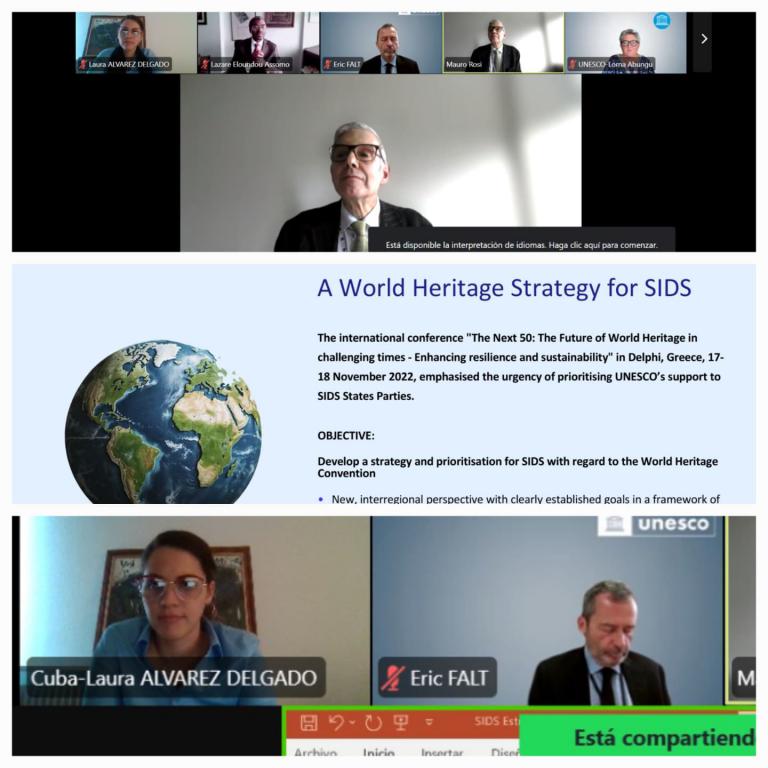
Paris, 16 September 2025. — The Republic of Cuba actively participated in the regional virtual consultation organized by the UNESCO World Heritage Centre, aimed at key stakeholders from the Small Island Developing States (SIDS) of the Caribbean. The meeting sought to contribute to the design of the new World Heritage Strategy for SIDS and to define the next steps in its development.
During the meeting, Laura Alvarez Delgado, Third Secretary of the Permanent Delegation of Cuba to UNESCO, presented the main experiences, challenges, and strengths of the country in implementing the 1972 World Heritage Convention. In her statement, she underlined Cuba’s firm commitment to the protection of natural and cultural heritage, as well as the active role of the Cuban State in heritage education, participatory site management, and capacity-building at the local level.
Alvarez highlighted that Cuba has nine sites inscribed on the World Heritage List and a strong institutional framework for conservation and restoration, led by the Office of the Historian of Havana and supported by an extensive network of cultural and scientific institutions. She also emphasized the alignment between Cuba’s national sustainable development policies and UNESCO’s priorities, particularly in culture, the environment, and community resilience.
The Cuban representative also pointed out the potential for South-South and triangular cooperation that Cuba promotes in the Caribbean, through the exchange of experiences in heritage management, coastal conservation, and the use of sustainable tourism as a source of income for local communities.
In her analysis of the main threats and weaknesses, Alvarez referred to the negative impact of the economic, commercial, and financial blockade imposed by the United States, which hinders access to materials, technologies, and international funding necessary for heritage conservation. This context —she added— increases maintenance costs, hampers scientific and cultural cooperation, and limits opportunities for training and academic mobility.
Small Island Developing States have been recognized since the 1992 United Nations Conference on Environment and Development as a particularly vulnerable group due to their exposure to natural disasters, economic fragility, and the need to preserve their cultural identities. In response, UNESCO has developed strategic plans across all its sectors —education, natural sciences, social sciences, communication, and culture— to strengthen their capacities and resilience.
The new World Heritage Strategy for SIDS until 2029 includes six acceleration programs aimed at protecting and promoting culture as a driver of sustainable development, with emphasis on risk management, intergenerational transmission of knowledge, and equitable access to international cooperation.