
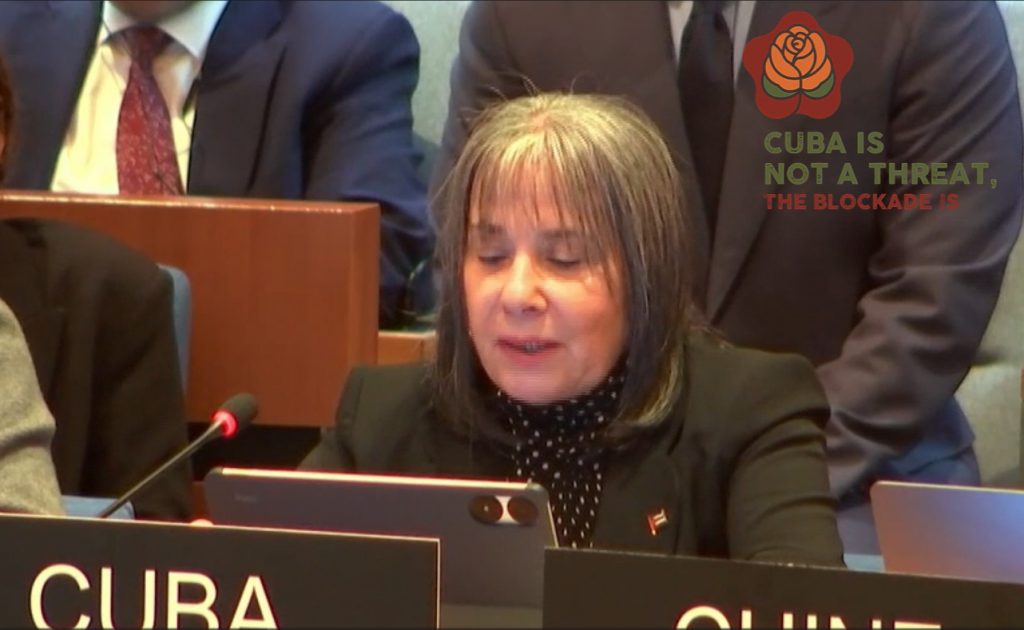
Paris, October 13, 2026.- Cuba denounced the impact of the economic, commercial and financial blockade imposed by the United States on its national education system, reporting losses amounting to USD 98 million between March 2025 and February 2026 in general and higher education.
Speaking before UNESCO’s Executive Board, Mirta Granda Averhoff, President of the Cuban National Commission for UNESCO and Cuba’s representative to the Executive Board, stated that fuel shortages and power outages hinder the functioning of educational institutions and affect teaching and learning conditions, particularly for persons with disabilities.
Cuba reaffirmed its commitment to education as a fundamental human right and advocated strengthening international cooperation, sustainable financing and efforts to reduce educational inequalities.
The full statement is reproduced below:
Madam Chairperson,
Cuba expresses its support for the amendments jointly submitted by Brazil, Bolivia, the Dominican Republic, Saint Vincent and the Grenadines, and Uruguay to the draft decision contained in document 225 EX/5.
We reaffirm that education is a fundamental human right and an indispensable pillar of sustainable development.
We support strengthening coordination, monitoring and cooperation mechanisms within the framework of SDG 4, with particular attention to sustainable financing, the training and professional recognition of teachers, inclusive digital transformation, and the reduction of educational inequalities. We also underscore the value of South-South and triangular cooperation.
Excellencies,
We are approaching a crucial international debate: the future of education as a development goal beyond 2030. Significant gaps remain in the global achievement of SDG 4, compounded by new challenges arising from the multiple crises facing our planet and the pressure being placed on the international order as we know it.
When education is debated, the future course of humanity is at stake. We appreciate the initiatives undertaken by various States to sustain this debate under current circumstances. However, we consider it essential that upcoming conferences, particularly those that will help shape discussions on the post-2030 education agenda, align with existing educational cooperation and monitoring mechanisms and guarantee the universal and equitable participation of all Member States, especially developing countries, small island developing States and nations facing the greatest resource constraints.
We also reaffirm that UNESCO, as the United Nations specialized agency for education, must be at the centre of these deliberations. Its expertise should inform Member States’ decision-making without further fragmenting the debate, particularly in a context of financial constraints across the United Nations system.
Madam Chairperson,
For Cuba, education is a national priority and a social achievement that our country continues to uphold and defend, even under extraordinarily difficult economic circumstances.
The intensification of the economic, commercial and financial blockade imposed by the Government of the United States, compounded by the current energy siege, has direct consequences for the functioning of our educational institutions. Between March 2025 and February 2026, the reported economic damage to the general and higher education sectors amounted to a combined USD 98 million.
Fuel shortages and power outages hinder the transportation of students and teachers, disrupt school schedules, and affect teaching and learning conditions.
These difficulties also affect the education of persons with disabilities. The lack of resources and equipment affects auditory stimulation services for approximately 1,100 learners in both special schools and mainstream educational institutions. These concrete challenges demonstrate how the United States’ hostile policy towards Cuba directly undermines the effective exercise of the right to education.
Nevertheless, despite these adversities, Cuba continues its efforts to sustain educational services, protect universal access to education and ensure that no one is excluded from learning opportunities.
Excellencies,
Education must remain a shared priority and an effective right for all, leaving no country behind.
Thank you very much.