
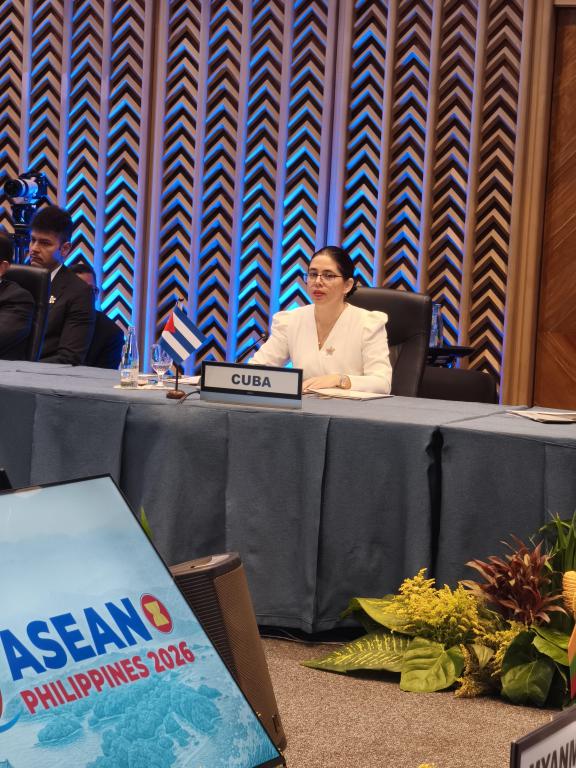
Manila, July 24. Cuba participated in the High-Level Conference of the High Contracting Parties to the Treaty of Amity and Cooperation in Southeast Asia,in its capacity as a State Party, commemorating the 50th anniversary of this instrument, in the Philippine capital.
During the debate on how to strengthen cooperation to address emerging threats and challenges, Cuban Ambassador Yadira Ledesma Hernández denounced in her remarks that the current escalation of aggression by the United States of America against Cuba that is illegal, unjustified, and multidimensional, encompassing numerous emerging threats discussed at the forum: from economic, commercial, financial, and energy blockades to threats of military action and diplomatic pressure, which, taken together, due to their scope and the damage they inflict, and their use as collective punishment, qualifies as an act of genocide against the Cuban people.
The Cuban diplomatic representative noted that Cuba has condemned several scourges that constitute emerging threats, in particular: the use of disinformation campaigns, fake news, and interference in the digital sphere to manipulate public opinion; the malicious use of new information and communication technologies, including Artificial Intelligence, to the detriment of security and critical infrastructures; the threat or use of tariffs and blockades as instruments of economic coercion; and the creation of unilateral and illegal lists to categorize sovereign countries as alleged sponsors of terrorism and thus justify aggression, the piracy, threats and the illicit appropriation of cargo in international waters, undermining maritime security and one of the most recent and inhumane: the use of oil blockades, threatening those who, in the exercise of free trade, decide to sell fuel to any sovereign country, to the detriment of its energy security and consequently, its food security.
In his remarks, he also emphasized the need to uphold the principles enshrined in this Treaty:
- Mutual respect for the independence, sovereignty, equality, territorial integrity, and national identity of all nations.
- The right of each State to conduct its national life free from external interference, subversion, or coercion.
- Non-interference in the internal affairs of other States.
- The peaceful settlement of disputes or differences.
- The renunciation of the threat or use of force.
- The promotion and defense of peace, friendship, and cooperation among peoples, which will contribute to their strength and solidarity.
The occasion was an opportunity to express gratitude for the invitation to participate in this important meeting under the leadership of the Philippine Charmanship of the Association of Southeast Asian Nations (ASEAN), and for the hospitality of the hosts, with whom Cuba is pleased to celebrate this month the 80th Anniversary of the establishment of diplomatic relations.
The Cuban delegation stated that it felt honored to have become the first Caribbean State to sign this Treaty (TAC) in 2020, reinforcing the historic ties of friendship with the countries of Southeast Asia.
Before concluding her remarks, the Cuban representative reaffirmed the commitment to the principles of peaceful coexistence and friendly cooperation among the States endorsed within the framework of this Treaty, affirming that the international community can always count on Cuba's firm defense of these purposes.