
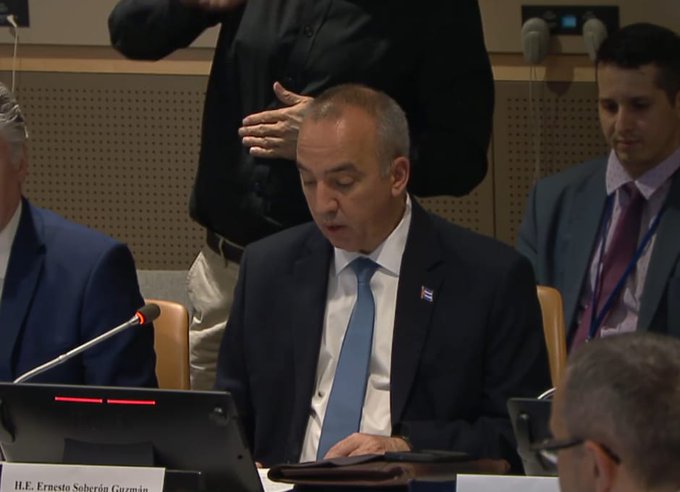
New York, June 10, 2026 – Cuba’s Permanent Representative to the United Nations, Ambassador Ernesto Soberón Guzmán, reaffirmed his country’s commitment to promoting sports as a tool for inclusion, equal opportunities, and international cooperation during the side event “Inclusive Sports Diplomacy: Building International Cooperation through the Experience of the Filippide Project – 20 Years after COSP,” held within the framework of the 19th Conference of States Parties to the Convention on the Rights of Persons with Disabilities (CRPD).
In his remarks, the Cuban diplomat thanked Italy and Albania for organizing the event and highlighted that, in an international context marked by growing challenges, strengthening cooperation in sports constitutes a valuable contribution to peace, dialogue, solidarity, and sustainable development. He noted that sports are a universal language and an effective instrument for advancing peace, promoting sustainable development, combating all forms of discrimination, and strengthening international solidarity.
Ambassador Soberón emphasized the importance of preserving the Olympic ideals of fair play, non-discrimination, and the non-politicization of sports as essential pillars for enhancing cooperation among States in this field. He also acknowledged the achievements of the Filippide Project, which has benefited children and young people with autism, as well as their families, around the world, including in Cuba, through initiatives developed in collaboration with the United Nations Department of Economic and Social Affairs (DESA) and UNICEF.
Referring to Cuba’s experience, he stated that sports are a hard-won right of the Cuban people and a priority of the country’s social policies. He added that Cuba’s international sporting achievements, despite the limitations faced by a developing nation under a strengthened economic blockade, demonstrate the importance of creating opportunities for all from an early age, including for persons with disabilities.
The Permanent Representative also underscored Cuba’s long-standing tradition of international cooperation in sports, supported by the work of thousands of Cuban sports professionals in more than 100 countries. He noted that this cooperation has encompassed general sports training; community sports programs, and the comprehensive preparation of high-performance athletes, including para-athletes. He also acknowledged the cooperation Cuba has received in the field of sports through technology transfer, capacity-building initiatives, and other projects that have benefited the Cuban people.
In the final part of his statement, the Ambassador denounced the negative impact of the economic, commercial, and financial blockade imposed by the United States on Cuba’s sports development, including on opportunities for Cuban athletes—particularly those with disabilities—to train and compete. Nevertheless, he reaffirmed Cuba’s determination to continue promoting universal access to sports, equal opportunities, and international cooperation, with a view to ensuring the full enjoyment of human rights and leaving no one behind.
Permanent Mission of Cuba to the United Nations