
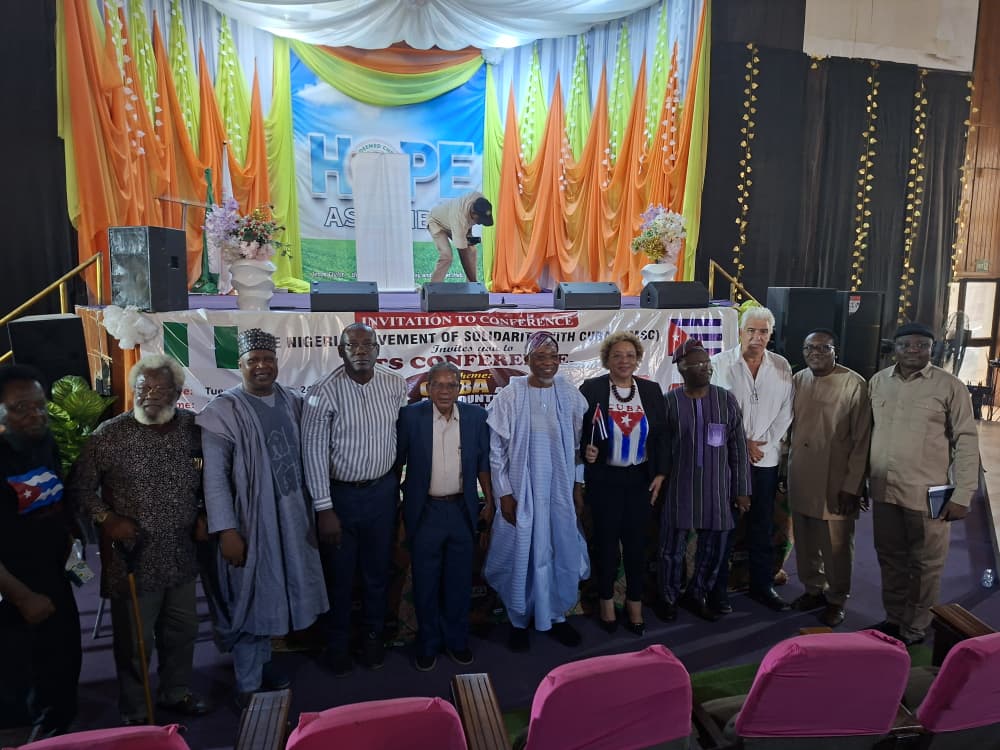
Abuja, February 24th, 2026.- With a massive presence of union leaders, political figures, members of the Cuban community in Nigeria, Cuban-trained graduates, and diplomatic representatives, the National Conference of the Nigeria–Cuba Solidarity Movement was held today at the conference hall of the Nigeria Labour Congress (NLC) under the slogan “Cuba Has the Right to Live.” 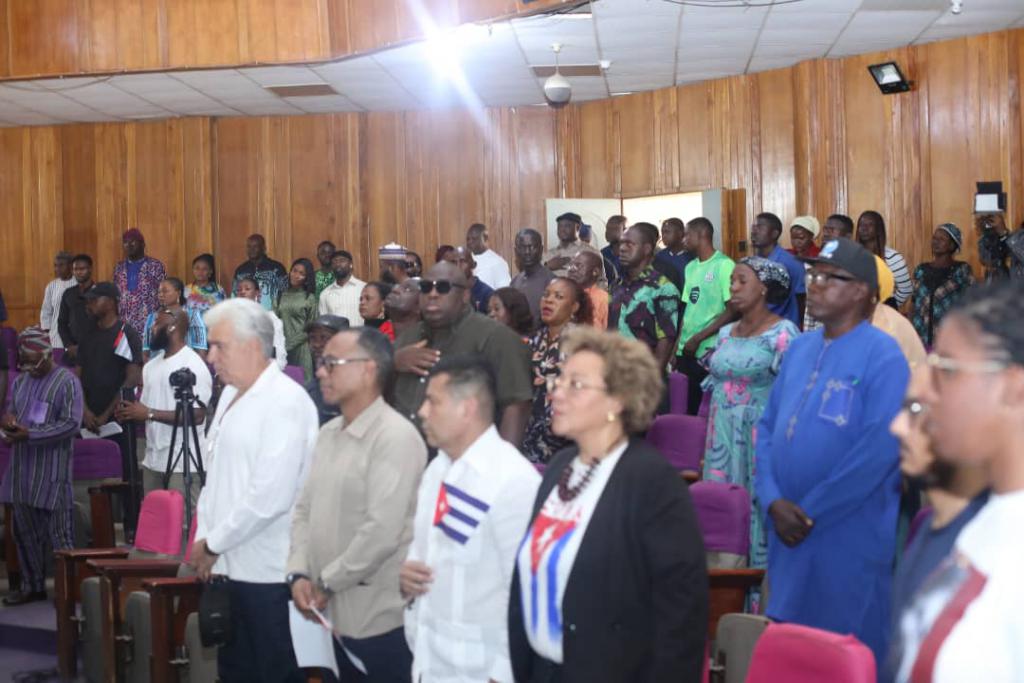 The event marked a milestone in reaffirming the historic brotherhood between the peoples of Africa and Cuba and constituted a strong protest against the inhumane policies of the United States government toward the Caribbean island.
Nigerian trade union leaders firmly denounced the unjust coercive measures imposed by Washington, including the more than 64-year economic, commercial, and financial blockade, describing it as prolonged economic suffering and oppression that violates the fundamental human rights of the Cuban people. They also condemned the executive order threatening sanctions against countries that trade oil or energy supplies with Cuba, undermining the right of peoples to cooperation and international solidarity. 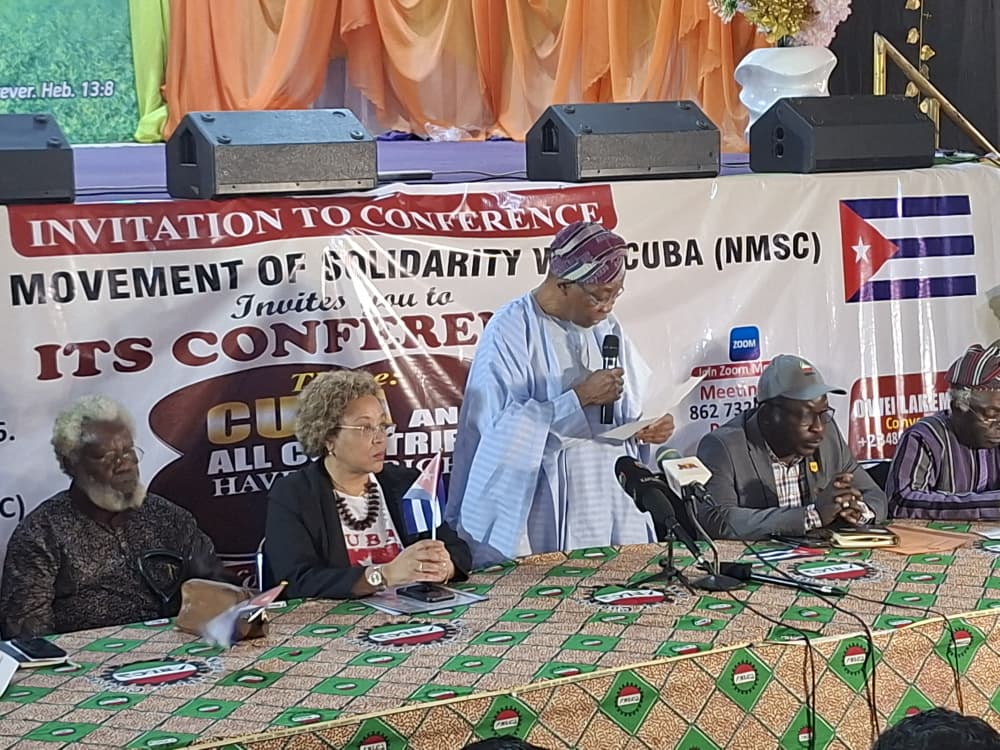
The Honorary President of the Nigeria–Cuba Solidarity Movement, Rauf Aregbesola, former Minister of Interior of Nigeria, stressed that the blockade and sanctions policy contravene international law and constitute a direct attack on human dignity. He called on African peoples to intensify their support for Cuba, emphasizing that “this is the moment when Cuba most needs the solidarity of all the peoples of the world.”
“Available reports indicate that fuel and energy shortages are affecting critical institutions such as hospitals and laboratories. This is the moment when Cuba needs the solidarity of all the peoples of the world,” Aregbesola declared.
“We Africans stand with the Cuban people because they have the right, like all other peoples, to live in peace and pursue their development,” he affirmed.
Senior Advocate of Nigeria (SAN) Femi Falana urged African nations to support Cuba amid the intensification of U.S. sanctions, warning that the measures could trigger a humanitarian crisis. 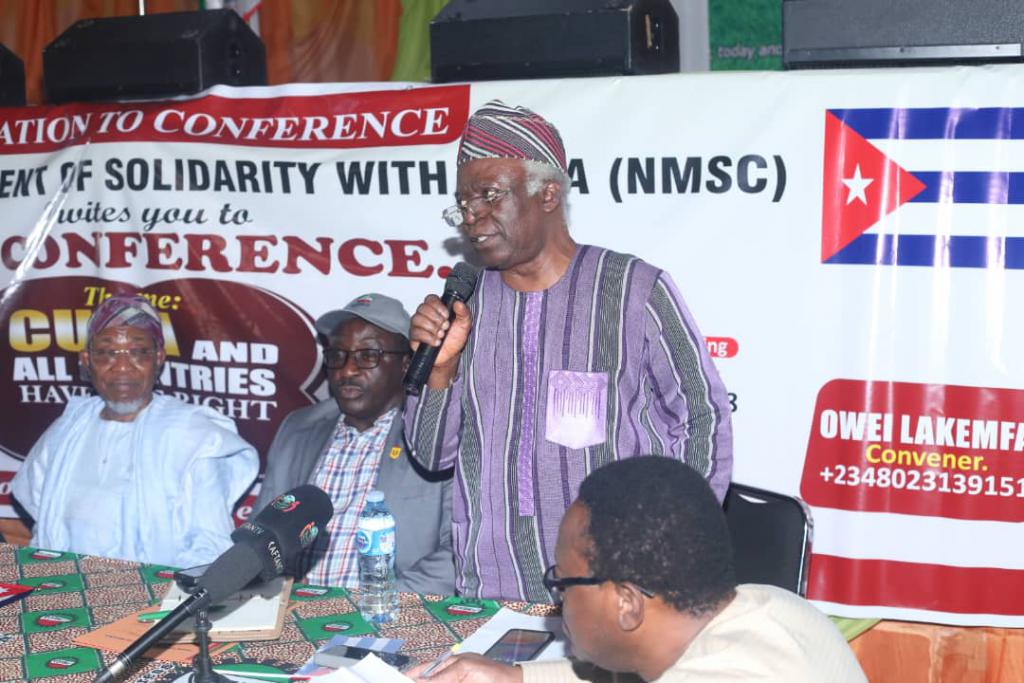
He described them as economic strangulation that violates Cuba’s sovereignty and humanitarian norms.
“In addition to the more than 60-year-old blockade, President Trump acted to prevent oil from reaching Cuba, which raised the prices of food, medicine, and transportation, and caused severe fuel shortages and blackouts lasting for hours,” Falana stated.
“The African Union recently urged the United States to end the sanctions imposed on Cuba. In addition to ignoring the African Union’s call, the U.S. government has subjected the Cuban people to a situation of economic strangulation,” he added.
“Considering Cuba’s invaluable contribution to the struggle for independence of the African people, all African countries have a duty to help Cuba defend its sovereignty in accordance with international law,” he emphasized.
Falana also referenced the 2026 U.S. Supreme Court ruling in Learning Resources Inc. v. Trump, which declared unconstitutional tariffs imposed under IEEPA, affirming that taxation powers rest exclusively with the U.S. Congress.
“The judges emphatically stated that the law does not authorize the use of tariffs and that the president has no authority to impose taxes. The court specifically declared that the power to impose taxes, including tariffs, rests exclusively with the United States Congress, in accordance with the U.S. Constitution,” he stated.
“In that sense, friendly countries like Nigeria, Algeria, Angola, and South Africa should sell oil to Cuba,” he concluded.
In his remarks, NLC President Joe Ajaero, represented by James Imoyera, Assistant to the NLC General Secretary and member of the union's Research Department, described Cuba as “a beacon of dignity that prioritizes human life over profit” and highlighted the heroic resistance of the Cuban people in the face of policies of economic strangulation.
“We demand a constructive engagement that supports the well-being of the Cuban people and promotes access to essential services,” he declared.
The President of the Trade Union Congress (TUC), Comrade Festus Osifo, represented by Secretary General Comrade Nuhu A. Toro, reaffirmed the TUC’s rejection of U.S. interference and its unwavering solidarity with Cuban workers and citizens.
“The TUC rejects the continued interference of the United States in Cuba’s internal affairs, as well as the policies that impose hardship on Cuban workers and citizens. The TUC reaffirms its unwavering solidarity with the Cuban workers and people in their legitimate aspirations for peace, economic stability, and national development,” Osifo declared. 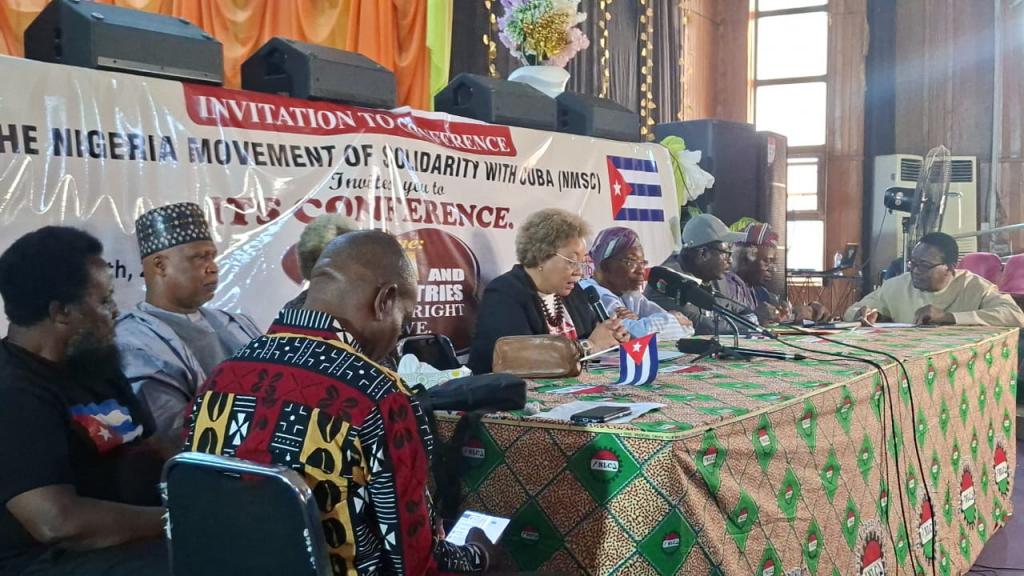
The Ambassador of Cuba to Nigeria, Miriam Morales Palmero, described the blockade as a “silent genocide” that has created shortages of energy, medicines, and food. She rejected threats against countries maintaining legitimate trade relations with Cuba and called for a joint labor, student, and community action plan to expand solidarity efforts.
“The recent executive order promoted by the President of the United States, which threatens to impose sanctions on countries that sell or trade oil with Cuba, constitutes a criminal act of genocide, a flagrant abuse of extraterritoriality, and a violation of international law. It not only seeks to exacerbate the energy, food, health, education, and transportation shortages of the Cuban people, but also aims to coerce the international community and punish legitimate cooperation between sovereign states,” she emphasized.
“Our economy is being strangled to create shortages and hardship for the population, with the vile purpose of forcing the Revolution to capitulate and bring us to our knees. Cuba categorically rejects these measures. We do not accept threats. We do not accept blackmail. We do not accept interference,” she reiterated.
“Our people have demonstrated, for more than six decades, that dignity is non-negotiable. Faced with the blockade, we have responded with greater social justice; faced with aggression, with greater unity; faced with adversity, with greater international solidarity. We did so when we shared what we had—not what we had in excess—by sending doctors, teachers, and technical assistance to dozens of sister nations, including this noble African country,” she emphasized.
“We encourage Cuba’s friends to continue promoting dialogue and cooperation among trade unions, academic institutions, youth organizations, and the media,” Palmero stated.
She also praised Nigeria’s long-standing relationship with Cuba. “Nigeria and Cuba share a history of cooperation and mutual respect. We value this relationship and hope to strengthen it even further,” she added. 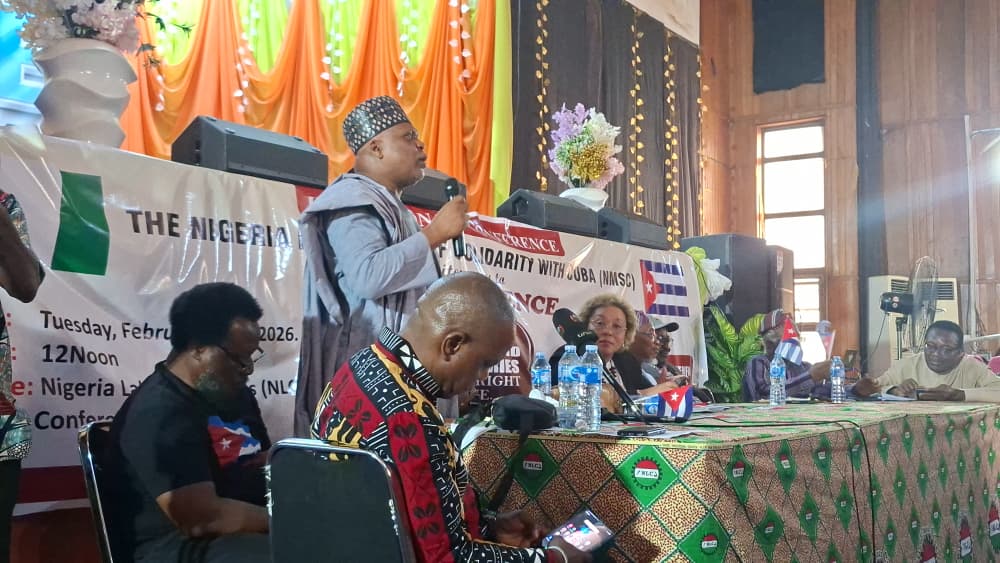
Among the speakers were also Comrade Femi Aborishade, Legal Advisor of the Solidarity with Cuba Movement; Comrade Lawson Osagie, founding member of the solidarity with Cuba movement in 1984; and Salisu Nuhu Mohammed, founder 42 years ago of the Solidarity with Cuba movement and its new president. 
Speakers also highlighted Cuba’s historic contributions to African liberation struggles—particularly in the fight against apartheid in Southern Africa—and its role in training African human resources in health, education, sports, engineering, and technical fields, benefiting generations across the continent. 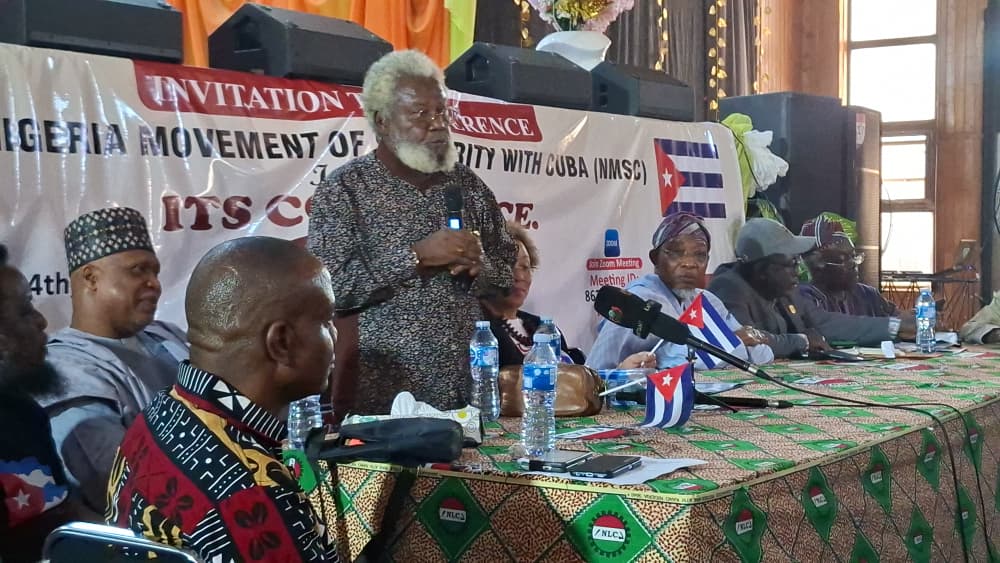
A central theme was the call to intensify humanitarian support for the victims of Hurricane Melissa in eastern Cuba, encouraging Nigerian trade unions and community organizations to coordinate the shipment of supplies and fuel as a concrete gesture of revolutionary solidarity.
Femi Falana also requested donations of funds and relief supplies to support Cuban communities affected by Hurricane Melissa in October 2025.
The lead lawyer stated: “In light of Hurricane Melissa, which struck the eastern provinces of Cuba last October, all African and Latin American countries should donate funds and relief supplies to Cuba.”
The conference, attended by hundreds both physically and virtually, received broad national media coverage. At least 11 major outlets—including The Guardian, Premium Times, Vanguard, New Telegraph, allAfrica, Independent, Blueprint, Sahara Reporters, News Minimalist, Latest Nigerian News, and Daily Dispatch—reported on the event, underscoring the strong stance of Nigerian trade unions and the call for African unity in defense of international justice and human dignity.
The conference concluded with a collective commitment to strengthen active solidarity with Cuba, counter imperialist policies of economic coercion, and promote unity among the peoples of the Global South in building a more just, sovereign, and solidaristic world.
(Embassy of Cuba to Nigeria)