
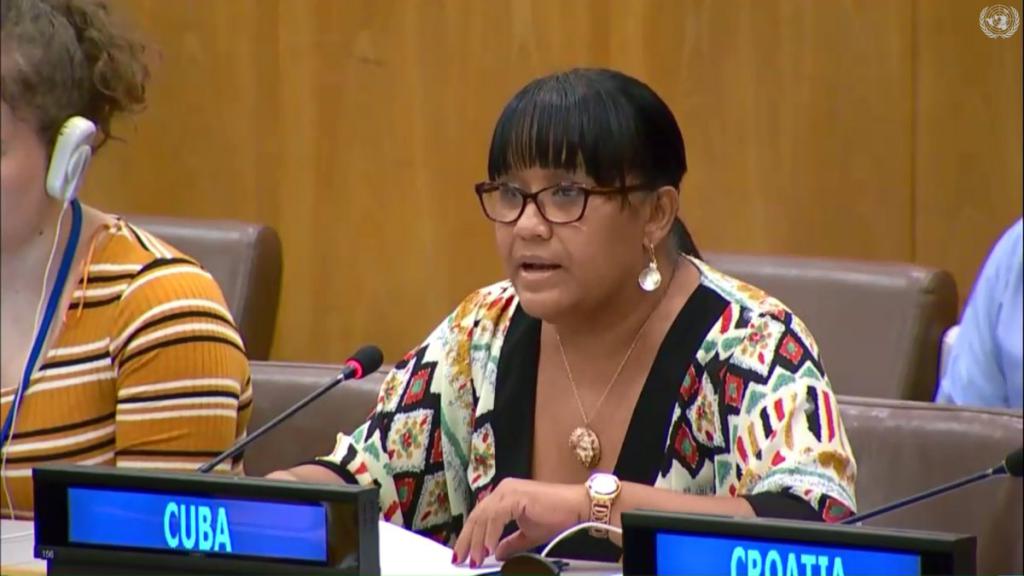
New York, October 5, 2018. In her statement at the debate on Item 29: Advancement of Women, in the Third Committee of the United Nations, the Permanent Representative of Cuba to the international organization, Ambassador Anayansi Rodríguez Camejo, urged to work to achieve a fair and equitable international order, which eradicates poverty and hunger, to put an end to wars, to privilege the human being over capital and to preserve the environment, emphasizing that in this way, progress will be made towards full gender equality and the empowerment of women.
Likewise, the Cuban diplomat proudly illustrated the advances of women in the Cuban revolutionary process. Among the achievements of the Cuban women, fruit of the socialist system, she listed: the payment of equal salary than men for work of equal value; the right to a pension for widowhood, to land, to receive bank loans, to paid maternity leave and its relevant benefits, which benefits the working woman before childbirth and until the baby is one year old, access to universal and free education, and respect for their sexual and reproductive rights, including the right to abortion and the free and responsible choice of their fertility. She also highlighted that 53.22% of the parliamentarians are women, being the second parliament in the world with the largest participation of women and that Cuba was the first country to sign and the second to ratify the Convention on the Elimination of All Forms of Discrimination against Women.
Rodríguez Camejo acknowledged that despite the advances shown in terms of gender since the Beijing Conference, it cannot be said that, on a global level, men and women enjoy equal rights; women are still very poorly represented at all levels of political decision-making; and they are 70% of the 2.7 billion poor people worldwide and two-thirds of the nearly 800 million of illiterate adults. She added that more than 300,000 women die each year from preventable complications during childbirth, 99% of them in countries of the South.
The ambassador recalled that in the case of the island, the economic, commercial and financial blockade imposed by the United States is an obstacle to the full development of the country, the advancement of women and is also a form of direct and indirect violence that has an impact on and hinders the enjoyment of the fundamental rights of Cuban women, including their right to development.
Permanent Mission of Cuba to the United Nations