
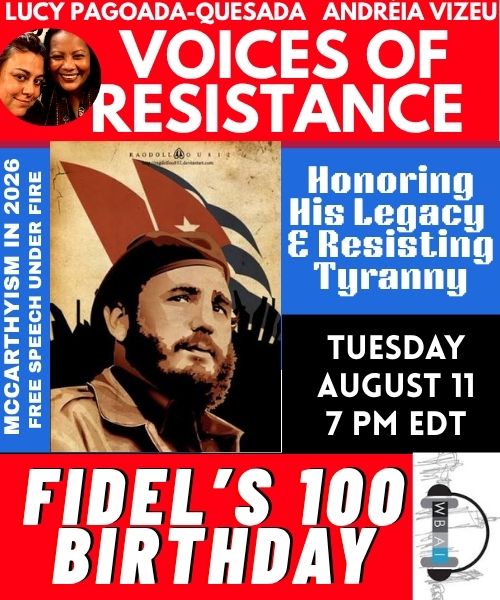
New York, 12 August 2026. - Cuba’s Deputy Permanent Representative to the United Nations, Ambassador Daylenis Moreno Guerra, took part in the radio broadcast “Voices of Resistance”, dedicated to the 100th anniversary of the historic leader of the Cuban Revolution, Commander-in-Chief Fidel Castro Ruz, where she approached the lasting relevance of his thought and revolutionary work, as well as his significance for Cuba and for the building of a world of peace, justice, solidarity and cooperation.
The Cuban diplomat emphasized that Fidel’s legacy extends beyond Cuba’s borders, as it is deeply linked to the defense of sovereignty, independence, the dignity of peoples, and international solidarity. She noted that his conception of internationalism was rooted in a fundamental conviction: peoples cannot remain indifferent to the suffering, injustice, or domination of other peoples.
Moreno Guerra also emphasized that the principles that guided Cuban foreign policy under Fidel’s leadership remain fully relevant today, including the defense of peace, cooperation among nations, the peaceful settlement of disputes, the sovereign equality of states, and the rejection of the threat or use of force. In this regard, she noted that these principles are fully consistent with the purposes and principles enshrined in the United Nations Charter, the defense of which remains a priority for Cuba.
The Deputy Permanent Representative stressed that, in an international context marked by conflicts, growing geopolitical tensions, and deep inequalities, Fidel’s ideas remain extraordinarily relevant today, particularly his call to replace confrontation with dialogue, selfishness with solidarity, and imposition with cooperation.
Moreno Guerra denounced the impact of the U.S. government’s policy of hostility toward Cuba, particularly the economic, commercial, and financial blockade, as well as the energy blockade and the constant threats of aggression against the island.
At the same time, she reaffirmed that Cuba will continue to defend its right to exist in peace, to freely build its political, economic, and social system, and to develop international relations based on mutual respect and sovereign equality.
Participation in “Voices of Resistance” also served to highlight the universal nature of Fidel Castro Ruz’s legacy: the defense of human dignity, solidarity among peoples, internationalism, the struggle for justice, and the conviction that peace is a collective responsibility of humanity.
One hundred years after his birth, Cuba continues to uphold Fidel’s legacy not only as part of its historical memory but also as a guide to principles and values for addressing the challenges of the present and contributing to the construction of a world in which peace prevails over war, cooperation over confrontation, solidarity over selfishness, and international law over the law of the strongest.
Permanent Mission of Cuba to the United Nations