
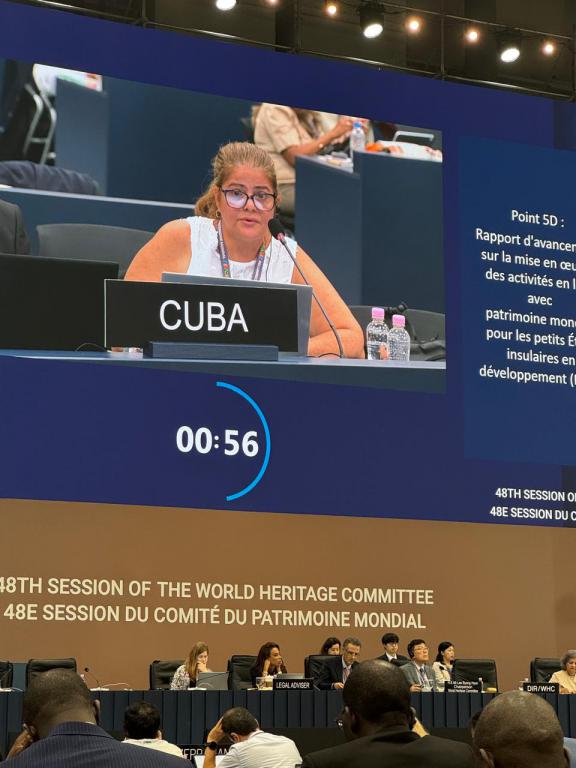
Busan, 21 July 2026 – Cuba reaffirmed on Tuesday, during the 48th session of UNESCO's World Heritage Committee, its commitment to implementing the new Strategy for Small Island Developing States (SIDS) in the field of World Cultural and Natural Heritage protection, while denouncing the effects of the economic, commercial and financial blockade imposed by the Government of the United States on the country's capacities for heritage management and disaster resilience.
During the debate devoted to the adoption of the Strategy for SIDS, the Cuban delegation reaffirmed the country's support for this instrument, designed to address the specific and multidimensional vulnerabilities faced by Small Island Developing States as a result of, among other factors, climate change, extreme hydro-meteorological events, biodiversity loss, and limited access to financial and technological resources.
Cuba highlighted that the Strategy is the result of a broad participatory process led by UNESCO, in which Cuban experts actively contributed through virtual consultations and regional Caribbean meetings, sharing experiences, identifying priorities, and providing input on the specific needs of Small Island Developing States regarding heritage conservation and disaster risk reduction.
The delegation recalled that the adoption of this Strategy represents an opportunity to strengthen international cooperation and channel greater capacities towards a group of States that constitutes a priority for UNESCO, in line with the Organization's Operational Strategy for Small Island Developing States.
In its statement, Cuba presented the main national actions undertaken in accordance with this new framework, including the progress made in the nomination dossier for the Cuban Caribbean Reef System, currently under evaluation by the Advisory Bodies to the Convention, as well as efforts to strengthen national capacities for disaster prevention, preparedness and response in properties inscribed on the World Heritage List and those included on Cuba's Tentative List.
The delegation stressed that heritage protection is a priority of Cuba's cultural and environmental policy and recalled that the management of these properties is grounded in scientific research, community participation, integrated disaster risk management and climate change adaptation.
Nevertheless, Cuba warned that the economic, commercial and financial blockade imposed by the Government of the United States continues to severely limit the country's ability to fully achieve these objectives. Restrictions on access to technologies, specialized equipment, international funding and cooperation mechanisms directly affect conservation programmes, monitoring activities and scientific research related to cultural and natural heritage, as well as the country's capacity to respond to and recover from increasingly frequent extreme events resulting from climate change.
The Convention concerning the Protection of the World Cultural and Natural Heritage, adopted by UNESCO in 1972, recognizes that certain sites possess Outstanding Universal Value and therefore form part of the common heritage of humankind. The 48th session of the World Heritage Committee, held in Busan, Republic of Korea, from 19 to 29 July 2026, brings together representatives of the Committee's 21 Member States, as well as observer States Parties to the Convention, including Cuba, to review the implementation of the Convention, evaluate new nominations for inscription on the World Heritage List and examine the state of conservation of properties already inscribed.
The Cuban delegation is composed of Nilson Acosta, Vice-President of the National Council for Cultural Heritage and Cuba's Focal Point for the World Heritage Convention, and Aylem Hernández Ávila, Deputy Director for Science, Technology and Innovation at the National Centre for Protected Areas (CNAP) and Cuba's Focal Point for Natural Heritage.