
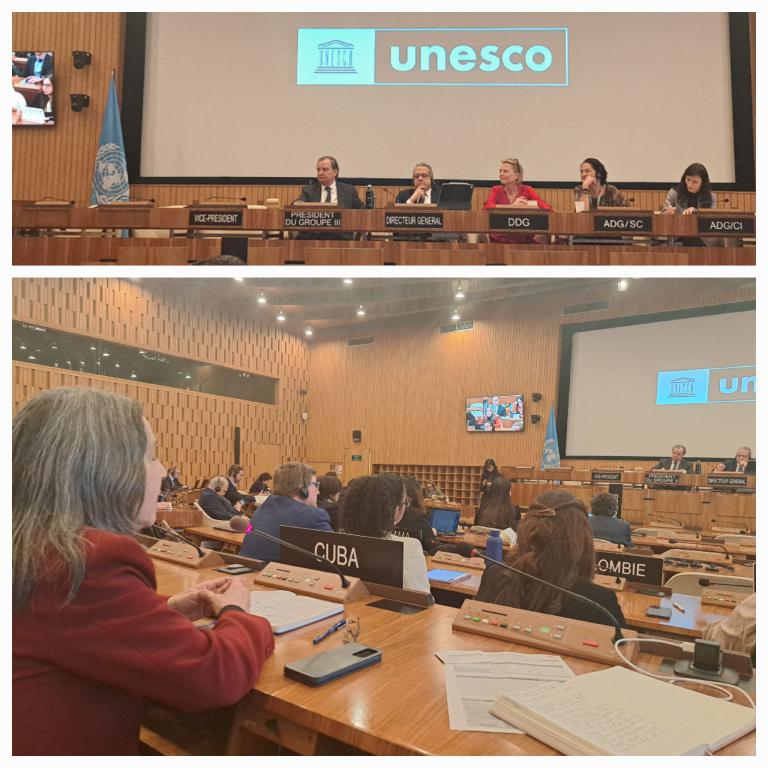
Paris, March 24, 2026. – Within the framework of the consultation of the Director-General of UNESCO, Dr. Khaled El-Enany, with the Group of Latin American and Caribbean Countries (GRULAC) on the UNESCO 80 Roadmap, Cuba reaffirmed its support for the initiative, while positively assessing the transparency and inclusive nature of the process of elaborating the proposal, aimed at strengthening the Organization in a complex international context.
The meeting was also an opportunity for the Cuban delegation to denounce the intensification of the economic, commercial and financial blockade imposed by the United States, as well as the energy siege that has a cross-cutting impact on all sectors of society, including education, culture, communication, information and science.
The Ambassador and Permanent Representative of Cuba to UNESCO, María del Carmen Herrera Caseiro, underlined the illegal nature of these unilateral coercive measures, which constitute a collective punishment against the Cuban people and undermine national sovereignty and the population's living conditions.
In her intervention, she also highlighted the country's resilience, creativity and capacity for adaptation, as well as the firm commitment of the Cuban State to the continuity of educational processes, informational transparency and the search for solutions based on national scientific potential, even in the current adverse context.
Cuba emphasized that the current international scenario demands a strengthened UNESCO, capable of responding effectively to threats to the values it promotes, including peace, cooperation and multilateralism. In this sense, it favorably assessed the UNESCO 80 Roadmap as an instrument to consolidate the future of the Organization.
The Cuban delegation also highlighted the importance of prioritizing issues such as gender equality and Small Island Developing States (SIDS), as well as strengthening the mainstreaming of these axes within the institutional structure.
Likewise, it underscored the need to strengthen the capacities of field offices, particularly highlighting the role of the UNESCO Regional Office in Havana, whose work has been key in responding to recent natural disasters and in supporting the country in the current energy context, as was seen after the passage of Hurricane Melissa through the Caribbean and the recent call by this regional office to different international partners to safeguard the achievements made in the Cuban educational sector, in the face of the effects of the coercive measures facing the country.