
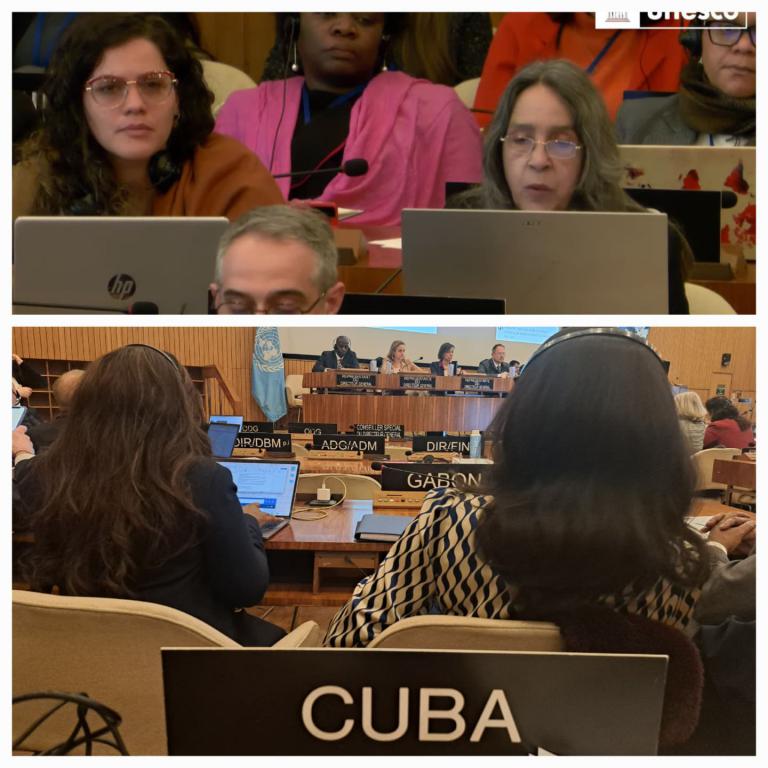
Paris, March 17, 2026. – The Permanent Delegation of Cuba to UNESCO today intervened in the preparatory group meeting of the 224th session of the UNESCO Executive Board, during which the UNESCO80 roadmap was presented. This initiative will be examined by the Executive Board at its upcoming session in April.
During the exchange, the Ambassador and Permanent Delegate of Cuba to UNESCO, María del Carmen Herrera Caseiro, highlighted the leadership of the Director-General and the work of the Secretariat in preparing this proposal within a short period of time following the start of the new administration.
The UNESCO80 initiative, aligned with the UN80 proposal promoted by the United Nations Secretary-General, António Guterres, seeks to strengthen the Organization's effectiveness, institutional coherence and sustainability in an international context marked by growing challenges to the multilateral system.
In her intervention, Cuba positively assessed the broad consultation process carried out with Member States and with the various components of the UNESCO ecosystem, and underlined the importance of preserving the intergovernmental character of the Organization and the integrity of its constitutional mandate.
The Cuban delegation also highlighted the need to strengthen UNESCO's presence on the ground, a key element to ensure that the Organization's programs and actions translate into concrete results for Member States.
It also underscored the potential of the proposal to consolidate the Natural Sciences and Social and Human Sciences sectors into a single Sciences sector, which could favor interdisciplinary approaches to address global challenges such as climate change, technological transformations and social inequalities.
During the debate, Cuba raised questions aimed at deepening the mechanisms of Member State participation in the process of reviewing the implementation of the Organization's mandate, as well as the operational and resource aspects linked to the proposal to consolidate the sciences sector.
The delegation reaffirmed Cuba's willingness to continue participating constructively in this process, aimed at strengthening the relevance, effectiveness and sustainability of UNESCO, for the benefit of all Member States.
The UNESCO80 roadmap responds to the outcomes of the 43rd session of the UNESCO General Conference, in alignment with the broader initiative of the United Nations Secretary-General, UN80. It establishes the start of a gradual, forward-looking reform framework, structured around three interrelated pillars: institutional efficiencies and improvements; review of mandate implementation; and structural adjustments.
Below is the full intervention:
Mr. Chair,
The Delegation of Cuba wishes first to thank the Secretariat and to recognize the leadership of the Director-General in conducting this process, as well as the effort made to present the UNESCO80 Roadmap in such a short time after the start of a new administration, as a starting point for a structured reflection on the institutional future of our Organization.
We take note with satisfaction of the broad and transparent consultation process carried out with Member States and with the various components of the UNESCO ecosystem. This participatory approach is essential to ensure that any reform process retains its intergovernmental character and reflects the collective priorities of the membership.
Cuba welcomes the proposal presented. We consider that the focus on three interrelated pillars — institutional efficiency, review of mandate implementation, and structural adjustments — in line with the broader UN80 initiative, constitutes a relevant framework for addressing current challenges, particularly in an international context marked by growing pressures on the multilateral system and persistent financial constraints.
In this regard, we wish to highlight several positive elements of the proposal.
First, the clear reaffirmation that the review process is not intended to modify or restrict UNESCO's constitutional mandate, but rather to strengthen its implementation through greater strategic coherence and better prioritization. For our delegation, preserving the integrity of the Organization's mandate remains a fundamental principle.
Second, Cuba particularly values the emphasis placed on strengthening presence on the ground. Field offices, institutes and associated networks are essential instruments for translating UNESCO's standards and programs into tangible results for Member States and communities. In this sense, any reform process must contribute to strengthening — not weakening — the Organization's operational capacity in countries and regions.
Likewise, we wish to underline the value of consolidating the Natural Sciences and Social and Human Sciences sectors into a single Sciences sector. From our perspective, this measure reflects an evolution consistent with current practices of the international scientific community, where addressing global challenges — such as climate change, technological transformations or social inequalities — increasingly requires interdisciplinary approaches integrating natural, social and political perspectives, while maintaining existing programs and governance mechanisms.
Finally, we agree that this Roadmap should be understood as the beginning of a gradual process of institutional transformation. Its implementation should continue to be guided by close and ongoing consultations with Member States, while ensuring the protection of UNESCO's mandate, substantive programs and global priorities, particularly at a time when the multilateral system faces significant financial constraints.
Before concluding, we wish to pose two brief questions to the Secretariat:
First, could the Secretariat offer further details on how the effective participation of Member States in the working group foreseen under Pillar II will be ensured, particularly regarding the definition of programmatic priorities?
And second, with regard to the consolidation of the Sciences Sector, we can see that this proposal aims to strengthen interdisciplinary synergies without affecting the visibility or implementation capacity of existing programs. Precisely in this regard, concerns have been expressed about factors such as staff availability after the merger both at headquarters and in the field, and the operational capacity of a new structure that would see at least some sections reduced. Could we obtain more specific details about what is gained in terms of staffing, operational capacity and resources by contemplating this merger?
Mr. Chair,
The Delegation of Cuba reiterates its willingness to continue participating constructively in this collective process aimed at strengthening the relevance, effectiveness and sustainability of our Organization.
Thank you very much.