
Author: Eduardo Palomares Calderón | internet@granma.cu
June 13, 2021 10:06:47 PM
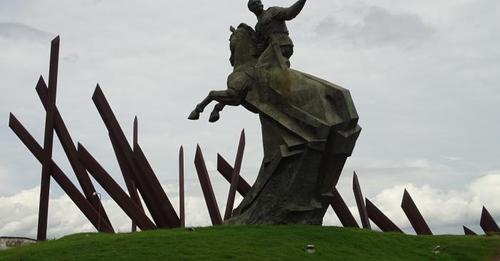
The equestrian statue of Antonio Maceo in the Plaza de la Revolución in Santiago de Cuba, a work by Lescay. Photo:
From a lion and a lioness came that June 14, 176 years ago in Santiago de Cuba, the Titan that from East to West would trace, in front of the Spanish colonial yoke, a trail of value, dignity and patriotism, which has illuminated this Island ever since irredeemable before the world.
At the hands of his mother Mariana Grajales, along with father Marcos Maceo and his brothers, Antonio de la Caridad took the path of the “manigua” (name given by the Cubans to the places at the countryside where the rebels fought the Spanish army) just two days after Céspedes (Carlos Manuel de Cespedes, Cuban hero who started the first Independence war)started it in La Demajagua (Cespedes´ farm), and he could only stop him, in 28 years of hard fighting , the wound 26 that would render lifeless his "bronze" body, which had put the chest to the bullets in some 800 actions of war.
Through dint of courage and intelligence he grew throughout that time in prestige, in military positions and in a greatness recognized beyond our borders, at the same time that he bequeathed to the Homeland insurmountable feats that, in the opinion of Generalissimo Máximo Gómez, define as an extraordinary man and an exalted figure.
If it is difficult to summarize the main battles in his extensive service record, it is enough to immortalize the Baraguá Protest, described by Martí as "one of the most glorious in our history." With Baraguá, Maceo left us intransigence and resistance. That cry resounds today in the face of new combat scenarios, against recent or historical enemies, whether invisible or imperial.
Shame, not giving up, not giving up, fighting ... Since then, the Titan, who carried the machete from East to West, along with Gómez, in an invasion that many specialists of the time considered the fact of weapons more bold of the century.
But the Apostle well said that "Maceo has as much strength in his mind as in his arm ...", hence that kind of deep son also in ideas will sentence, like the Homeland or Death that identifies us today, that "whoever tries to appropriate de Cuba will collect the dust of its soil drenched in blood, if it does not perish in the fight.
Impressive in turn is the warning about the nascent northern empire: «From Spain I never expected anything (...). Freedom is conquered with the edge of the machete, it is not requested; begging for rights is typical of cowards incapable of exercising them. Nor do I expect anything from the Americans; We must trust everything to our efforts; it is better to rise or fall without his help than to incur debt of gratitude to such a powerful neighbor”.
Thus, on one occasion during a banquet in his honor in Santiago de Cuba, one of the guests expressed his belief that Cuba would become fatally annexed to the United States, and Maceo immediately replied with a conclusive phrase: «I think, young man , although it seems impossible to me, that this would be the only case in which perhaps I would be next to the Spaniards ».
It is said that fighting by his side, always at the forefront, was then considered a pride, hence in these times of constant imperial siege it is worth remembering the high honor of feeling it ours, and the validity of Che Guevara's words when saying the December 7, 1962: "Maceo's fighting spirit is the spirit of today's Cuban people, in the most difficult moments."