
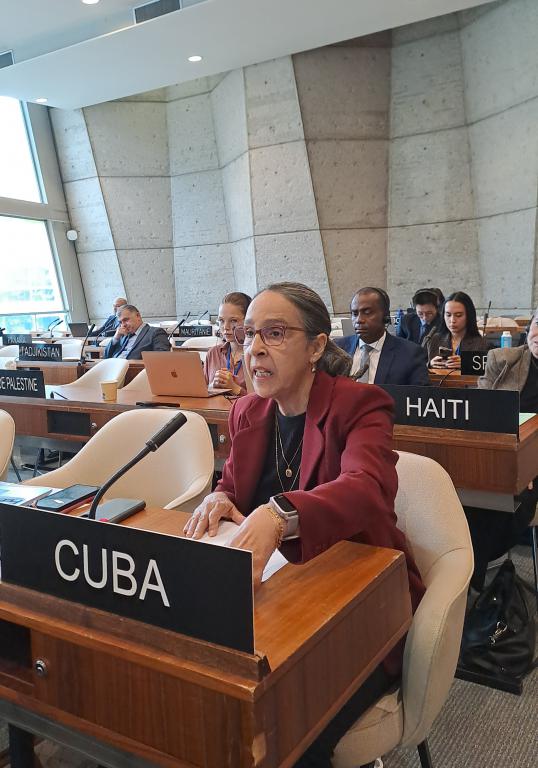
Paris, October 1st, 2026. – The Plenary Assembly of the G77 and China Chapter at UNESCO was the setting for a strong denunciation by the Ambassador and Permanent Representative of Cuba to UNESCO, María del Carmen Herrera Caseiro, of the consequences of the economic, commercial, and financial blockade imposed by the United States against Cuba for more than six decades and intensified today to unprecedented levels, with an energy siege aimed at suffocating the country and whose consequences directly affect the lives of Cuban women and men.
The intervention took place before representatives of the developing countries that are members of the Organization, following Cuba’s presentation of the Report on the Effects of the U.S. Blockade, covering the period from March 2025 to February 2026. The document constitutes Cuba’s contribution to the report presented annually by the Secretary-General of the United Nations on the need to put an end to the economic, commercial, and financial blockade imposed by the United States against Cuba. The issue will be considered by the United Nations General Assembly on October 27 and 28.
The Ambassador highlighted the longstanding support of the G77 and China for Cuba and denounced the impact of the measures intensifying the blockade, including the energy blockade and the application of secondary sanctions against entities in third countries that maintain commercial ties or investments in Cuba.
In her intervention, she placed particular emphasis on the repercussions of this policy on sectors falling within UNESCO’s mandate, particularly education, science, culture, communication, and information, as well as on its serious humanitarian consequences.
The Ambassador noted that the report presented contains data, testimonies, and examples concerning the effects of this policy on the Cuban economy, human rights, and the daily lives of the population, and stressed the need to put an end to the blockade.
The full text of the remarks by the Ambassador of Cuba before the Plenary Assembly of the G77 and China Chapter at UNESCO is reproduced below:
Just this month, Cuba’s Minister of Foreign Affairs presented the country's report on the impact of the blockade imposed by the U.S. government against Cuba for more than six decades.
This report constitutes Cuba’s contribution to the annual report presented by the UN Secretary-General pursuant to the resolution entitled "Necessity of ending the economic, commercial and financial blockade imposed by the United States of America against Cuba"—a resolution adopted annually by the General Assembly since 1992 with the support of the overwhelming majority of the international community. More than 180 Member States and 35 international organizations, including UNESCO, submit their contributions to the Secretary-General’s document year after year.
This year, Cuba’s contribution reflects the devastating impact caused by the intensification of the blockade to unprecedented levels—by the imposition of an energy blockade against our country and the application of a comprehensive scheme of secondary sanctions against any entity from third countries maintaining investments or commercial ties with Cuba.
As a result of this multidimensional aggression by the United States government against Cuba, the Cuban people have suffered a decline in their quality of life and incalculable humanitarian harm. An almost total lack of fuel, prolonged power cuts exceeding 30 consecutive hours, widespread disruptions to the national electrical grid, and impacts on the supply of water, transportation, food, and medicines have defined the daily lives of Cubans since the beginning of 2026.
To quote just a few examples, infant mortality rose from four per thousand live births in 2018 to 9.9 in 2025. These are children, not numbers.
The country's surgical waiting list has reached 100,000 patients, 12,000 of whom are children. There examples of incidents where major surgeries had to be completed using rechargeable lamps or the light from medical staff's mobile phones.
The number of cancer deaths in the country has risen significantly. Among children and young people, survival rates have dropped from 85% to 65%. Parents suffer as they anxiously search for essential medication—medicine that might be sitting in one of the more than seven thousand shipping containers blocked from reaching the island due to U.S. government threats against shipping companies.
The effects of these measures extend to all sectors of national life, including areas within UNESCO’s mandate—particularly education—a fact recently highlighted by the Director of the UNESCO Regional Office in Havana. In addressing the impact of these measures, she acknowledged that—and I quote—they “jeopardize the future of an entire generation, with long-term consequences.”
The energy blockade, alongside other measures that have drastically intensified the blockade, constitutes an act of genocide—also defined as collective punishment against the Cuban population—and a grave violation of international law and international human rights law; it even qualifies as a violation of international humanitarian law, despite the absence of a state of conventional war between the United States and Cuba.
Such genocidal actions have been presented under the absurd and ridiculous justification of deeming Cuba an “unusual and extraordinary threat” to the national security and foreign policy of the United States.
The devastating impact of this policy against Cuba has been denounced by senior officials of the United Nations system—including the Secretary-General himself—as well as by experts and special rapporteurs of the Human Rights Council and the international community at large.
On July 7, during the General Assembly debate on this issue, numerous Member States raised their voices to demand an end to this aggression against Cuba and its people, including a forceful statement by the Group of 77 and China, the text of which was circulated to all delegations at this venue.
Last week, during the General Debate of the 81st Session of the UN General Assembly, high-ranking officials from numerous countries denounced this outrage against the people of Cuba in their statements.
On October 27 and 28, the United Nations General Assembly will once again consider this issue. Despite the extraordinary pressure and intimidation exerted by the United States government on member states, our people are confident in the world's overwhelming support for the call to end the blockade.
The report we are presenting today—which has been circulated to all delegations—details the damage caused by the economic war against Cuba between March 2025 and February 2026. It compiles compelling examples, harrowing testimonies, and irrefutable data regarding the devastating impact on our economy, human rights, and people's daily lives.
Thank you very much.