
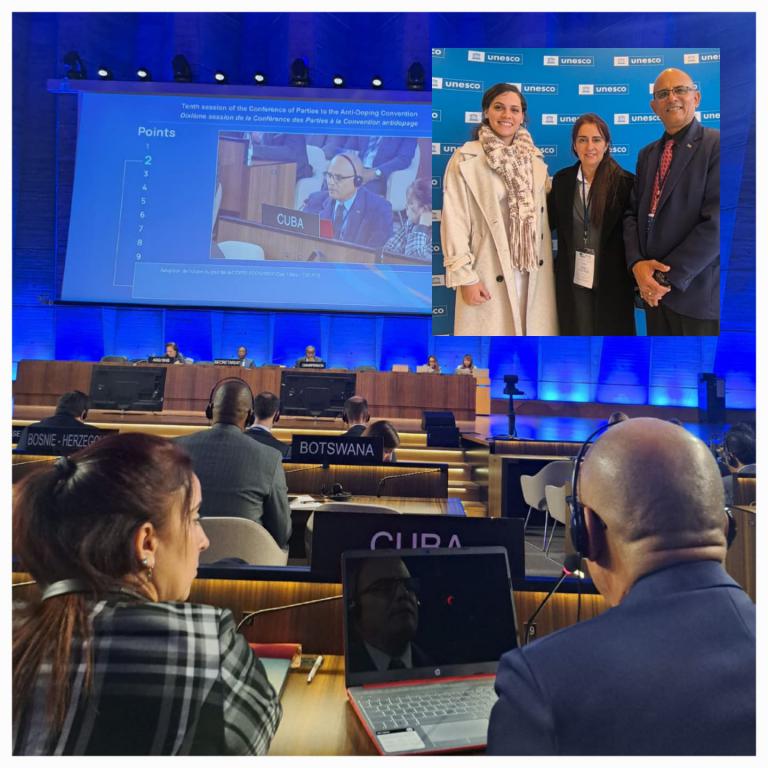
Paris, 20 October 2025.– Cuba is participating in the 10th International Convention against Doping in Sport, organized by UNESCO, taking place from 20 to 22 October in Paris, France. The Convention serves as a forum for analysis, debate and decision-making aimed at strengthening the International Convention against Doping in Sport and international cooperation in this field.
During the working sessions, the Cuban delegation denounced the negative effects of the economic, commercial and financial blockade imposed by the Government of the United States, which directly impacts the implementation of anti-doping programmes and the fulfilment of the country’s international commitments. These unilateral coercive measures restrict access to financial resources, equipment, technologies, specialized supplies and normal mechanisms of cooperation, unfairly affecting sports institutions and athletes.
In particular, the impact of the blockade on the Havana Anti-Doping Laboratory was underscored. On numerous occasions, the institution has been unable to receive payments for services rendered or to comply with payments to international bodies, including the World Anti-Doping Agency, due to the impossibility of carrying out direct banking transfers from Cuba. In addition, the laboratory cannot access most equipment, reagents and supplies of U.S. origin and must assume additional costs ranging from 40 to 50 per cent above those incurred by other accredited laboratories worldwide, as well as face restrictions in accessing state-of-the-art anti-doping technologies.
The Cuban delegation also presented concrete examples of these limitations, such as the inability to acquire monoclonal antibodies required to determine the hormone erythropoietin, produced by U.S. companies, as well as restrictions on maintaining scientific exchanges, knowledge-sharing and personnel cooperation with highly qualified specialists from that country, and difficulties in obtaining visas to participate in international scientific symposia and events.
The Cuban delegation is composed of José Cedeño Tamayo, Director General of Physical Education and Sport for All and representative of INDER before this organization; Dr. Daisy Yahumara Castro Gutiérrez, Director of the National Anti-Doping Organization; María del Carmen Herrera Caseiro, Ambassador of Cuba to UNESCO; and Laura Álvarez Delgado, official of the Cuban Delegation to UNESCO.
The main items on the Convention’s agenda include information on the governance and visibility of the Convention and its Fund, the amendment of Annex I concerning the list of prohibited substances and methods for 2026, the regional allocation of funding to the World Anti-Doping Agency by governments, and the report on the implementation of the second phase of the 2020–2025 Operational Strategy of the Fund for the Elimination of Doping in Sport.
Cuba’s participation in the 10th International Convention against Doping in Sport reaffirms the country’s commitment to ethics, fair play and multilateral cooperation, as well as its determination to continue defending a fair and inclusive anti-doping system, despite the effects of the blockade.