
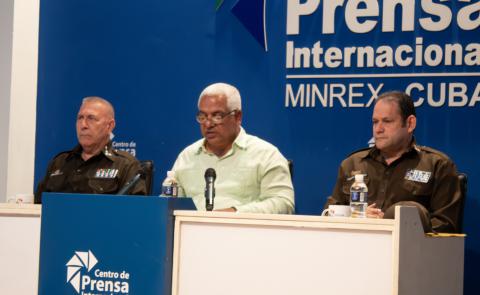
Havana, December 4, 2025 – High-ranking Cuban officials presented a detailed report on the results of the fight against drugs this year at a press conference held at the International Press Center on Thursday, attended by national and international correspondents. The meeting reaffirmed the “zero tolerance” policy, operational successes, transparent international cooperation, and the preventive approach that characterizes the national strategy.
The panel was chaired by the Minister of Justice and President of the National Drug Commission, Oscar Manuel Silveira Martínez, who was accompanied by First Colonel Ivey Daniel Carballo Pérez, Chief of Staff of the Border Guard Troops Directorate of the Ministry of the Interior (MININT), and Colonel Juan Carlos Puey Guerra, Head of the Specialized Anti-Drug Enforcement Unit of the same ministry.
Minister Silveira Martínez began his remarks by reaffirming the guiding principle of Cuban policy: “In Cuba, there is a zero-tolerance policy toward the production, consumption, possession, and trafficking of drugs. This is not a slogan; it is a state directive that is implemented through coordinated actions of prevention, education, control, and punishment.” He emphasized that the preventive approach is the fundamental pillar, aimed at consolidating a culture of social rejection of drug use, especially among young people.
He announced that, as part of institutional strengthening, on November 15, 2024, territorial subgroups for combating drug use were established in all provinces and the special municipality of Isla de la Juventud. These subgroups will be chaired by the vice-governors and coordinated by the provincial justice departments to articulate actions at the local level.
For his part, First Colonel Ivey Daniel Carballo Pérez offered specific data on the effectiveness of interdiction operations. He highlighted that, in the last fourteen years, the Border Guard Troops have seized more than 40 tons of drugs. “For the 2024-2025 period,” he specified, “we have thwarted 72 drug smuggling operations originating from 11 different countries. In these operations, we have captured 14 speedboats, arrested 39 drug traffickers, and seized a total of 4,487.1 kilograms of various substances.”
As an example of the ongoing vigilance, he detailed a drug bust that occurred between November 19 and 23 in Guantánamo province, where 792.5 kg of marijuana and 12.25 kg of cocaine were seized in 43 containers and 333 packages.
He reported that Cuba maintains 37 permanent working contact points with its counterpart anti-drug services in other nations, with which the exchange of information is fluid. From 1990 to November 2025, Cuba sent 1,547 formal messages to the United States Coast Guard reporting incidents or situations related to drug trafficking, having received only 468 messages from that counterpart.
The panelists warned about the evolving nature of the threats. Colonel Poey Guerra noted that Cuban specialized services have detected and analyzed 41 new formulations of synthetic cannabinoids that are being smuggled into the country, primarily from the United States. “These highly harmful substances represent a global challenge to public health,” he explained, highlighting the capacity of Cuban laboratories to identify these new psychoactive drugs, despite the obstacles posed by the U.S. embargo against Cuba.
The inauguration in July 2025 of Cuba's National Drug Observatory was highlighted, a key scientific institution for diagnosis, research, and the early warning system. Minister Silveira Martínez emphasized the multisectoral nature of the National Drug Commission, which includes the Ministries of Foreign Affairs, Justice, Interior, Public Health, Education, Higher Education, the General Customs Office, and the Public Prosecutor's Office, with the participation of other agencies such as Tourism, Culture, and Agriculture.
First Colonel Carballo Pérez emphasized that all operations are conducted in strict adherence to international law, specifically citing the United Nations Convention on the Law of the Sea, the 1988 Convention against Illicit Traffic in Narcotic Drugs, and the UN Basic Principles on the Use of Force.
In closing, Cuban authorities reaffirmed the island's unwavering commitment to the international drug control system and related treaties. They reiterated Cuba's willingness to continue cooperating actively, responsibly, and transparently with all countries and international organizations, based on mutual respect, sovereignty, and international law, to collectively confront a scourge that affects all of humanity.
(Cubaminrex)