
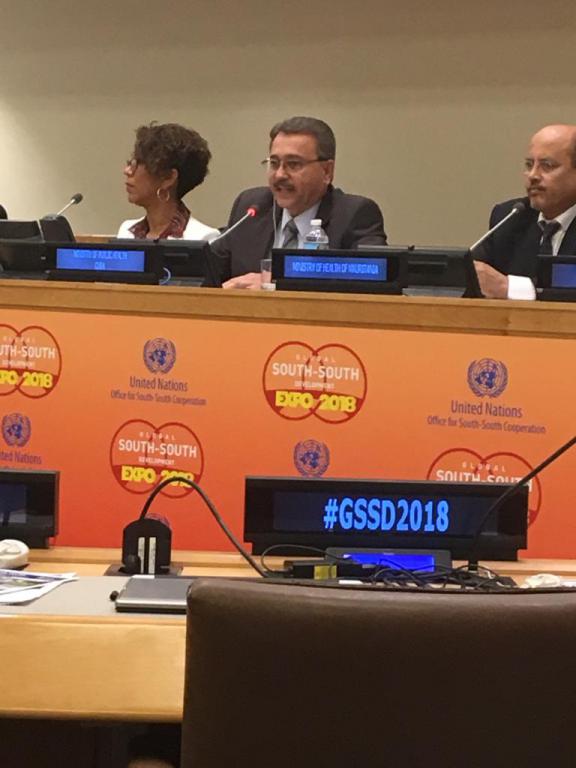
New York, 29 November. Cuba maintains its active participation in the Global Exhibition on South-South Cooperation (SSC) for Development 2018, which is being held at the United Nations from 28 to 30 November.
On November 29, Dr. Néstor Marimón, Director of International Relations of the Ministry of Public Health of Cuba (MINSAP, by its Spanish acronyms), participated as a panelist in the Thematic Forum "The potential of South-South and Triangular cooperation to achieve health results", where he expressed that international solidarity is a principle of the Cuban National Health System, and relies on medical collaboration in countries of the South, as well as triangular cooperation with other countries and International Organizations.
He said that in figures, Cuban cooperation in the area of health translates into 55 years of medical cooperation and over 400,000 professionals and technicians who have served in 164 countries. Currently, he added, more than 40,000 workers are cooperating in 67 countries, of which 20,000 are doctors providing services in 30 African countries, 25 in Latin America and the Caribbean, 8 in Asia, 3 in Oceania and 1 in Europe.
Cuba has also contributed to the formation of human resources, teaching and training of health personnel, as shown by the schools of medicine created in 14 countries and the 18,589 foreign professionals who have graduated from these schools. Nowadays, 1,579 professors provide services in eight schools, who are involved in the training of 36,850 students. At the same time, 35,142 health professionals from 136 countries have studied in Cuba, with 9,200 undergraduate students and 2,327 postgraduate students currently enrolled in the different Medical Sciences careers, representing 126 nations from all continents.
Dr. Marimón presented as examples and positive reference of South-South and triangular cooperation, Cuba's participation in the confrontation of the Ebola virus in three West African countries (Guinea, Liberia and Sierra Leone), in conjunction with WHO in 2015. He also mentioned the More Doctors for Brazil Program, based on the successful Cuba-PAHO-Brazil triangular cooperation. The program, which had been operating since 2013 primarily in the most remote and distant areas of the Brazilian territory, consisted in the contribution of around 20,000 Cuban workers who provided assistance to more than 113 million patients in over 3,600 municipalities. More than 700 municipalities had a doctor for the first time in history, while Cuban doctors made up 80 percent of all the doctors involved in the program.
He also noted that the work of Cuban doctors in places of extreme poverty, in the slums of Rio de Janeiro, Sao Paulo, Salvador de Bahia, in the 34 Special Indigenous Districts, especially in the Amazon, was widely recognized by the federal, state and municipal governments of that country and by its population, which gave it 95 percent of acceptance, according to a study commissioned by the Brazilian Ministry of Health from the Federal University of Minas Gerais.
Other outstanding programs and projects of great social and human impact developed by Cuba are: Comprehensive Health Program (PIS); Latin American School of Medicine (ELAM); Henry Reeve International Contingent of Doctors specialized in Disaster Situations and Serious Epidemics; Operation Miracle; Barrio Adentro Mission in Venezuela; Triangular Cooperation: WHO/PAHO-Cuba-Angola cooperation for the eradication of Poliomyelitis, Cuba-Haiti-Brazil and Norway-Haiti-Cuba; and the joint production with Brazil of Meningococcal Vaccine A and C for the countries of "Africa´s meningitis belt".
The Cuban experience in South-South cooperation in the field of health and its positive results were widely recognized by several of the participants in the meeting, including representatives of international organizations such as the Pan American Health Organization and the United Nations Population Fund.
Permanent Mission of Cuba to the United Nations.