
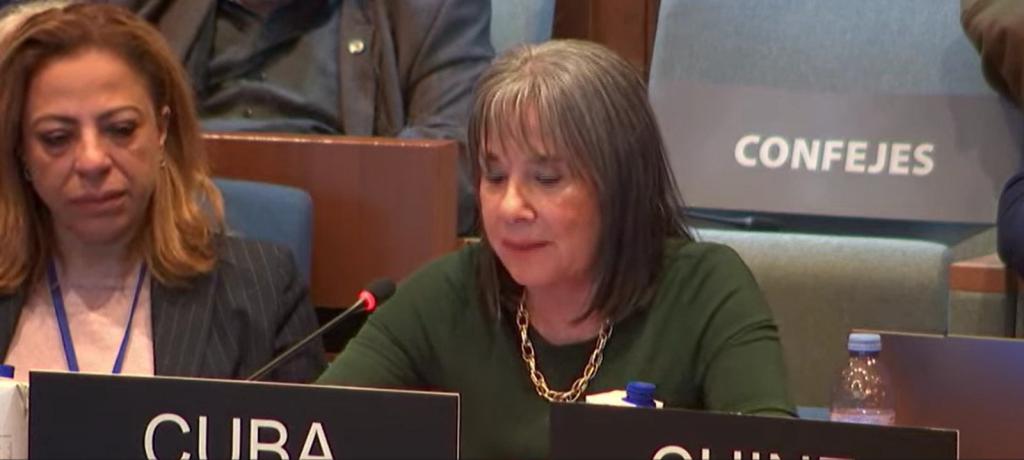
Paris, 9 October 2026.- H.E. Ms. Mirta Granda Averhoff, Representative of Cuba to the UNESCO Executive Board and President of the Cuban National Commission for UNESCO, addressed the plenary of the 225th session of the Organization’s Executive Board. In her statement, she addressed the main challenges facing multilateralism, denounced the multidimensional consequences of the intensification of the economic, commercial and financial blockade imposed by the Government of the United States against Cuba, and reaffirmed Cuba’s commitment to strengthening UNESCO and upholding its mandates.
During her statement, the Cuban Ambassador also referred to the situation of the Palestinian people, the impact of the blockade on essential sectors such as education, the importance of international solidarity, and the forthcoming 80th anniversary of uninterrupted relations between Cuba and UNESCO. She also emphasized the need for the UNESCO 80 Roadmap to strengthen the Organization through a transparent and inclusive process involving consultations with Member States, and underscored the importance of ensuring that developing countries participate fully in the governance of artificial intelligence.
The Executive Board is one of UNESCO’s three constitutional governing bodies and is composed of representatives of 58 Member States elected by the General Conference. Cuba is a member of this body for the 2023–2027 term and actively participates in its work, contributing to the examination of the Organization’s strategic priorities and to the strengthening of international cooperation in the fields of education, science, culture and information.
The full text of the statement is reproduced below:
Mr President,
We live in a world plagued by multidimensional crises and threatened by fierce hegemonic interests that undermine our peoples’ aspirations for peace. The genocide against the Palestinian people, for example, wounds the conscience of all humanity and must be brought to an end.
In this turbulent context, which poses major challenges to multilateralism and the United Nations system, UNESCO’s mission and the strengthening of its mandate take on particular relevance and urgency.
We share the Director-General’s vision of a revitalized, people-centred UNESCO, translated into policies that ensure access to education, science, culture, information and knowledge is not subject to pressure or conditionality, and that these reach everyone equally, leaving no one behind.
Mr President,
The Cuban people continue to suffer a silent genocide as a result of the unprecedented intensification of the economic, commercial and financial blockade imposed by the Government of the United States for more than six decades. This has been compounded by an energy siege that prevents fuel from reaching the country, as well as constant threats of military intervention.
As a result of this aggressive policy, the Cuban people have experienced a deterioration in their quality of life and suffered incalculable humanitarian harm, affecting every sector of the country, including those within UNESCO’s fields of competence, particularly education. This was denounced by the Organization itself, which stated, and I quote, that it “endangers the future of an entire generation, with long-term consequences”.
In this regard, we reiterate our gratitude to UNESCO for its continued support for and solidarity with our people, not only in the face of natural disasters but also under the difficult circumstances imposed by the blockade. The recent visit to Cuba by Lidia Brito, Assistant Director-General for Priority Africa and External Relations, was an expression of solidarity with the Cuban people. It also complemented the outstanding work carried out by UNESCO’s Regional Office in Havana, demonstrating the Organization’s commitment to strengthening cooperation for the benefit of people.
In this centenary year of the birth of Commander-in-Chief Fidel Castro Ruz, allow me to recall one of his reflections, and I quote: “Humanity will attain its highest degree of consciousness when each people is capable of feeling the suffering of other peoples around the world as its own.”
Mr President,
Cuba is a country of peace, as its history demonstrates. It is not a threat to the United States or to any other country. It is a Small Island Developing State which, despite facing enormous challenges and external pressures, continues to promote universal access to education, science, culture and information, while sharing its capacities and experience with other countries, convinced that solidarity is one of the most effective tools for addressing contemporary challenges.
Mr President,
In 2027, Cuba will celebrate 80 years of uninterrupted relations with UNESCO and of the establishment of the National Commission that I have the honour to preside over.
In this context, we believe that the implementation of the UNESCO 80 Roadmap should strengthen the Organization and its capacity to fulfil its mandates. Any reform must be carried out transparently and inclusively, in consultation with Member States.
We value the efforts aimed at strengthening cross-sectoral coordination, particularly in areas such as artificial intelligence and responses to crises and emergencies.
Artificial intelligence offers opportunities, but also entails risks. Developing countries must participate fully in its governance in order to prevent new digital and cognitive divides and promote responsible use that protects young people and future generations.
We reaffirm our commitment to Sustainable Development Goal 4, as well as to a post-2030 agenda in which UNESCO will play an essential role. We welcome the United Nations General Assembly’s proclamation of the International Decade of Culture for Sustainable Development.
We conclude by reiterating our willingness to continue working to strengthen UNESCO and defend its values and principles.
Thank you very much.