
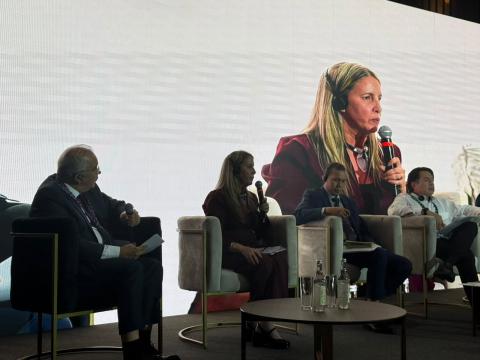
Chiapas, Mexico, September 8, 2026.— Cuba’s Minister of Education, Naima Ariatne Trujillo Barreto, spoke on Tuesday at the main panel, “Literacy in the service of people, the planet and prosperity,” as part of the global celebration of International Literacy Day convened by UNESCO.
The World Conference on Literacy for People, the Planet and Prosperity is taking place on September 8 and 9, on the occasion of the 60th anniversary of International Literacy Day, under a theme that places at the center the contribution of literacy to sustainable development in its social, environmental and economic dimensions, as well as to peace.
Cuba’s presence in this international forum is not fortuitous. It reflects the recognition of the country’s accumulated experience in literacy, whose starting point lies in the historic 1961 National Literacy Campaign. UNESCO itself has recognized the National Literacy Campaign as a landmark event in Cuban education and culture in the 20th century and as a reference for popular education movements in Latin America.
That experience was followed by a policy of educational continuity and international cooperation that transcended the borders of the Island. In 2003, at the initiative of the historic leader of the Revolution, Fidel Castro Ruz, Cuba made the “Yo, sí puedo” program available to other peoples. The program was designed to facilitate the literacy of young people and adults through audiovisual and, subsequently, digital tools adapted to different cultural and linguistic contexts.
Cuba’s achievements in education are today confronted with the harsh electro-energy reality facing the country, as a consequence of the unprecedented tightening of the economic, commercial and financial blockade imposed by the Government of the United States against Cuba for over six decades, and of its effects on access to resources, equipment, technologies and other means essential to the teaching and educational process.
The criminal U.S. energy siege is today one of the main obstacles to guaranteeing the continuity and quality of education in Cuba. External restrictions that hinder fuel imports have direct impacts on the functioning of essential services, affecting transportation for students and teachers, school meals, and the availability of electricity necessary for educational activities. UNESCO itself has recognized this situation, calling in February 2026 for international cooperation to support the continuity of education in Cuba.
Cuba’s participation in the global celebration of International Literacy Day thus reaffirms the country’s commitment to contributing to the international debate on the present and future of literacy and to sharing an experience that, from the 1961 National Literacy Campaign to current cooperation programs, has placed education and literacy as fundamental rights and pillars of social transformation.
(Cubaminrex-MisiónCuba Unesco)