
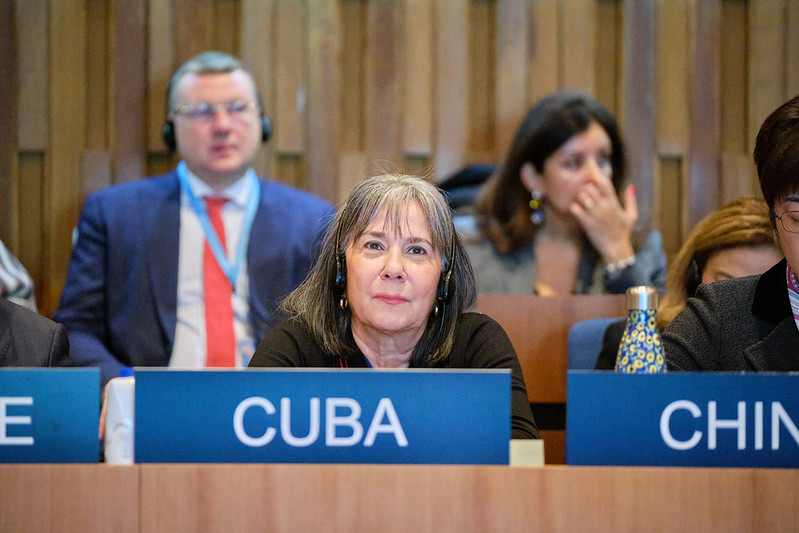
Paris, October 12, 2026.- Ambassador Mirta Granda Avehoff, Cuba’s representative to the Executive Board of the United Nations Educational, Scientific and Cultural Organization (UNESCO), reaffirmed Cuba’s commitment to the democratization of culture and to its recognition as a right for all people, an essential component of national identity, and a pillar of sustainable development. In her intervention on the UNESCO World Conference on Cultural Policies and Sustainable Development (MONDIACULT 2025), she underscored the importance of strengthening international cooperation, ensuring adequate resources for cultural policies, and protecting cultural diversity in the face of global challenges.
The Cuban representative welcomed the Secretariat’s report on the implementation of the priority areas of MONDIACULT 2025 and congratulated Saudi Arabia on its willingness to host the next edition of the Conference in 2029. She also welcomed the proclamation by the United Nations General Assembly of the International Decade of Culture for Sustainable Development (2027–2036).
In her intervention, the Ambassador outlined the efforts undertaken by Cuba since 1959 to expand access to artistic creation, education, and cultural enjoyment through specialized arts education, the training of arts instructors, Houses of Culture, and community-based creative spaces. She also denounced the effects of the United States’ economic, commercial, and financial blockade and the energy siege on Cuban cultural institutions, while highlighting the country’s determination to preserve and promote its cultural life.
The Cuban representative also highlighted the celebrations taking place across the country from October 10 to 20, featuring an extensive programme of artistic, literary, musical, and community activities. This year’s edition is dedicated to the centenary of Fidel Castro’s birth and the 50th anniversary of the establishment of the Ministry of Culture, and includes tributes to the nation’s historical roots, its artists and cultural creators, and the institutions that contribute to preserving and enriching its heritage.
The full text of the intervention follows:
Thank you, Madam President.
Distinguished colleagues,
For Cuba, culture is a right for all people and an essential pillar of the identity, dignity, and sovereign development of peoples. It must not be regarded as an accessory element of public policy, but rather must occupy a central place on the post-2030 development agenda.
We thank the Secretariat for its report on the implementation of the priority areas of MONDIACULT 2025. We also congratulate the Kingdom of Saudi Arabia on its willingness to host the UNESCO World Conference on Cultural Policies and Sustainable Development, MONDIACULT 2029. We trust that this gathering will help consolidate culture as a pillar of sustainable development, dialogue among peoples, and peace.
We also welcome the proclamation by the United Nations General Assembly of the International Decade of Culture for Sustainable Development (2027–2036). We trust that, under UNESCO’s leadership, this Decade will translate into concrete action, increased international cooperation, and adequate resources to strengthen cultural policies and institutions.
Madam President,
Since the triumph of the Revolution in 1959, Cuba has embraced the democratization of culture as a social commitment, grounded in the principle that access to artistic creation, arts education, and cultural enjoyment must be a right for all the people, rather than a privilege reserved for a few.
The expansion of specialized arts education, through art schools in different provinces, the training of arts instructors, Houses of Culture, and community creative spaces, has helped bring the arts closer to children, young people, and communities throughout the country.
Today, these efforts face serious obstacles arising from the economic, commercial, and financial blockade imposed by the United States and the energy siege affecting my country. This criminal policy of collective punishment, pursued by the United States Government, exacerbates the difficulties involved in acquiring materials and instruments, maintaining equipment, transporting students and artists, and sustaining cultural programming. Despite these challenges, our institutions and communities continue to defend and promote cultural life, convinced that culture is also a source of collective resilience and an essential component of national sovereignty and identity—something we are not willing to surrender.
It is precisely during this period, from October 10 to 20, that Cuba holds its celebrations of National Culture. This year’s edition is dedicated to the centenary of Fidel Castro’s birth and the 50th anniversary of the establishment of the Ministry of Culture, and includes tributes to the nation’s historical roots, its artists and cultural creators, and the institutions that contribute to preserving and enriching its heritage.
Excellencies,
In the face of conflicts, the climate crisis, emergencies, and rapid advances in artificial intelligence, we must strengthen multilateral cooperation and this Organization’s capacity to protect cultural heritage and diversity, ensuring that truly no one is left behind.
Thank you.