
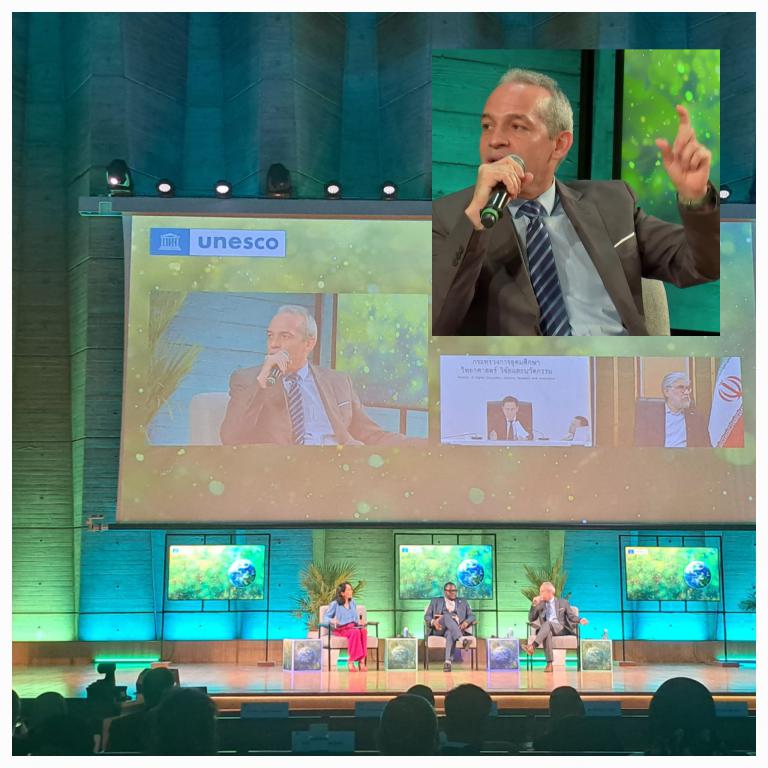
Paris, 15 July 2026. – With the participation of ministers, senior government officials, representatives of United Nations organizations, scientific institutions, universities, research centres and civil society organizations, the Global Conference of the International Decade of Sciences for Sustainable Development (2024–2033) was officially inaugurated on Tuesday at UNESCO Headquarters.
The Conference constitutes the principal political and scientific milestone for reviewing the first two years of implementation of the Decade, proclaimed by the United Nations and led by UNESCO. It aims to strengthen the role of science in advancing the Sustainable Development Goals (SDGs) and in building a more just, resilient and inclusive world beyond 2030.
Cuba's Minister of Science, Technology and Environment, Armando Rodríguez Batista, addressed the High-Level Ministerial Segment entitled "Science for Sustainable Development: From Commitment to Implementation."
The ministerial panel also featured the Minister of National Education and Vocational Training of Haiti, the Minister of Science, Research and Technology of the Islamic Republic of Iran, and the Deputy Prime Minister and Minister of Higher Education, Science, Research and Innovation of Thailand.
Recalling Commander-in-Chief Fidel Castro Ruz's conviction that "the future of our country must necessarily be a future of people of science," Minister Rodríguez Batista shared Cuba's experience in building a science, technology and innovation system conceived as a public policy serving national development. He presented eight proposals intended to guide science policy in support of sustainable development.
The Minister presented the following proposals:
1. Sharing experiences and knowledge. Promote mutual learning and ensure the continuous updating of science policies based on evidence, while regularly adjusting their course in light of emerging knowledge and experience.
2. Consolidating inclusive national Science, Technology and Innovation (STI) systems aligned with development priorities. He explained that Cuba has around 50 universities, an extensive network of research centres dedicated to national priorities, sectoral science and research programmes implemented at the national, territorial and local levels, as well as a significant number of universities specializing in medical sciences and others focused on food production.
3. Grounding environmental decision-making in scientific research. He emphasized that Cuba's environmental policies are based on knowledge generated by universities and research institutions. He highlighted Tarea Vida (State Plan for Confronting Climate Change) and recalled that approximately 20 per cent of the country's territory is protected under one category or another of the National System of Protected Areas.
4. Strengthening participatory governance of science. The scientific community, public institutions, local governments and other stakeholders should contribute to the formulation of science policies and the country's legal framework. In this regard, he highlighted the adoption of the General Law on the System of Natural Resources and the Environment and the General Law on Science, Technology and Innovation.
5. Mission-oriented innovation. The entire Science, Technology and Innovation policy framework is mobilized to address clearly identified national challenges. Cuba's development of domestically produced COVID-19 vaccines, based on its own scientific and technological capacities, constitutes a notable example. This achievement was made possible by a universal, free and inclusive public health system, a strong scientific culture fostered through education, and high levels of public trust in scientists and healthcare professionals.
6. Strengthening the governance of science. Scientific knowledge must be placed at the centre of public decision-making, as is the case in Cuba through mechanisms such as the National Innovation Council, chaired by the President of the Republic, and the Government Management System Based on Science and Innovation.
7. Developing scientific project management capacities. These capabilities are essential for strengthening research institutions, protecting intellectual property, generating patents and expanding access to international funding dedicated to science, climate action and environmental protection.
8. Science and innovation as a source of national resilience.
Under this final proposal, Minister Rodríguez Batista denounced the fact that the economic, commercial and financial blockade imposed by the Government of the United States continues to constitute the principal obstacle to Cuba's sustainable development and a major constraint on scientific development and international scientific cooperation.
He explained that the most recent Executive Orders and unilateral coercive measures adopted by the current United States Administration have reinforced the extraterritorial nature of the blockade, hindering the country's access to international research projects, scientific platforms, technologies, financing, fuel and other essential resources required for development.
"Imagine having to manage a research centre or a hospital without electricity," the Minister stated, illustrating the tangible impact of these measures on the operation of universities, scientific institutions and essential public services.
He further noted that the restrictions on acquiring fuel in third-country markets result in instability in electricity generation and transportation, weaken the country's environmental early warning systems in meteorology, seismology and radiological monitoring, affect the integrated management of municipal solid waste, and constrain the normal functioning of Cuba's extensive network of universities, educational institutions and scientific research centres.
The Minister affirmed that this situation represents a profound injustice that must be denounced by the international community, as it limits the right of peoples to harness science as a tool for achieving sustainable and inclusive development.
As a collective commitment ahead of the next Global Conference of the Decade, Cuba called for strengthening international scientific cooperation, promoting South-South cooperation, defending universal access to scientific knowledge, and ensuring that no country is excluded from the benefits of science as a consequence of unilateral coercive measures.
He also called for the strategic integration of science, technology and sustainable development into a single public policy framework, making them the foundation of national development strategies.
The First Global Conference of the International Decade of Sciences for Sustainable Development (2024–2033) will continue until 17 July. During the three-day meeting, participants will review the progress achieved since the launch of the Decade, identify priorities for the 2026–2029 implementation phase, and promote new partnerships among governments, international organizations, universities, research institutions, the private sector and civil society to strengthen the contribution of science to sustainable development.