
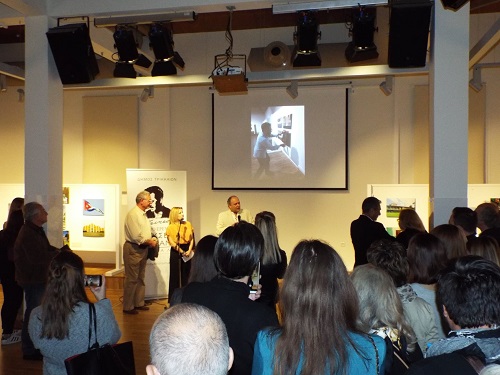
(Taken from Facebook Oriol Marrero, counselor of the Embassy of Cuba in Greece)
SEVENTH part: Cuban exhibition in Tríkala, Thessaly.
On October 14, 2018, the photographic exhibition “With Cuba in the heart” was inaugurated in a crowded room, with a friendly and attentive audience, in the Greek city of Trícala, in Thessaly, which is perhaps, if not the most, one of the most central cities of present-day mainland Greece, located about 250 kilometers in a straight line, to the northwest of Athens.
A curious fact and apparently verified by those who hold it reveals that a carrier pigeon covers the distance between Athens and Trícala "in 3 hours and 29 minutes".
According to Greek mythology Tríkala takes its name from Tricca, daughter of Peneo, a river god, son of Ocean and Tethys, and one of the three thousand rivers of Greece, in turn father of four sons and three daughters with the nymph Creusa, among them, Daphne's father.
It is a legend that the Greek god of love, Eros, would throw an arrow at Apollo to make him fall in love with Peneus' daughter, Daphne, but only with the hidden intention that she would despise him since Apollo had mocked Daphne's skill. with the bow. Then, always according to mythology, Daphne asked Peneo for help, who as said was a river god, and he transformed her into the laurel tree, which from then on would be sacred to the god Apollo, although like almost everyone , such a Greek myth has many versions.
Tríkala or “Trica” is mentioned by the poet Homer in the Iliad, and it is worth noting it because here an interesting link with José Martí will be revealed shortly.
Particularly in Homer's Catalog of Ships of the Iliad, he describes in one of his verses The Contingent of the Asclepiads, when he says, in the text of the poem the Iliad:
"The Contingent of the Asclepiads"
"And those who occupied
Trica and Itoma of steep ground,
And those of Ecalia, the city
of Eurito the Ecalieo, they occupied;
these, for their part, led
the two sons of Asclepius,
two good healers,
Podalirio and Macaon;
at your command thirty hollow ships
they advanced in the line of battle ”.
This information can be relevant for a number of reasons.
The first of them is that Trícala –current city– or what is the same Trica, –ancient Greek polis–, where the photographic exhibition “With Cuba in the heart” would take place –for some, perhaps the first Cuban expo in this city -, was mentioned by Homer in the catalog of ships of the Iliad, specifically when in the renowned poem the Greek ships that left for the Trojan War are listed (previously this topic was addressed a little in the publications Santa Ifigenia I and II , in this wall, when the Patrimonial Cemetery of Santa Ifigenia, in Santiago de Cuba, was discussed and the hypothetical Ethiopian / Greek origin of said name was addressed).
It also appears that the regions of Trica (that is, Tríkala), Itoma and Eucalia, sent "thirty hollow ships" to the Trojan War. That is, if it is calculated with respect to the total number of ships, it will not be difficult to establish that approximately 2.5% of those that departed in the 29 Greek contingents from Stylida to Troy came from this region.
And another important piece of information is also known from Homer in the Iliad: the fact that those who occupied Trica and Itoma, "with steep ground", were squad - or commanded - by the two sons of Asclepius, "two good healers", " Podalirio and Macaon ”.
It is precisely Asclepius, god of medicine and son of Apollo with the nymph Coronis, who would have been born precisely, in Trica!
So the expo "With Cuba in the heart" had come not only to Trícala, a land where not a few friends of Cuba and its people live today, who requested and prepared this exhibition with love, and attended its opening, having the honor to have the presence of the mayor of the city, representatives of various political forces and society in general; rather, the modest expo of Cuba, and with it the message of friendship, world solidarity and humanism, of peace, the appeal to the necessary cultural encounters between all the peoples of the world, had also reached “Trica”, the ancestral land and mythological Asclepius, god of medicine: to receive, and to give life!
Cuban and world doctors and paramedics know very well the inspiring name of Asclepio; but Homer already knew him and cited him in the Iliad; The Cuban National Hero José Martí also met and quoted him: how much symbolism came together in the crowded opening of the “Trica” exhibition that October 14, 2018, in the land of Asclepio, also a land of love and passion for Cuba and his people, as will be seen in the images, and where reciprocal gratitude was expressed to the Greek brothers of Trica, and of all Greece. It was exciting to appreciate the presence of people who came from Tríkala, Larissa, Kalambaka (Meteora) and from other surrounding regions.
José Martí also mentioned Asclepio, a native of Trica.
The first mention by Martí of Asclepius, Aesculapius, Asklepios or Aesculapius, apparently was associated with the discovery of the theater of Epidaurus, and he spoke about it 139 years ago in a Latin American press. There the Apostle referred to the theater "of Aesculapius."
This is no accident. Precisely the main temple to Aesculapius in Ancient Greece was located in the vicinity of the unspeakable theater of Epidaurus, where the famous hospital of Greek antiquity was also located. The Greeks believed - perhaps correctly - that art, culture, music, theater, had healing properties, and they also interpreted them as therapy. Consequently, the most prodigious theater of Greek antiquity was erected next to the hospital, and / or vice versa, to develop Asclepeia, a competitive festival in honor of the god Asclepius. This theater, built around 350 BC, offers performances and today shows an impressive state of conservation. Martí would mention it on January 17, 1882.
Then in 1883, in the context of his translation of the work Roman Antiquities, by the English writer A. S. Wilkins, for the Appleton and Cía House in New York, Martí would translate:
"Another century passed and by order of the same books, the god of healing, Asklepios, was solemnly brought to Rome and worshiped ever since with the name of Aesculapius."
The opening of the exhibition “With Cuba in the heart” in Trícala had a great closing, a Cuban carrier pigeon, the Cuban artist residing in Greece Marlen Olano, offered an unforgettable concert and presentation to the hundreds of people gathered in that already unforgettable October night of 2018 with friends from Cuba in "Trica".
Repeated thanks to the people who follow this modest series of publications, for their words and reading, and thanks to those who have been interested in reading the publication of the Adelante newspaper, from Camagüey, on the book Martí and "the Greek", placed in previous delivery.
Thanks especially to the friends of Cuba in “Trica”.
Thanks to the friends of Larissa and Kalambaca who went to Trícala, and after seeing the expo some of them traveled to Cuba, got to know Cuba, with its virtues and defects, and already love it with their own eyes, and Cuba is them. essential, thanks for feeling "Cuba in the heart".
In the next EIGHTH part of the series, "Cuba: a country sponsor of world solidarity and humanism, respect for life and friendship, promoter of peace and cultural encounters among all the peoples of the world": Photographic exhibition "With Cuba in the heart ”in Kalamata, Peloponnese, Greece, December 7, 2018.
In pictures: exhibition “With Cuba in the heart” in Tríkala, Thessaly, Greece, October 14, 2018.


