
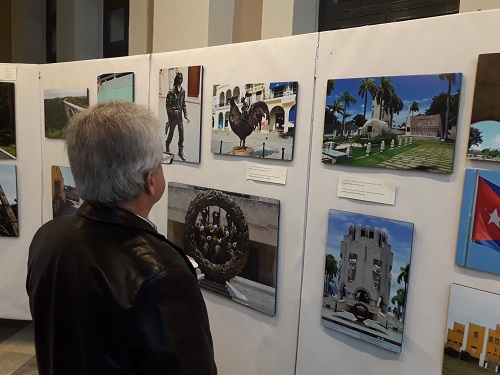
(Taken from Facebook Oriol Marrero, counselor of the Embassy of Cuba in Greece)
EIGHTH: photographic expo "With Cuba in the heart". Kalamata, Peloponnese, Greece. December 7, 2018.
The strong and faithful love for the struggles of Cuba and its heroic people in the Greek friends of Kalamata made it possible to inaugurate on December 7, 2018 the photographic exhibition "With Cuba in the heart" in said city.
Before it had been seen in a city in the Persian Gulf (Manama), in Attica (Athens), on a Greek island in the Ionian Sea (Lefkada), in Thessaly (Trikala), and in Thebes (maximum security prison for ladies of the country) . These actions were discussed before, from the first to the seventh publication. As said, the genesis of these exhibitions is the participation of Cuba in the LEA Festival, Literature in Athens, 2018 and 2019.
Today we talk a little about the unforgettable expo in Kalamata, or Kalamai, name given to the city by the Byzantines (Eastern Roman Empire), present in Greece almost from the beginning of the Middle Ages until the middle of the 15th century, when it falls in 1453 the Eastern Roman Empire before the irruption of the Ottoman Empire.
In distant latitudes of Kalamata a few years later (1492) the "discovery" of America by the Spanish colonial empire would take place, then the conquest and invasion of Cuba -among other territories-, which as it is known would generate two great wars in Cuba. for Independence against an occupying foreign colonial power: that of 1868, proclaimed by the Father of the Nation, Carlos Manuel de Céspedes, and that of 1895, organized by José Martí, National Hero and Apostle of the Independence of Cuba.
It is not a question of "prefabricating" unnecessary historical parallels in the 21st century in networks, about distant eras and times, however, it is almost unquestionable that the libertarian struggles of the peoples for their independence not infrequently have certain points in common, even in different geographies.
When the aforementioned photographic exhibition is inaugurated in Kalamata, just the day on which the 122th anniversary of the fall in combat of the distinguished Cuban general Antonio Maceo y Grajales was remembered, who dies precisely fighting against an occupying foreign power - and to whom history gave the Greek epithet of "Bronze Titan" -, the expo "With Cuba in the heart" had been seen before by about 20 thousand people.
However, it is perceptible that each site has its own symbolic charge, “its particular chemistry”, a kind of imprint that each place provides, and this sometimes happens for more than one reason.
In this case, on the one hand, it was the first time that "With Cuba in the heart" had been exhibited at a site in the important and historic Greek region of the Peloponnese, a site located, as it is popularly said in Greece, “under the Canal” of Corinth.
But above all there is a perceptible feeling from Marti, because José Martí would have mentioned in his Complete Works more than 20 sites, cities, regions, rivers, mountains, fortresses, valleys or temples located in the Greek Peloponnese, south of the Corinth Canal, built in the last years of Martí's life.
Before there was the so-called Diolkos, a straight, impressive, astonishing road, made of stones through which ships from the Aegean to the Ionian - and vice versa - were loaded, on carriages, by hand. Maybe they used draft animals? The visible remains of this intelligent and simple engineering work of antiquity remain. In 1893 a maritime canal of just over 6 kilometers was inaugurated that joined the Aegean and the Ionian, below which everything is called the Peloponnese. And the Diolkos would be - almost - forgotten (if it is of interest, it could be shown).
The fact is that with Diolkos or channel, Martí was clearly aware of the existence of the Peloponnese region, he will mention it by his name since he was a young man, almost a teenager, at the University of Zaragoza; but earlier, already in 1869, not yet turning 16 years old, he would quote Sparta in the dramatic poem Abdala. Sparta - about which it is debated whether it became a polis or not since it had neither walls nor an acropolis - is just another city in the Peloponnese located a few kilometers from Kalamata.
Later, in his short and intense life, Martí will cite other cities and regions of the Peloponnese, already directly in his Works, already in his translations of the work of other authors. And he will cite him not infrequently in the relatively large press for which he wrote - and where his work was highly valued, even though he was not always paid a lot for it, "even though they use it", as he once told a friend: " Tit for tat"--.
Considering that this modest sample or part of it would also be presented in other cities of the Peloponnese, which will be discussed in future installments - such as Tripoli, in March 2019, or Olympia in March 2020 -, with the presence of many Greeks friends of Cuba and also of Cubans residing in Greece, only essential elements related to the expo in Kalamata are discussed here, and especially with the context of Marti's journalistic and poetic production about this region. The exhibition itself is a means and does not mean much, the end, which is understood: that is what is relevant.
So Martí would write more than once about the Peloponnese region. Almost 30% of his mentions about sites in Greece refer to places located precisely in this region, as the investigation Martí and "the Greek" could establish.
His mentions of Arcadia, Argos, Mycenae, Messenia (very close to Kalamata), the Alpheus river, Epidaurus or Megalopolis, Orcomenos, Nemea, Sparta, Corinth or Olympia itself, among others, all located in the Peloponnese are particularly symbolic. , although the same could be affirmed of his mentions to other Greek regions, be they of Attica, Central Greece, Epirus, Thessaly or his own and then distant region of Macedonia or Thrace, with special mention to the journalistic or poetic treatment of Marti also to the islands of Greece. However, the “Peloponnesian intensity” in Marti's work on “the Greek” is an impressive fact, as are its exact descriptions astonishing. This is another matter.
A special motivation is that the Greek Peloponnese region, and Kalamata or Tripoli, among other cities, played an important role in the beginning and development of the Revolution for the independence of Greece, whose 200th anniversary is commemorated on March 25, 2021. And Martí would also talk about it, and about the influence of the struggles of Greece in the struggles for the independence of Cuba.
Today Kalamata is a port city, located about 180 kilometers southwest of Athens, and is the capital of the Messinia region. It is justly located, as if sitting looking at the sea and the sun setting, on the banks of the Gulf of Messinia, on the Nédonta river valley, and in its mountains, valleys and rivers, the heroic and resistant people of Cuba have many and faithful friends who carry it in their hearts. And above all: they admire her.
On the territory that the city of Kalamata occupies today, the ancient city of Feras stood, locating archaeological sites there that speak of the presence of constructions erected since the 8th century BC.
This was a region traditionally dominated by Sparta, from the mentioned 8th century BC. C. and until 371 a. C., that is, until the crucial battle of Leuctra, when the polis of Thebes faces and defeats Sparta, and the historical Sacred Battalion of Thebes defeats the powerful Spartan phalanx, a battle that will mark the end of the Spartan hegemony in history Greek and the beginning of the relatively short-lived Theban hegemony in the history of Ancient Greece. Note that Martí also wrote about Thebes. It is another matter.
An archaeological site of great national relevance in this region is that of Messenia (or Messini), located in the town of Mavromati, less than 25 kilometers from Kalamata, the main city of the Messinia region, as was said. This archaeological site marks the point where the Messinian nation was established in Greek antiquity.
And precisely in the Agora (market) of Kalamata, is the temple of the Holy Apostles, site from where on May 23, 1821 the official declaration of the Greek Revolution would be made.
The foregoing is relevant only because it will be necessary to mention that the pen of José Martí would not leave these events unattended, either in direct mentions of them in his Works, or in his translations of the work of other authors, because as has been said, the Cuban National Hero not only wrote about Ancient and contemporary Greece, but also translated quite a bit about Ancient Greece, from the English language.
The modest series of publications, "Cuba: a country sponsor of world solidarity and humanism, respect for life and friendship, promoter of peace and cultural encounters among all the peoples of the world", tries to show some elements on how the Cuba's tradition of solidarity, love and friendship towards the peoples of the world has deep roots in time, it is part of a humanist tradition that is established and emerges from the colossal creative work of those human columns that make up the temple of an undefeated nation, that has among its foundations a universal and master column: José Martí.
Marti's work is above all an act of love: Cuba's work is, consequently, an act of love.
Congratulations!
In pictures: expo "With Cuba in the heart" in Kalamata and archaeological site of Messenia, cradle of the Messinian nation.


