
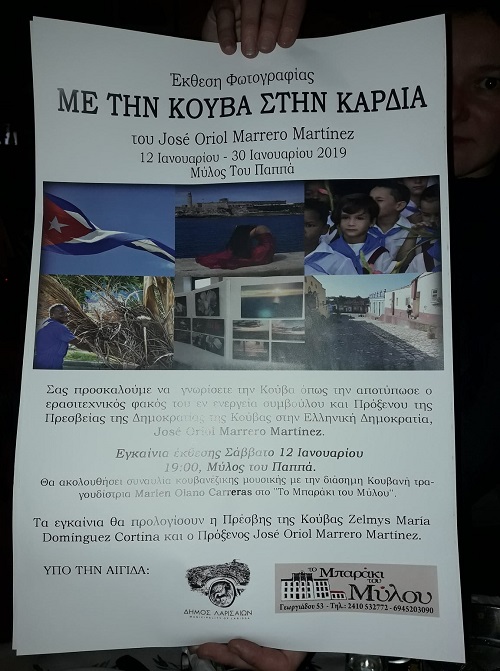
(Taken from Facebook Oriol Marrero, counselor of the Embassy of Cuba in Greece)
NINTH part: "With Cuba in the heart", Larisa, Thessaly, Greece. January 12, 2019.
I
Friends who went from the city of Larisa to Tríkala on the night of October 14, 2018 to attend the inauguration of the expo "With Cuba in the heart" in the Asclepios polis --as seen in the SEVENTH delivery--, there expressed interest in showing the expo in Larisa
Thus, on January 12, 2019 "With Cuba in the heart" was inaugurated in the well-known gallery "Milos tu papa" of Larisa, capital of Thessaly, after the words of welcome by the mayor of the city, and the greeting of the Ambassador of Cuba in Greece. During the presentation, as usual, there were spontaneous questions, answers, and a substantive exchange about Cuba.
Also present were representatives of numerous political forces and society in general, Cuban compatriots residing in Larisa and the neighboring city of Volos, with their Cuban-Greek families.
The Cuban artist residing in Greece Marlen Olano offered an unforgettable artistic presentation that lasted for several hours, with an excellent reception, in a Larisa frozen outside, but surrounded by a warm brotherhood, contagious Cubanness and solidarity.
It was gratifying to witness how the same people who had gone to see the expo on Cuba in Tríkala, and who had proposed taking it to Larisa, joined from early hours and spontaneously to the assembly of the expo in their city, thus contributing decisively, supportive and detached, to materialize their proposal in this cultural action that further strengthened relations between the peoples of Cuba and Greece.
II
Larisa is located about 355 kilometers north of Athens, somewhat to the west. The region of which it is the capital, Thessaly, has cities such as Tríkala, Volos, Kalambaka or Meteora - known worldwide for its cliffs and monasteries built on the tip of the stone -, as well as the group of islands called Sporades.
Now, if Thessaly has in its demarcation a historical, geographical, and above all mythical reference of world knowledge, that is Mount Olympus, pantheon of the gods of Greek Olympus, with the god of gods Zeus in front, and with the highest elevation in Greece, second in the Balkan mountain range at 2,918 meters above sea level, surpassed by 6 meters by a mountain in Bulgaria.
Litojoro is the most typical, perhaps romantic and famous village at the base of the giant Mount Olympus.
From around that area was Christos Kakkalos, the Greek hunter who guided the -supposed- first expedition that crowned the top of Olympus, the Mytikos peak, on August 2, 1913, in the company of the Swiss Frédéric Boissonnas, photographer, and Daniel Baud-Bovy.
A Greek friend from Thessaly, a worker, a native of Litojoro, who knows about the story of “a Cuban flag on Olympus”, had the gesture of sending an excellent book containing photos taken by the Swiss photographer Frédéric Boissonnas when he first climbed once, with a camera, to Mount Olympus, just on August 2, 1913.
Mount Olympus and Mount Pinus separate Thessaly from Macedonia and northwestern Greece. The pluvial plain of Thessaly is considered the largest and richest in Greece.
The surrounding mountains in ancient times provided abundant resources for hunting, the cutting of wood for construction and the gathering of many fruits, yes, with a raw cold, due to the height, with heights of almost three kilometers above the level of the river. sea.
Several sources point out that in ancient history Thessaly was a relatively isolated region of Greece, for two reasons: because of its high mountains, which hampered relations with the outside, and because of the aforementioned natural wealth, which made possible the economic self-sustainability of these regions.
An agricultural economy and geography predetermined that to some extent Thessaly, as it appears, would not develop as a city-state or polis, without a marked urban life, but rather that market-cities would prosper, particularly in the case of Larissa, which was a hub for internal communications, benefiting from the fact that it was located at the confluence of the Europo and Peneo rivers, at the entrance to the famous Tempe valley.
In 352 a. Thessaly was conquered by Philip II of Macedonia. From 146 a. C. was a Roman province. During the Byzantine period it suffered raids from the Goths, Huns, Slavs, Bulgarians and Normans.
After the taking of Constantinople by the Franks in 1204 it was in the hands of the Venetians, Boniface of Momferato, the lordship of Épiro, the Nicene Empire and the Byzantines. In 1420 it was invaded by the Turks. In 1881 it joined Greece.
A distinctive feature of Thessaly since ancient times - not very common in Greece, whose surface is 80% mountainous - is horse breeding, which seems to be objectively related to its plains, which made it possible for this region to carefully promote and Equine livestock fame, although essentially these were raised only for fighting.
The Thessalian cavalry was a powerful weapon, as was the “mambisa” cavalry (Note: Cuban fighters for independence at the XIX century were named mambises), Ignacio Agramonte's in the fight against the foreign invader, as was put to the test in the rescue of Brigadier Sanguily, and in other Cuban “machete” charges (Note:machete was a kind of sword or big knife, that was used to cut the sugar cane and it was the main weapon used by mambises). The soul of a cavalry that will not die, be other steeds and horsemen today.
So during some battles in Greek antiquity the Thessalian cavalry was famous, feared, and powerful. The Athenian, Spartan, Macedonian phalanxes, the Sacred Battalion of Thebes, or the cavalry of Thessaly, among other formations, were renowned military bodies in the art of combat of ancient Greece, as were also "the Persian immortals", or the archers.
It is particularly said that the two thousand horsemen commanded by Alexander the Great in the crucial Battle of Queronea in August 338 BC. - his first combative action of him, at the age of 18, led by his father, King Philip II of Macedonia - they were precisely horsemen of the fearsome Thessalian cavalry.
Like the Persian king Darius I in 480 BC, the forces of Philip II of Macedonia had “descended” from Thessaly towards Queronea through the pass of the Thermopylae Gorge, the same site where Leonidas of Sparta would star 142 years earlier in the epic feat. of his resistance until death, immortalized by Martí in his 1889 speech dedicated to Heredia.
Right on the plate where the heroic resistance of the Greeks against the Persians in Thermopylae is remembered and immortalized this epitaph is inscribed: "Tell the Lacedomonians, traveler, that fulfilling his orders, here we lie."
III
Marti's approaches to this Greek region now allow nothing more than to pass pointing "over the summits of the mountain range."
Martí would be deeply inspired by the struggles for the independence of Greece, evoking death if necessary, it is a fact, as it is that Martí drank not only from the enriching Greek culture, from its artistic, sculptural, architectural, literary traditions, from his famous tragedies and renowned works. He actually studied the Greek language, and translated some poems from Greek into Spanish.
It is known that the most universal of Cubans died in combat, died a soldier, and also, died in combat being a writer with a classic work, a poet with a classic work, an artist, a translator, a diplomat. It was the light of the light of his time, and of his era, of his Nation, and not only. He gave his life when he was 42 years old. It's not about words. It is about offering life to freedom and independence. "Everything on fire," he said in 1889, "even art, to feed the bonfire!" And he wonders: "What does the artist live on but on the feelings of the homeland?"
On May 25, 1892, already immersed in the preparation of the war for Cuban independence that would break out three years later, José Martí made an important reference to the struggle of the Greek patriots in Missolonghi, in his article “The clubs”, published in the newspaper Patria, in which he praised the example of struggle and the heroic resistance of the Greeks in Missolonghi, and placed this example as a paradigm for future battles in Cuba, which he expressed in these terms:
“We have for the fatherland, for our holy flame pure patriotism, for example, the deeds of our parents, of those sublime men who abandoned all the comforts and pleasures of the universe to show the world how a people dies who aspires to reach the steps of the august capitol of freedom”.
And it will add with full resolution:
“We will work… without truce or rest; and if the enemy asks us to surrender, we will throw Cambrone's phrase in his face; and if we fall, we will exclaim like the Greek patriot in Misolonghi: “Tyrant, here you will find the Cuban dead but not a slave. Dulce et decorum est pro patria mori ”(end of quote).
That is to say, he also said it in Latin: "It is sweet and honorable to die for the country."
Apparently, Martí would take as a reference for Cuba's struggles, among others, the response of the Greek patriots in Missolonghi to the demand for surrender formulated by the besiegers - Ottomans - who would have demanded that they unconditionally hand over the keys to the city. And the answer was clear:
"The keys to the city hang from the end of our cannons"; "We will die, but we will not surrender."
José Martí mentioned Tesalia at least twice in his Complete Works, and three times in his translations.
During his studies at the Literary University of Zaragoza, Spain, he will note the word Thessaly as part of the geographical structure of Greece at that time. And in 1888 he will write that "in the same United States Bryant sings to Thessaly."
And in his translations of the work Greek Antiquities Thessaly will appear cited together with Laconia when it is said that the defeated primitive peoples lived there in laborious servitude, whose children were miserable servants assigned to the earth as a mere part of it; who survived with the products of the land, in addition to paying the owner increased rent. And it appears that, "in Thessaly these deer were called penestas."
On the other hand, the content of Marti's mentions of Mount Olympus, Olympus, is so important and enriching, since the Apostle said "Olympus" that it will require another space. Hopefully it is, after placing the deserved plaque in his memory, "on Olympus."
Thanks Larisa. And to you, for reading.


