
Cuba: The world’s longest siege
. . . how US turned an economic blockade into a military stranglehold
Mafa Kwanisai Mafa (Coordinator of Fidel Castro Chair, The Patriot)
Decolonising the Mind
IN 2026, what had long been described as an economic blockade against Cuba crossed a dangerous threshold and assumed an openly military character.
Oil tankers were seized in the Caribbean in rapid succession, millions of barrels of fuel were confiscated, and one vessel was taken despite not being under any formal sanctions regime.
The scale of the operation marked the largest US naval deployment in the region since the Cuban Missile Crisis of 1962.
Surveillance drones monitored tanker routes from Mexico, while a sweeping executive order threatened punitive tariffs against any country on earth that dared to sell Cuba a single barrel of oil.
Under this pressure, Mexico, facing nearly US$4 billion in trade exposure to the United States, halted shipments. Venezuela’s already strained supply lines were neutralised by force.
No alternative supplier was willing to risk retaliation, seizures, or financial ruin.
The consequences inside Cuba were immediate and devastating. Daily power cuts stretched up to 20 hours. Hospitals ran on emergency generators while diesel supplies dwindled. Families cooked with firewood as fuel disappeared from the formal economy. These were not unintended side effects of policy miscalculation.
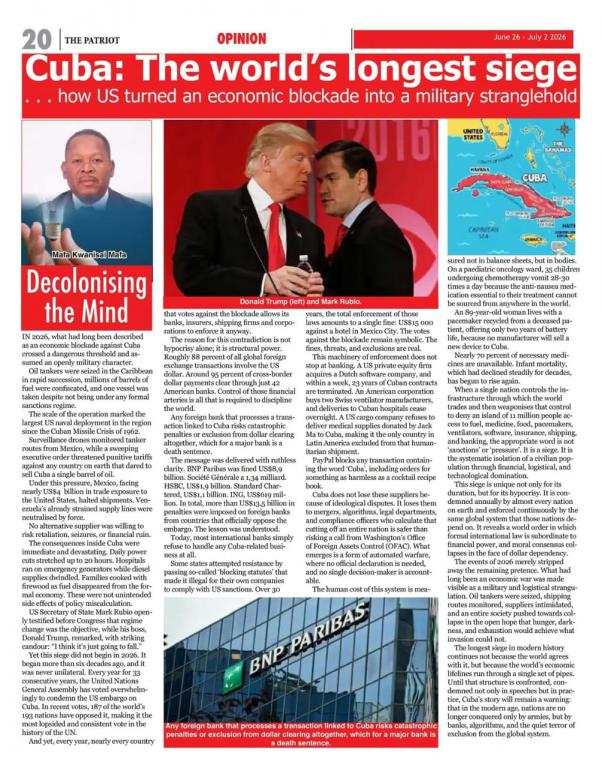
US Secretary of State Mark Rubio openly testified before Congress that regime change was the objective, while his boss, Donald Trump, remarked, with striking candour: “I think it’s just going to fall.”
Yet this siege did not begin in 2026. It began more than six decades ago, and it was never unilateral. Every year for 33 consecutive years, the United Nations General Assembly has voted overwhelmingly to condemn the US embargo on Cuba. In recent votes, 187 of the world’s 193 nations have opposed it, making it the most lopsided and consistent vote in the history of the UN.
And yet, every year, nearly every country Donald Trump (left) and Mark Rubio. years, the total enforcement of those laws amounts to a single fine: US$15 000 against a hotel in Mexico City. The votes against the blockade remain symbolic. The fines, threats, and exclusions are real.
This machinery of enforcement does not stop at banking. A US private equity firm acquires a Dutch software company, and within a week, 23 years of Cuban contracts are terminated. An American corporation that votes against the blockade allows its banks, insurers, shipping firms and corporations to enforce it anyway.
The reason for this contradiction is not hypocrisy alone; it is structural power. Roughly 88 percent of all global foreign exchange transactions involve the US dollar. Around 95 percent of cross-border dollar payments clear through just 42 American banks. Control of those financial arteries is all that is required to discipline the world.
Any foreign bank that processes a transaction linked to Cuba risks catastrophic penalties or exclusion from dollar clearing altogether, which for a major bank is a death sentence.
The message was delivered with ruthless clarity. BNP Paribas was fined US$8,9 billion. Société Générale a 1,34 milliard. HSBC, US$1,9 billion. Standard Chartered, US$1,1 billion. ING, US$619 million. In total, more than US$13,5 billion in penalties were imposed on foreign banks from countries that officially oppose the embargo. The lesson was understood.
Today, most international banks simply refuse to handle any Cuba-related business at all.
Some states attempted resistance by passing so-called ‘blocking statutes’ that made it illegal for their own companies to comply with US sanctions. Over 30 buys two Swiss ventilator manufacturers, and deliveries to Cuban hospitals cease overnight. A US cargo company refuses to deliver medical supplies donated by Jack Ma to Cuba, making it the only country in Latin America excluded from that humanitarian shipment.
PayPal blocks any transaction containing the word ‘Cuba’, including orders for something as harmless as a cocktail recipe book.
Cuba does not lose these suppliers because of ideological disputes. It loses them to mergers, algorithms, legal departments, and compliance officers who calculate that cutting off an entire nation is safer than risking a call from Washington’s Office of Foreign Assets Control (OFAC). What emerges is a form of automated warfare, where no official declaration is needed, and no single decision-maker is accountable.
The human cost of this system is meaAny foreign bank that processes a transaction linked to Cuba risks catastrophic penalties or exclusion from dollar clearing altogether, which for a major bank is a death sentence. sured not in balance sheets, but in bodies. On a paediatric oncology ward, 35 children undergoing chemotherapy vomit 28-30 times a day because the anti-nausea medication essential to their treatment cannot be sourced from anywhere in the world.
An 89-year-old woman lives with a pacemaker recycled from a deceased patient, offering only two years of battery life, because no manufacturer will sell a new device to Cuba.
Nearly 70 percent of necessary medicines are unavailable. Infant mortality, which had declined steadily for decades, has begun to rise again.
When a single nation controls the infrastructure through which the world trades and then weaponises that control to deny an island of 11 million people access to fuel, medicine, food, pacemakers, ventilators, software, insurance, shipping, and banking, the appropriate word is not ‘sanctions’ or ‘pressure’. It is a siege. It is the systematic isolation of a civilian population through financial, logistical, and technological domination.
This siege is unique not only for its duration, but for its hypocrisy. It is condemned annually by almost every nation on earth and enforced continuously by the same global system that those nations depend on. It reveals a world order in which formal international law is subordinate to financial power, and moral consensus collapses in the face of dollar dependency.
The events of 2026 merely stripped away the remaining pretence. What had long been an economic war was made visible as a military and logistical strangulation. Oil tankers were seized, shipping routes monitored, suppliers intimidated, and an entire society pushed towards collapse in the open hope that hunger, darkness, and exhaustion would achieve what invasion could not.
The longest siege in modern history continues not because the world agrees with it, but because the world’s economic lifelines run through a single set of pipes. Until that structure is confronted, condemned not only in speeches but in practice, Cuba’s story will remain a warning: that in the modern age, nations are no longer conquered only by armies, but by banks, algorithms, and the quiet terror of exclusion from the global system.