
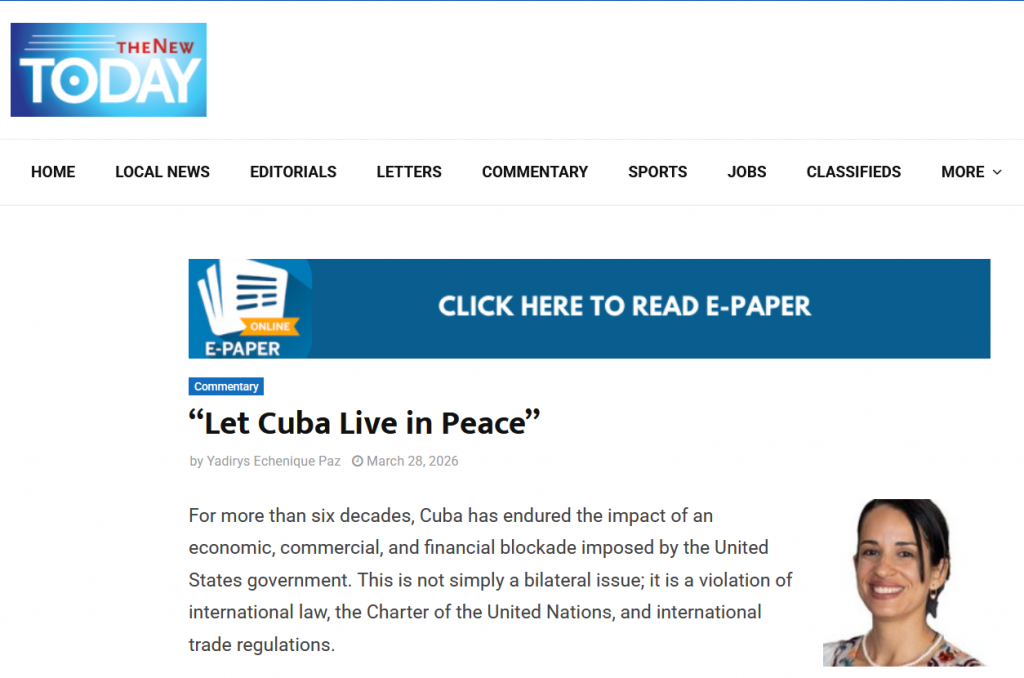
The Grenadian newspaper The New Today recently published an article by the Cuban ambassador to Grenada, Yadirys Echenique Paz, denouncing the effects of the economic, commercial, and financial blockade imposed by the United States against the island. The diplomat outlined the consequences of this hostile policy on the daily lives of Cubans and called on the international community not to remain indifferent.
In her remarks, the ambassador recalled that the blockade is not only a bilateral issue but also a violation of international law and the Charter of the United Nations. She quoted the words of Lester D. Mallory, a US official who in 1960 openly acknowledged that Washington's objective was "to provoke hunger, desperation, and the overthrow of the Cuban government."
The Cuban representative emphasized that this strategy, conceived during the height of the Cold War, remains in place and has been refined with new measures. She pointed out that the initial purpose remains to economically strangle the country while constructing a narrative that blames the Cuban government for the shortages caused by the blockade itself.
Referring to the new specificities of the political-legal framework behind the blockade, Echenique Paz wrote that “the executive order issued by President Donald Trump on January 29, 2026, threatens to impose punitive tariffs on countries that attempt to supply oil to Cuba, establishing a total energy blockade designed to subdue an entire population through hunger.” This measure directly affects food transportation, the operation of hospitals and schools, and forces families to endure long hours without electricity, the diplomat added.
In her article, the Cuban official also reiterated that Cuba poses no threat whatsoever to the security of the United States and that it is a nation of peace that defends multilateralism and cooperation among peoples. “Our call is simple: that Cuba may live in peace,” the Cuban representative concluded.