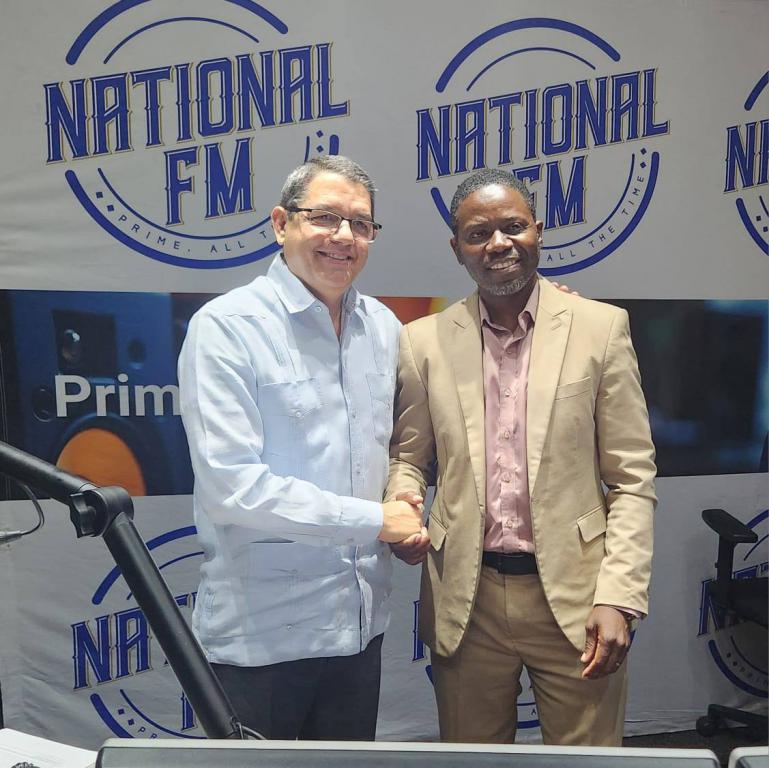
National FM, the Namibia Broadcasting Corporation (NBC) station, conducted a live interview with Ambassador Sergio Vigoa de la Uz for its morning program "9th Hour", in which they discussed issues related to the escalating US government policy against Cuba.
The Cuban diplomat denounced that Cuba's current economic situation is the acumulation of 66 years of US blockade and has been exacerbated by Donald Trump's latest presidential decree imposing tariffs on countries that attempt to supply fuel and its derivatives to Cuba.
“For any country's economy, large or small, fuel is vital to its functioning. In the case of Cuba, where electricity generation depends fundamentally on fuel, the lack of fuel makes it impossible to generate electricity, causing many hours of blackouts and the unstable operation of industries, hospitals, schools, solid waste collection, the pumping of drinking water to the population, and the production of manufactured gas for cooking,” he explained.
Vigoa de la Uz pointed out that this situation affects important sectors that guarantee the inflow of foreign currency to cover purchases in the international market, as well as the arrival of tourists to Cuba during the country's peak tourist season. “Many airlines have had to interrupt their flights or make unscheduled stops in nearby countries to obtain fuel.
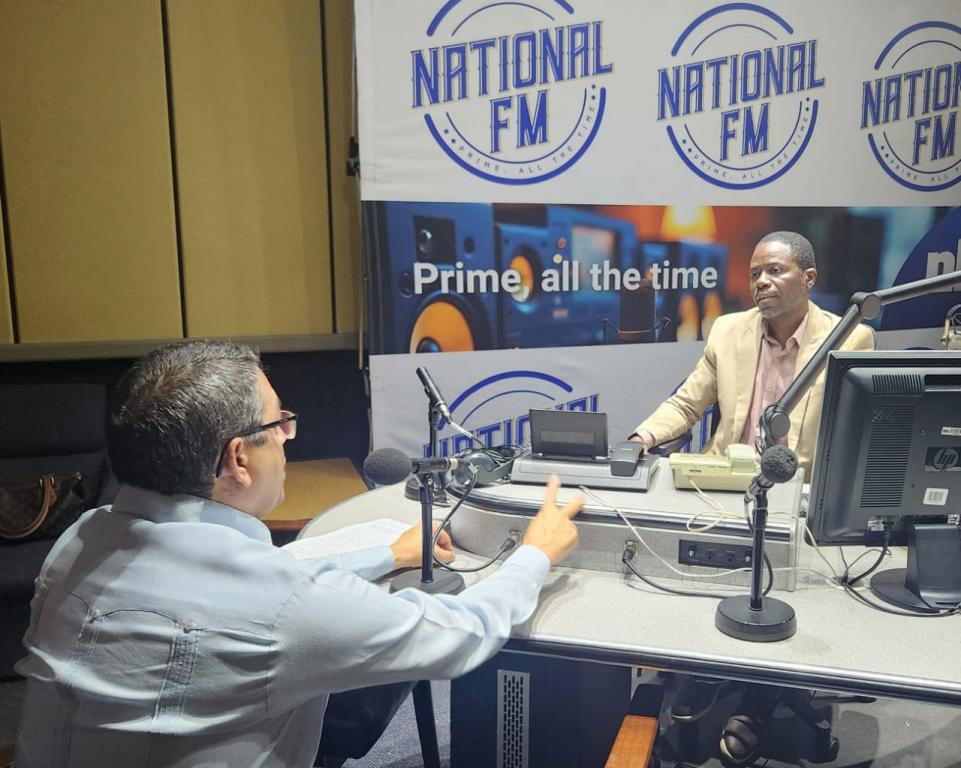
It is a very delicate situation that has a devastating effect on the Cuban population because it doesn't manifest itself in indiscriminate bombings, but we could categorize it as a silent genocide,” he asserted.
When asked by a journalist how he characterized Donald Trump's position of labeling Cuba a "failed nation," the ambassador commented that his statements and threats go against international logic and international law.
"If Cuba were truly a failed nation, what need would there be to subject it to constant pressure to try to strangle its economy? One could not speak of a failed nation if, despite more than 66 years of a rigid economic, financial, and commercial blockade, Cuba maintains social, health, education, sports, and cultural indicators similar to, and in some cases superior to, those of the United States."
“How can you talk about a failed state that is capable of sending thousands of healthcare workers to provide services in more than 60 countries around the world, as it is doing today in Namibia? I think the President of the United States should focus on the many problems he has internally in his country and let Cuba live in peace,” he pointed out.
The NationalL FM journalist inquired about the possibility of a real space for negotiation with the United States and, if so, under what terms a constructive dialogue could take place. The diplomat responded that Cuba has always stated for respectful dialogue with its northern neighbor on issues such as orderly and legal immigration between the two countries, the fight against drug trafficking, international crime in the region, the joint response to natural disasters that affect us, air and maritime security, and others.
“The only condition is that it be between equals and that Cuba’s sovereignty be respected, along with its will to develop a social system chosen by the vast majority of the Cuban people, who reaffirmed this in the approval of the new constitution in 2019 with almost 87% of the votes cast. Our sovereignty is a precious asset that Cubans have known how to defend for many years. That is the only way there could be a dialogue: respectful and constructive,” Vigoa de la Uz asserted.
The ambassador explained that the current situation the Cuban people are suffering is fundamentally a result of the United States’ hostile policy toward Cuba since the very triumph of the Revolution, and as early as 1960 when an Sub Secretary of State drafted a memorandum stating that the way to overthrow the Cuban government was by strangling its economy and, consequently, its population.
“It is impossible to think that a small island, without significant material resources, possessing no nuclear weapons or strategic offensive military capabilities, and lacking an official doctrine of confrontation with the United States, could pose a threat to that power. In reality, this declaration of a national emergency is a fallacious argument intended to justify aggression against Cuba.
The Cuban diplomat thanked the Namibian people and government for their unwavering solidarity with Cuba. “We have always had Namibia’s voice in the main regional and international forums, demanding an end to the U.S. blockade and denouncing its impact on the lives of Cubans.”
“We assure you that once again the resilience and dignity of our people will defeat the intentions of the United States government to break our will to build, in peace, the country we have chosen,” he concluded.