
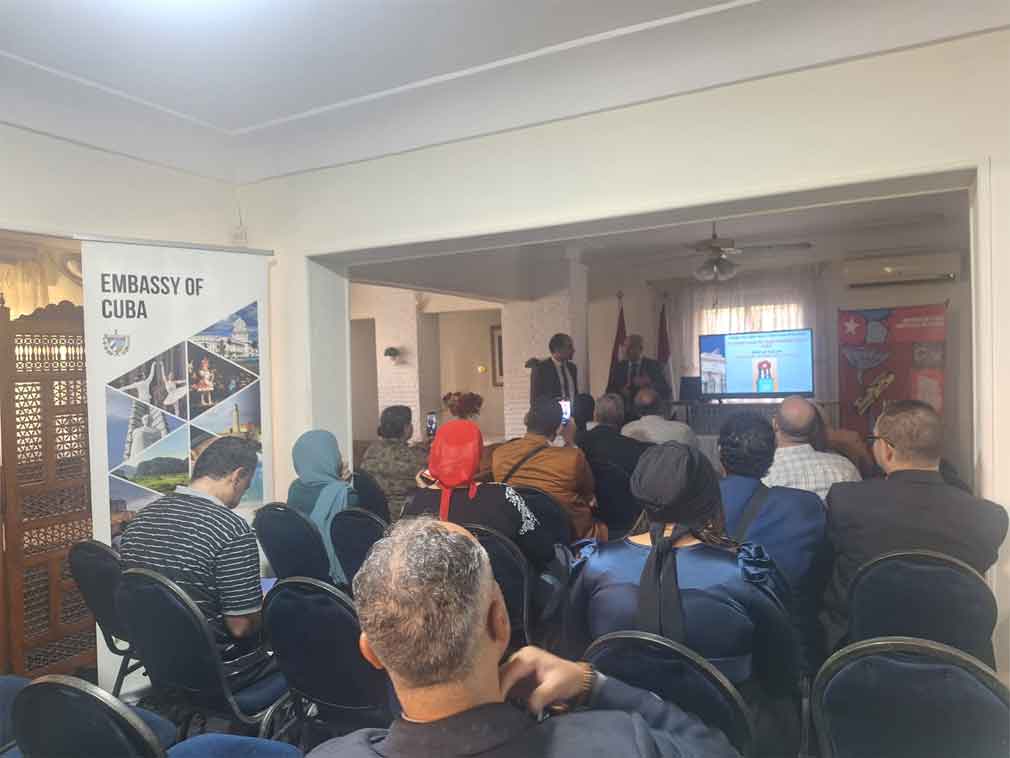
Cairo, October 22, 2025. The financial, economic, and commercial blockade imposed by the United States for more than 60 years is the main obstacle to Cuba's development, denounced Alexander Pellicer Moraga, the island's ambassador to Egypt, today.
This punitive measure is the basis of the policy of maximum pressure adopted by Washington against the Caribbean country to affect its economy and generate internal discontent, Pellicer said during a press conference in this capital attended by more than a dozen representatives of the Egyptian media.
The diplomat pointed out that the siege against Cuba violates international law and the United Nations Charter, as well as global norms on trade and the human rights of a nation.
It also infringes on the sovereignty of third countries due to its extraterritorial actions and the constitutional rights of the American people by preventing them from visiting the island, he stressed.
At current prices, the cumulative damage caused by more than six decades of blockade amounts to more than $170.677 billion, equivalent to $2.1 trillion at the value of gold, he said.
Pellicer explained that from March 1 of last year to February 28 of this year alone, losses amounted to more than $7.5 billion, an increase of 49 percent compared to the previous period.
The U.S. blockade has a real and permanent impact on the Cuban population, the diplomat stressed, citing as examples the damage to sectors such as health, education, and food.
In this regard, he explained that, due to these sanctions, the island cannot acquire health technology and medicines from that country or equipment from other latitudes with more than 10 percent U.S. components.
It also prevents or hinders our access to fertilizers, fuel, machinery, and other agricultural technologies, he noted.
Pellicer explained that Havana is also unable to conduct transactions in US dollars or access loans from international organizations controlled by Washington, such as the International Monetary Fund and the World Bank.
He noted that since 1992, the international community has overwhelmingly supported a resolution presented by Cuba to the UN General Assembly condemning the blockade.
In 2025, the initiative was backed by 187 nations and rejected only by the United States and Israel, he said.
The blockade represents an extraterritorial, coercive, and unilateral policy that violates international law and UN principles, he stressed.
It also undermines the rights of Cubans to peace, development, and self-determination, he concluded. (Embacuba Egipto/Prensa Latina)