
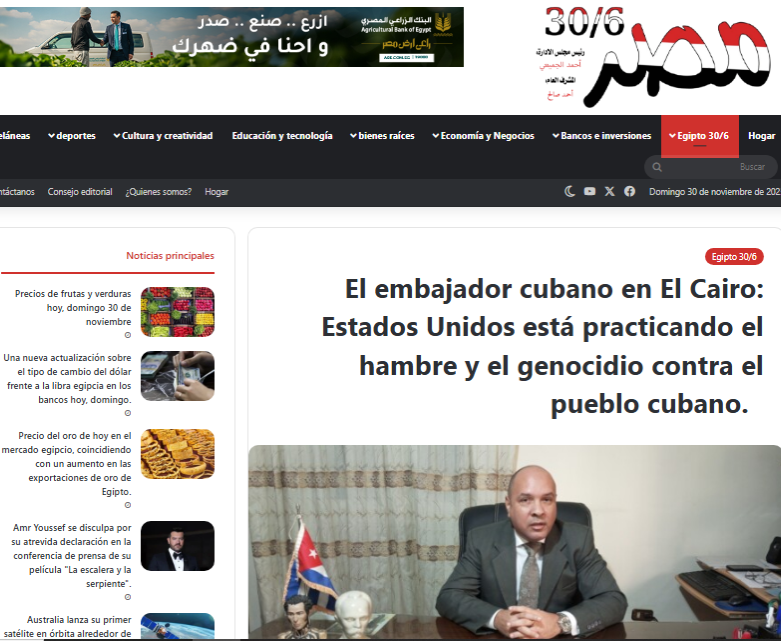
Cairo, November 30, 2025. In an exclusive interview with the Egyptian newspaper Misr 30/6, the Cuban Ambassador to Egypt denounced the aggressive policy of the United States against his country and Latin America and the Caribbean.
He also addressed the historic relations of friendship and cooperation between Cuba and Egypt and the situation in Palestine and the Middle East region.
The interview is reproduced in full below:
What can you tell us about bilateral relations between Egypt and Cuba?
Cuba and Egypt have maintained historic relations of friendship and cooperation for more than 75 years. Egypt was the first Arab and African country to establish diplomatic relations with Cuba on September 5, 1949.
Since then, relations have been maintained without interruption. Throughout these years of relations, the close friendship established between Cuban leader Fidel Castro Ruz and Egyptian President Gamal Abdel Nasser, two of the greatest statesmen of the 20th century, stands out.
Egypt and Cuba are two peace-loving countries and maintain a high degree of agreement in their views on the main issues on the international agenda. This is especially true with regard to support for the Palestinian people's cause to create their independent and sovereign state and live in peace.
Both countries are founding members of the Non-Aligned Movement and both countries have held the presidency of the Movement, which promotes political cooperation among the countries of the South in defense of their rights.
Egypt has maintained its unconditional support for the Cuban resolution against the blockade imposed by the United States, which is presented every year at the UN General Assembly. I would like to take this opportunity to thank the Egyptian government for its solidarity with the Cuban people on this important issue for Cuba.
What are the main areas of cooperation between the two countries?
Unfortunately, the level of our economic and trade relations is not on par with the political and diplomatic relations between our nations.
However, there is political will and interest on the part of both governments to work on developing and strengthening economic and trade relations in areas of common interest. These include the health sector and the biopharmaceutical industry, which has great potential for development thanks to Cuba's advances in research and the creation of new medicines, and Egypt's progress in the production of large volumes of medicines.
An example of both countries' interest in developing relations in the health sector has been the exchange of visits between the health ministers of both countries over the last two years.
Other areas of cooperation include culture, sports, and agriculture.
How would you describe the political and economic situation in the Republic of Cuba?
The political situation in Cuba is stable, with a democratically elected government that has the support of the majority of the Cuban population.
However, the country is experiencing difficult economic, commercial, and financial conditions due to the intensification of the blockade and sanctions imposed by the United States. The measures implemented by the Trump administration are aimed at persecuting and obstructing all sources of financing that Cuba receives, including remittances that Cuban citizens send from the United States to their relatives in Cuba, tourism to the island, and income from medical services exports, among others.
Similarly, there is a strong campaign to limit Cuba's access to fuel supplies, which are essential for electricity generation and the normal functioning of the Cuban economy.
The objective of this criminal and genocidal policy is to cause shortages of all kinds, hunger, and disease among the Cuban people and to create popular discontent in order to provoke social unrest that would justify intervention in Cuba. The opinion matrices generated by social media and the main US information operators are aimed at blaming the current economic crisis on the socialist system in Cuba and the inefficiency of the government, which is false.
How have the Cuban government and people managed to overcome the aggression, blockade, and economic sanctions imposed by the United States?
For more than 60 years of blockade, we have worked with friendly countries to develop our economy and improve the living conditions of our population. Cuba's great advances in health, education, sports, culture, and scientific research are well known.
The country continues to implement plans to continue developing even amid the harsh conditions imposed by the blockade. These include increasing foreign investment in key areas such as tourism, agriculture, and biotechnology, among others.
However, the blockade imposed by the United States remains the main obstacle to further economic and social development in Cuba.
Why do you think the United States tries to intervene in Cuba's internal affairs?
The United States' desires regarding Cuba have been known since even before that country became an independent nation in 1776. Cuba occupies a strategic location in the Caribbean Sea as a point of connection between North America, South America, and Central America, in addition to its natural beauty and special conditions for developing agriculture and tourism.
This American dream came true in 1898 when they opportunistically intervened in the war between Cuban rebels and Spain. This intervention led to the invasion of Cuba by the US army, which remained in Cuba until 1902 after imposing as a condition for its withdrawal the introduction of the Platt Amendment into the new Cuban Constitution, which limited our sovereignty by granting the United States the right to intervene on the island whenever it deemed appropriate. For the next 57 years, the United States exercised almost absolute control over Cuba's political and economic life, turning it into a neocolony.
With the triumph of the Revolution in 1959, led by Fidel Castro, this domination over Cuba came to an end and Cubans began to be truly free, sovereign, and independent. The United States has never forgiven Cuba for being a sovereign and independent nation and continues to attack it with the aim of regaining the dominance it once had over the island.
What is your opinion of the current US administration?
It is an arrogant and overbearing administration that seeks to impose its interests through force and blackmail. They lack the moral authority to condemn others on issues such as democracy, freedoms, and human rights.
This administration is a real danger to international peace and security. Today, they are threatening to attack a country like Venezuela with falsehoods and with the sole aim of overthrowing President Maduro and seizing the oil and many other natural resources that this South American country possesses.
What is your view on international organizations such as the Security Council and the UN? Do you think we need alternative organizations?
I believe they are necessary organizations, but they must be democratized, especially the Security Council and the use of the veto. The Security Council must be expanded, and that includes the permanent members, which today number only five. There must be representatives from Africa, Latin America, the Arab world, and Asia. I believe that if this goal is achieved, alternative organizations would not be necessary.
What is your opinion on the veto power and the hegemony of certain countries that use it for their own benefit?
The world has changed a lot since the creation of the UN and the Security Council, which included the five victorious countries of the time and granted them permanent membership and the right to veto, which served a very important function. However, today the Security Council and the UN are unable to maintain international peace and security, among other reasons because of the existence of the veto. I cite as an example the United States' use of the veto on several occasions to block a ceasefire in Gaza and stop the genocide against the Palestinian people.
I believe that the veto should not exist as a privilege of a few over the vast majority of countries and that decisions should be made in the UN General Assembly, where all the nations of the world are represented with equal voting rights and opinions.
What do you think of BRICS? Could it be an alternative to current multilateral institutions?
BRICS is a very important group, especially from an economic point of view. Its actions could bring balance and equilibrium to the multipolar world that is taking shape. Given its nature and the number of members it has, I don't think it could become an alternative to current multilateral institutions, at least in the short or medium term.
What is your view of the geopolitical situation in the Middle East region?
The situation in the region is extremely complex and dangerous, especially because Israel is acting with great impunity, violating all the rules established by the United Nations Charter and international law. Its incursions into Gaza, Lebanon, Syria, Yemen, and Iran prove this. Even despite the ceasefire for Gaza, signed last month in Sharm El Sheik, Israel has repeatedly violated it, causing more than 300 deaths.
I would like to highlight the role played by Egypt in the search for a negotiated solution to the crimes committed by Israel in Gaza, and the support it has provided to hundreds of thousands of Palestinian refugees and refugees from other countries in the region that are also in conflict, such as Sudan, Libya, Syria, and Yemen.
I believe that the greatest challenge for the countries in the region is to stop Israel and its aggressive and expansionist policies that threaten peace and security throughout the region. Similarly, the creation of a sovereign and independent Palestinian state is another major challenge, because until the conflict between Israelis and Palestinians is resolved, there will be no peace or stability in the Middle East region.
What role does the United States play in current world affairs?
The United States is the world's leading political, economic, and military power and has a great deal of influence over other nations, which means it plays a decisive role in everything that happens in the world, whether it be seeking peace in a conflict or unleashing a war.
Regarding the Palestinian cause, how do you view the nature of the conflict today?
It is a very unequal conflict in which the Palestinians suffer the worst, with the daily violation of their fundamental rights and the extermination and displacement of their population, coupled with the loss of their territory every day.
However, there is growing international solidarity with the cause of the Palestinian people and their right to self-determination and to have their own sovereign and independent state within the pre-1967 borders.
The international community must continue to press for a solution to the conflict and put an end to so many years of suffering by the noble Palestinian people.
With your extensive experience in the Arab world, do you think Israel will be able to achieve its goals of annihilating and displacing the Palestinians, as well as expanding its territory over Arab lands?
I don't believe Israel will achieve its goals of annihilating and displacing the Palestinians, but I am sure it will continue to try, and in the meantime it will cause the Palestinians a great deal of suffering. I am sure they will continue to resist and fight for their rights until the end of time.
Do you think that current circumstances are favorable for an expansion or resurgence of socialist thinking? Why?
The world needs change if we want to survive as a species. The capitalist system that currently prevails in the world, based on irrational consumerism, only leads to the destruction of the planet. We need to create a system that is more supportive, fair, and friendly to nature and our planet.
It is obvious that socialism could be the alternative, but this requires a level of awareness that human beings have not yet achieved, as the most basic human instincts, such as the ambition for wealth and power, continue to prevail.
Why do the Cuban people hold leader Gamal Abdel Nasser in such high regard?
Nasser was a great leader of our time who embodied the noblest values of humanity. His thinking was revolutionary, and he focused on the welfare of the most needy and vulnerable people. That was the very meaning of the Cuban Revolution in 1959, which is why we Cuban revolutionaries immediately identified with Nasser and his ideas, which were a source of hope for many peoples around the world, especially those under colonial rule and exploitation by the powerful. (Embacuba Egipto/Misr 30/6)