
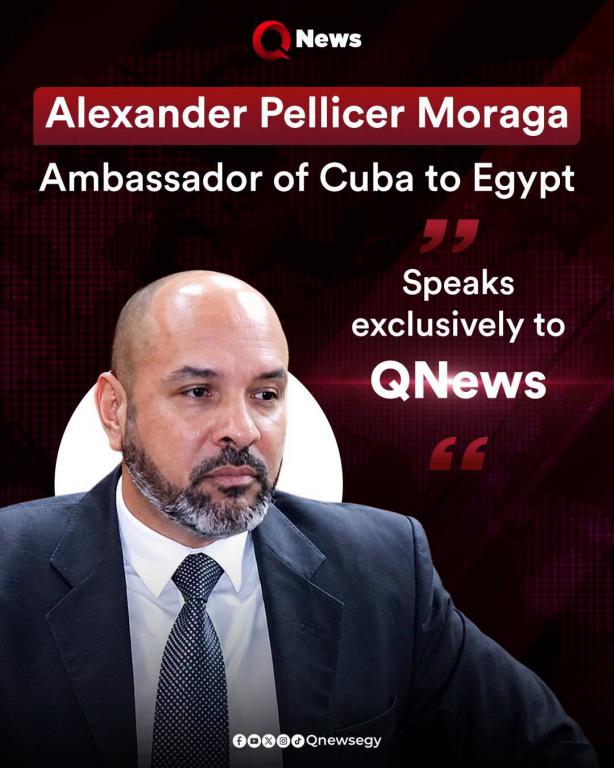
Cairo, July 29, 2026. The Cuban Ambassador to Egypt, Alexander Pellicer Moraga, granted an exclusive interview to Qajira News, in which he addressed issues of interest related to the situation in Cuba, its foreign policy, and relations with the United States.
The diplomat denounced the intensification of the blockade and the energy blockade, which are causing great suffering to the Cuban people. He also highlighted the Cuban people’s determination to resist and defend their independence and sovereignty to the very end.
The interview was published on July 22 on the Qajira News website in Arabic.
The full text of the interview is reproduced below:
• With the new Trump-friendly government in Colombia, it seems that Cuba is under pressure from the United States. What is your opinion on this?
Cuba has been under pressure from the United States since January 1, 1959, the day the Cuban Revolution triumphed. The United States has never supported the major political and social changes implemented in Cuba to help the most disadvantaged and benefit the entire Cuban people; the achievements of the Cuban Revolution in education, health care, sports, and scientific research are widely known.
What has happened in Colombia is a decision for the Colombian people; they have elected a new president, and time will tell whether they made a good choice or not. It is not Cuba’s place to judge what other countries do, in accordance with respect for the sovereignty and independence of states. Cuba will always be willing to engage in respectful dialogue and collaborate with all countries in the world, including those with governments that do not share our political ideology.
• Is Cuba preparing for possible actions by the United States? How are they doing so?
For many years, Cuba has been subjected to a cruel blockade that limits our economic and social development. In addition to this blockade, terrorist actions and assassination plots against Cuban leaders have been carried out; there are many examples of this. Cuba has been preparing for many years to confront the United States’ aggressive policy, including a military intervention. The Cuban defense doctrine is called “War of the Entire People,” which means that any Cuban man or woman willing to take up arms to defend the homeland may do so.
For several years now, Cuba has been carrying out a broad reform of its economic system, which includes greater openness to the private sector and foreign capital. These reforms are continuing and deepening with the aim of revitalizing our economy and overcoming the illegal blockade imposed on us.
• Does Cuba still have allies in Latin America, or does it feel isolated from Washington in the face of the rise of right-wing governments? Is it seeking support from other countries to protect itself?
Cuba’s most important allies in Latin America are the people of those countries; even in nations with right-wing governments, governments come and go but the people remain. Therefore, Cuba is not—and will not be—alone. At the governmental level, we maintain excellent relations with many governments, such as those of Mexico, Brazil, Venezuela, Uruguay, Nicaragua, and the Caribbean islands.
Cuba knows how to defend and protect itself, and we do not ask anyone else to do so. Obviously, we count on the political support of many governments around the world, for which we are infinitely grateful.
We are a nation committed to and a defender of peace, international law, multilateralism, truth, and justice. A people that has been fighting for its freedom and independence for more than 150 years—and that has written glorious chapters in history by standing firm against all attacks—will defend its independence and sovereignty to the bitter end. In the year marking the centennial of the historic leader of the Cuban Revolution, Commander-in-Chief Fidel Castro Ruz, and faithful to his legacy, the decision of the Cuban people will always be: Homeland or Death; We Shall Overcome.
• How does Cuba view the current situation, given the U.S. embargo?
The situation in Cuba is extremely difficult at the moment due to the intensification of the embargo and the oil blockade that prevents fuel from entering Cuba. In recent months, the humanitarian damage to our population has multiplied, with a deterioration in the quality of life, a reduction in sources of livelihood, limitations on the potential for personal, family, and social development, and the massive, flagrant, and systematic violation of the human rights of an entire people in an act of collective punishment. The U.S. government is waging a multidimensional, unconventional war that has lasted nearly seven decades and has become harsher and more ruthless over the past seven months.
Now added to this is the energy blockade—equivalent to a naval blockade—which constitutes an act of war. Access to fuel supplies for Cuba, whether commercial or humanitarian, is being prevented through direct threats, unilateral coercive actions, and even the harassment or intimidation of tankers by U.S. naval forces.
In addition to the economic, commercial, and financial blockade, there are unprecedented actions of an extremely extraterritorial nature, such as the use of secondary sanctions that follow the macabre plan to provoke a humanitarian crisis in Cuba and the total destabilization of the country, which would pave the way for or force the presidential order for an imperialist military intervention that would result in a bloodbath and massive losses of Cuban and American lives.
The damage caused by the blockade during the period from March 1, 2025, to February 28, 2026, at current prices, amounts to a record $8,083 million, 7% higher than the previous year. The cumulative impact since its inception totals $178,700 million at current prices.
The data confirms that this aggressive behavior does not represent the interests of the majority of U.S. citizens. According to a recently completed study, 98.3% of posts and comments on social media in the United States do not support the energy blockade, do not support the embargo, and do not support aggression against Cuba.
This genocidal and criminal policy stems from the anti-Cuban and revanchist whims of a tiny but powerful and influential segment concentrated primarily in southern Florida, yet capable of manipulating the U.S. political system and guiding the current administration’s actions.
• There are reports of electricity and gas shortages due to the crisis. How would you describe the actual situation within the country?
The shortages of electricity, water, and gas in Cuba are directly linked to the energy blockade—can any country survive without fuel? In the last six months, only one Russian oil tanker has been able to enter Cuba, which is completely insufficient for the country to function normally. Power outages can last for several days in some areas of the country; in Havana, they can reach 20 hours a day.
Cuban families—especially children, young people, and mothers—suffer from prolonged and unbearable blackouts or power cuts. Often, when there is no electricity, there is also no drinking water. The infant mortality rate, which was 4.0 per 1,000 live births, has risen to 9.9. This means the preventable deaths—under different circumstances, with access to appropriate equipment, devices, and treatments—of 1,780 newborns.
The number of people dying from cancer in the country has increased significantly. Among children and young people, the survival rate has fallen from 85% to 65%. This trend coincides with the harshest periods of the U.S. blockade. What the United States is doing today against Cuba is an act of genocide.
• Is there any possibility of negotiating or reaching agreements with the United States?
There are bilateral diplomatic talks proposed by the U.S. government and accepted by Cuba, in accordance with its tradition and foreign policy principles, with the sincere and constructive aim of trying to find a solution to bilateral differences. However, these talks have shown no progress, and it is unlikely they will make any if those leading them in Washington expect to treat Cuba as a defeated or conquered adversary, as a colonial possession, or as a territory over which the United States has jurisdiction and authority.
Cuba has always been willing to engage in dialogue to find a way to resolve our differences; we only ask that our sovereignty and independence be respected and that there be no pressure or conditions imposed.