
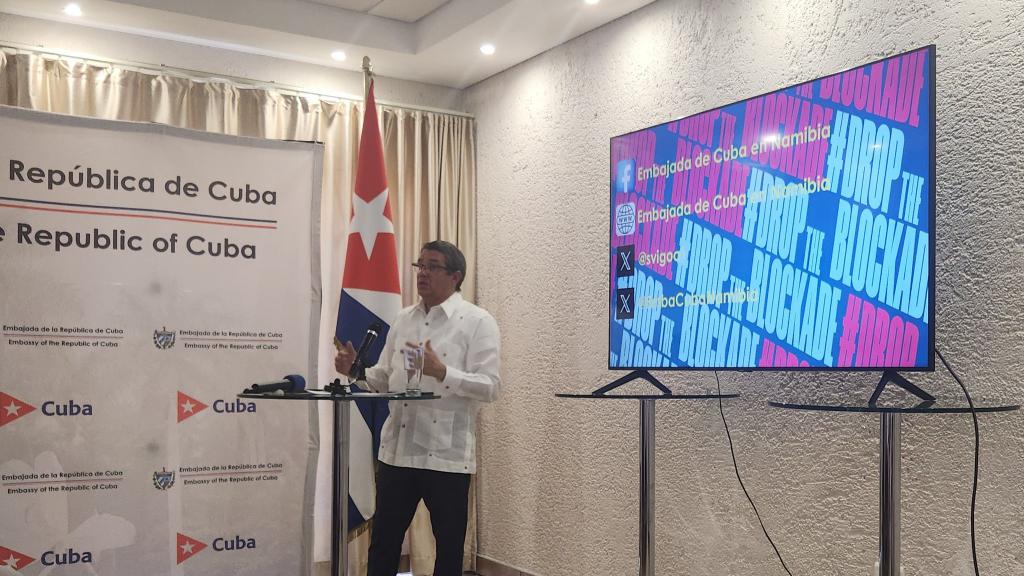
Ambassador Sergio Vigoa de la Uz presented the contents of Cuba's report pursuant to United Nations General Assembly Resolution 79/7, entitled "Necessity of ending the economic, commercial, and financial blockade imposed by the United States of America against Cuba," during a Press Conference held in Windhoek, attended by the country's leading media outlets.
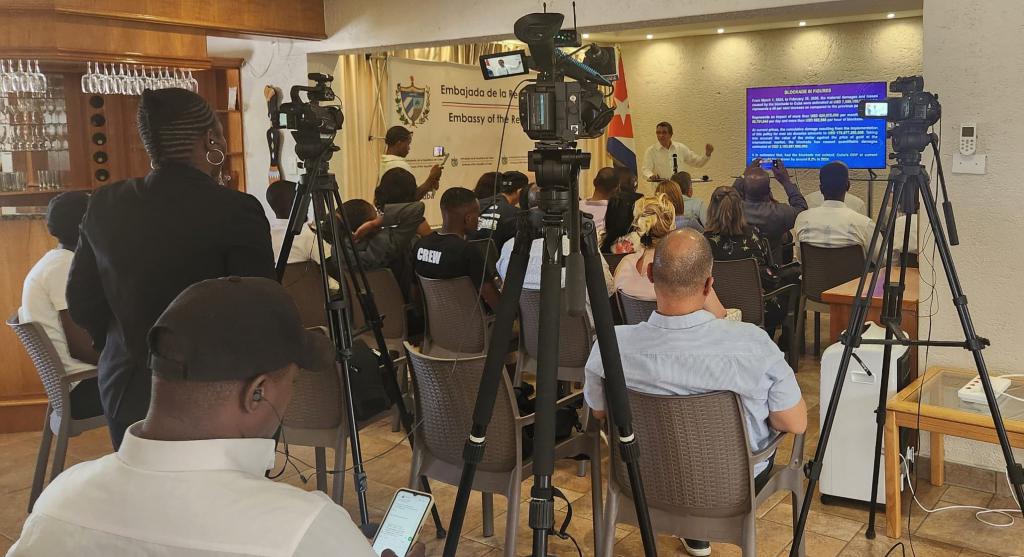
Along with the Venezuelan ambassador here, Magaly Henriquez, representatives from the Ministry of International Relations and Trade, and government institutions, the diplomat explained that the resolution will be presented to the General Assembly on October 28th, and a vote will be taken on the following October 29th.
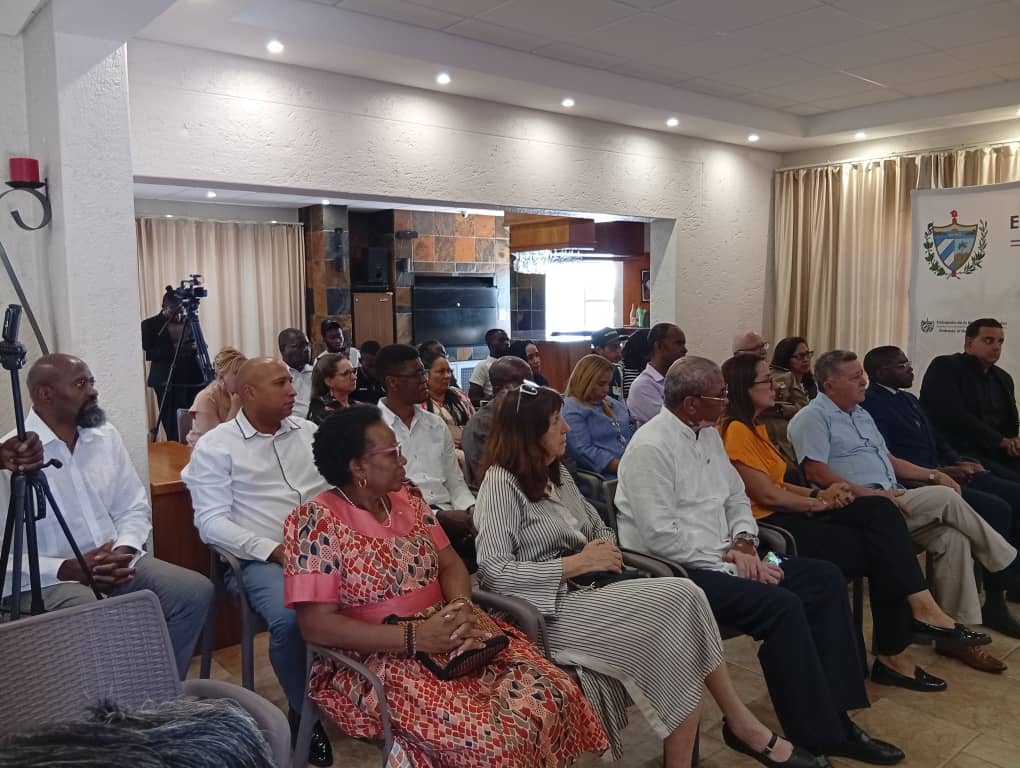
Vigoa de la Uz explained in detail the web of acts that underpin the nefarious blockade policy against Cuba, from the Trading with the Enemy Act of 1917, which included Cuba and is renewed year after year by all US presidents; through the Memorandum by Lester D. Mallory, Deputy Secretary of State and Assistant Secretary for Inter-American Affairs, issued on April 6th, 1960, which called for depriving Cuba of money and supplies; to the Trump administration's policies of maximum pressure and suffocation.
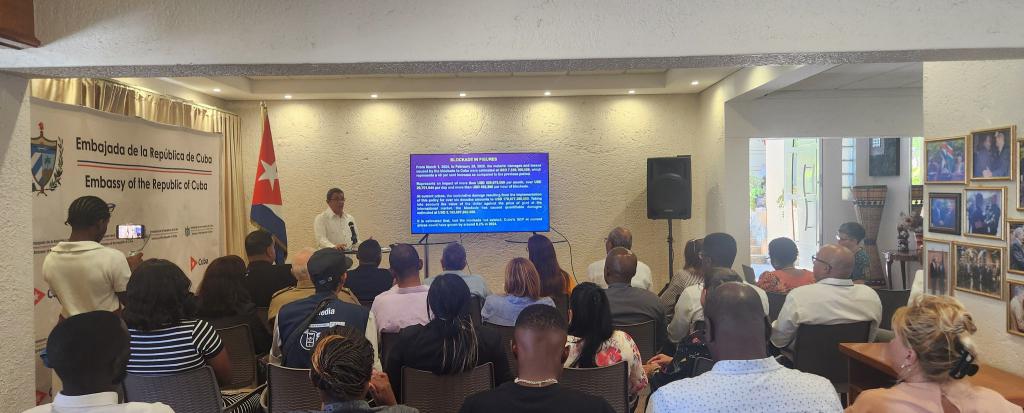
"It's a silent genocide," said the Cuban government representative in Namibia, who provided updated details of the blockade and denounced that from March 1st, 2024, to February 28th, 2025, the blockade caused material damages to Cuba, estimated at $7.5561 billion, representing a 49% increase compared to the previous period.
"All of this represents an approximate impact of more than $629,675,000 per month, more than $20,701,644 per day, and more than $862,568 in damages for each hour of the blockade," he noted.
Amid strong media interest, Vigoa de la Uz stated that, at current prices, the accumulated damages over more than six decades of this policy amount to $170,677.2 billion. Taking into account the dollar's performance against the value of gold on the international market, the blockade has caused quantifiable damages of more than $2 trillion.
The ambassador explained that the Trump administration has tried to suffocate our people, using new sanctions such as the reinstatement of Cuba to the list of alleged state sponsors of terrorism; the reactivation of Presidential Memorandum No. 5 of 2017, which restricts tourism, supports subversion, and enforces the blockade through the Helms-Burton Act; and the reactivation of Title III of this Act, which allows entities that invest in properties nationalized in Cuba after the triumph of the Revolution, including those belonging to Cuban citizens who subsequently became naturalized citizens, to be sued in U.S. courts.
He added that the U.S. government has ordered the reinstatement of Cuba to the list of restricted entities, which prohibits entities and individuals in the U.S. from conducting any transaction; has restricted visas for entry into the U.S. for government officials and their families worldwide linked to Cuban medical cooperation programs; and has increased financial persecution and threats against shipping companies that decide to trade with Cuba.
During his remarks, the information provided about the cost of the US blockade against Cuba on the lives of Cubans was striking, referring to the health, tourism, sports, education, culture, and energy sectors, as well as the impact on economic development, trade, and finance.
Cubans living abroad are not immune to the impact of the blockade. This was made clear by Rafael Ramírez, a young Cuban businessman living in Namibia, who explained his experience and that of his compatriots who are unable to send remittances to their relatives in Cuba.

In the substantial information provided, the ambassador confirmed that there is not a single sector of Cuban social and economic life that is immune to the effects of the blockade. "The majority of the Cuban population was born and lived under the constant siege of this criminal policy, which directly affects their well-being, quality of life, and their rights," he stated.
The diplomat expressed his gratitude for the 43 denunciations of the U.S. blockade against Cuba and the 19 calls to remove our country from the fraudulent, unilateral, and arbitrary list of state sponsors of terrorism, made by heads of delegations during the High-Level Segment of the General Debate of this session of the UNGA.
At this point, he thanked the people and government of Namibia for their countless displays of solidarity and support for the Cuban Revolution and for the strength with which this sister country has defended our island on occasions the Resolution has been presented at the UN, as well as at other international and regional events where it has raised its voice in defense of our independence and sovereignty.
The ambassador argued that, ignoring the clear position of the international community and the provisions of successive resolutions on the subject in the United Nations General Assembly, the U.S. government is exerting pressure on several countries with the aim of reducing international support for the Cuban resolution this year, following the corrupt agenda of its Secretary of State, which seeks to deceive the international community and hide the serious damage caused by the blockade.
"The Cuban Resolution has historically received the almost unanimous support of the members of the United Nations, which is a clear demonstration of recognition and support for the need to end this aggressive and retrograde policy against the largest of the Antilles," he said.
At the end of his remarks, the diplomat invited Cubans and Namibians to rejoin the caravan against the blockade in Windhoek, which will be held next Saturday, October 25th. "We invite you to join us, with your Cuban flags and your families, in this act of justice and love for our beloved homeland," he concluded.
