
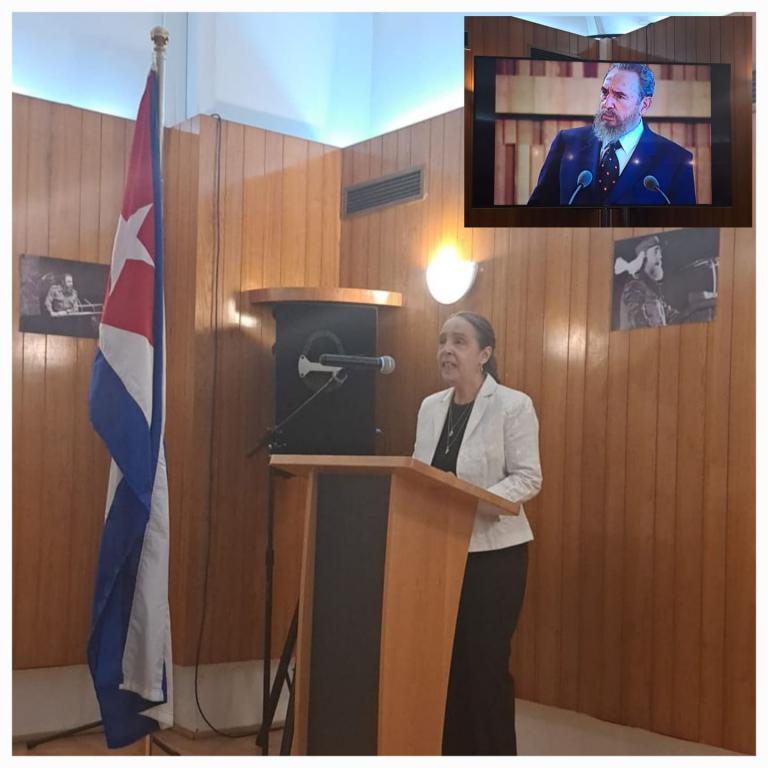
Paris, August 13, 2026.- As part of the commemorative activities marking the centennial of the birth of Commander-in-Chief Fidel Castro Ruz, the Cuban State Mission in France and the Permanent Delegation of Cuba to UNESCO paid tribute, on August 13, to the historic leader of the Cuban Revolution.
The event took place at the “Alejo Carpentier” Hall of the Embassy of the Republic of Cuba in France and was preceded by the opening, at the diplomatic mission, of a photographic exhibition devoted to the life and trajectory of Fidel Castro Ruz, from his childhood onward.
The tribute featured remarks by the Deputy Head of Mission and Chargé d’Affaires a.i. of the Embassy of the Republic of Cuba in France, Justo Enrique Rodríguez Rodríguez, who highlighted the historic significance of the Commander-in-Chief and his legacy for present and future generations of Cubans.
The event also included remarks by Ambassador María del Carmen Herrera Caseiro, Permanent Representative of the Republic of Cuba to UNESCO, who reflected on various facets of Fidel’s personality and thought, while underscoring the continuing relevance of his ideas for Cuba and the world.
In her remarks, the Permanent Representative particularly recalled the speech delivered by Fidel Castro before the UNESCO Executive Board on March 13, 1995, at the invitation of the Organization’s then Director-General, Federico Mayor. She stressed that the speech remains fully relevant today because of its defense of peace, international cooperation, sovereignty and the self-determination of peoples, as well as the importance the Cuban leader attached to education and culture as pillars of development and independence.
In this spirit, excerpts from Fidel’s historic 1995 speech at UNESCO were screened during the tribute, highlighting the enduring relevance of a body of thought that continues to address the major challenges facing humanity.
The event also provided an opportunity to recall the universal dimension of the Commander-in-Chief’s legacy and its close connection with the principles and purposes of UNESCO, particularly the defense of peace, education, culture, cooperation and understanding among peoples.
The Cuban people’s determination to defend their independence and sovereignty was also reaffirmed. The Cuban people remain victims of a brutal economic, commercial and financial blockade, as well as an energy siege with alarming consequences for the human rights of an entire population. It was recalled that, in his historic 1995 speech before UNESCO, Commander-in-Chief Fidel Castro Ruz had already denounced the unjust and anachronistic nature of a policy that was incompatible with the world moving toward the 21st century. Thirty years later, his words remain fully relevant in the face of the intensification of these coercive measures against Cuba.
Remarks by Ambassador María del Carmen Herrera Caseiro
Permanent Representative of the Republic of Cuba to UNESCO, at the tribute organized by the Cuban State Mission in France to mark the centennial of the birth of Commander-in-Chief Fidel Castro Ruz
August 13, 2026
On a day like today, August 13, but in 2009, a text by the renowned Colombian writer Gabriel García Márquez entitled “The Fidel Castro I Know” was published in Cuba. In this document, the Nobel Prize-winning author describes our Commander-in-Chief (and I quote) as “a man of austere habits and insatiable dreams, with an old-fashioned formal education, cautious in his words and gentle in his manners, incapable of conceiving any idea that is not monumental.”
Many other qualities could be added to this apt description. I think, for example, of Fidel as a frontline revolutionary, a deeply humanist leader, an unwavering defender of just causes, and an unconditional ally of the poor and disadvantaged.
I also think of Fidel as a man of great ideas and a universal vision of the future. His thought and his words are present in every corner of the world. They have also found an echo at UNESCO.
On March 13, a date that is also of great significance in the history of Cuba, but in 1995, our Commander-in-Chief addressed the UNESCO Executive Board at the invitation of the Organization’s then Director-General, Federico Mayor.
It was an epic speech. It may not be among the most widely circulated, but it is certainly one of the most relevant today.
On that occasion, Fidel reaffirmed the need for peace and cooperation for development, based on respect for the sovereignty and self-determination of nations. He also recalled that there can be no development without education, no education without culture, and no culture without independence and dignity. Thirty years later, these words have particular relevance in a world burdened by conflicts and inequalities, where solidarity and understanding are more urgent than ever.
Today, as we celebrate the centennial of the birth of that indispensable man, we invite you to share excerpts recovered from his historic 1995 speech at UNESCO, and to rediscover together the strength and continuing relevance of his ideas.
Thank you very much.