
By Patrick Brown
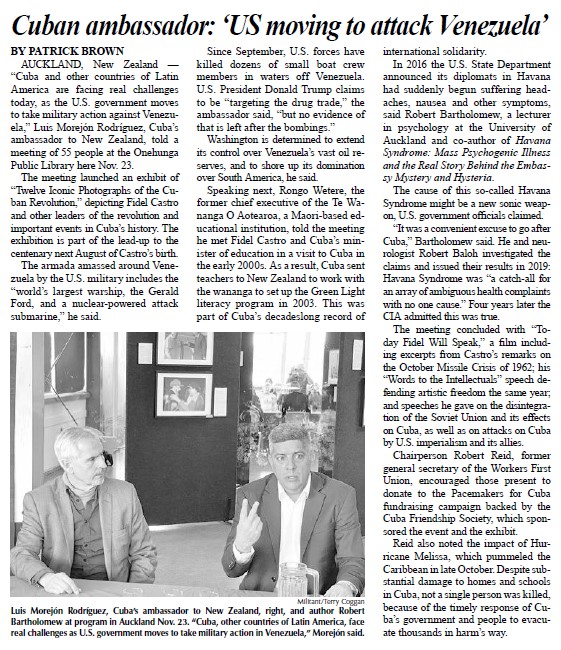
AUCKLAND, New Zealand — “Cuba and other countries of Latin America are facing real challenges today, as the U.S. government moves to take military action against Venezuela,” Luis Morejón Rodríguez, Cuba’s ambassador to New Zealand, told a meeting of 55 people at the Onehunga Public Library here Nov. 23.
The meeting launched an exhibit of “Twelve Iconic Photographs of the Cuban Revolution,” depicting Fidel Castro and other leaders of the revolution and important events in Cuba’s history. The exhibition is part of the lead-up to the centenary next August of Castro’s birth.
The armada amassed around Venezuela by the U.S. military includes the “world’s largest warship, the Gerald Ford, and a nuclear-powered attack submarine,” he said.
Since September, U.S. forces have killed dozens of small boat crew members in waters off Venezuela. U.S. President Donald Trump claims to be “targeting the drug trade,” the ambassador said, “but no evidence of that is left after the bombings.”
Washington is determined to extend its control over Venezuela’s vast oil reserves, and to shore up its domination over South America, he said.
Speaking next, Rongo Wetere, the former chief executive of the Te Wananga O Aotearoa, a Maori-based educational institution, told the meeting he met Fidel Castro and Cuba’s minister of education in a visit to Cuba in the early 2000s. As a result, Cuba sent teachers to New Zealand to work with the wananga to set up the Green Light literacy program in 2003. This was part of Cuba’s decadeslong record of international solidarity.
In 2016 the U.S. State Department announced its diplomats in Havana had suddenly begun suffering headaches, nausea and other symptoms, said Robert Bartholomew, a lecturer in psychology at the University of Auckland and co-author of Havana Syndrome: Mass Psychogenic Illness and the Real Story Behind the Embassy Mystery and Hysteria.
The cause of this so-called Havana Syndrome might be a new sonic weapon, U.S. government officials claimed.
“It was a convenient excuse to go after Cuba,” Bartholomew said. He and neurologist Robert Baloh investigated the claims and issued their results in 2019: Havana Syndrome was “a catch-all for an array of ambiguous health complaints with no one cause.” Four years later the CIA admitted this was true.
The meeting concluded with “Today Fidel Will Speak,” a film including excerpts from Castro’s remarks on the October Missile Crisis of 1962; his “Words to the Intellectuals” speech defending artistic freedom the same year; and speeches he gave on the disintegration of the Soviet Union and its effects on Cuba, as well as on attacks on Cuba by U.S. imperialism and its allies.
Chairperson Robert Reid, former general secretary of the Workers First Union, encouraged those present to donate to the Pacemakers for Cuba fundraising campaign backed by the Cuba Friendship Society, which sponsored the event and the exhibit.
Reid also noted the impact of Hurricane Melissa, which pummeled the Caribbean in late October. Despite substantial damage to homes and schools in Cuba, not a single person was killed, because of the timely response of Cuba’s government and people to evacuate thousands in harm’s way.