
New York, October 2nd, 2018. Since the triumph of the Revolution, the cultural policy of the revolutionary government has been guided by the indissoluble association of the concepts of culture and freedom, present in the ideas of the major figures of our history. Therefore, the development of culture in all its manifestations is a priority for the Cuban State, as demonstrated in the cultural events held at the Kennedy Center in Washington in May 2018.
Perhaps these are the reasons why the Cuban cultural sector suffered between April 2017 and March 2018, the scourge of the implementation of the US blockade. Some examples of the cultural exchange between both nations are:
- In 2017, the participation in performances and events of 497 American musicians and music professionals in Cuba had been scheduled. However, due to the tightening of the blockade these artists were unable to participate in the events which had been previously planned.
- Between the last quarter of 2017 and the beginning of 2018, the visit to Cuba of 15 American groups comprising around 300 persons, including musicians and companions, was cancelled.
- A group of students from the prestigious Berkeley Music School of Boston was unable to travel to Cuba to take part in workshops with Cuban professional musicians and music students. The sound engineers who were arranging the trip to Cuba sent word to EGREM that they had been warned by the authorities of their country to refrain from making the trip, due to the existing regulations.
On the other hand, the blockade sets up roadblocks for the commercialization and promotion of Cuban music, visual arts, performing arts and literature, as evidenced by the following examples:
- Between April 2017 and March 2018, a total of 37 groups of artists made up of 367 musicians travelled to the United States to put on performances, which had to be necessarily promotional due to the blockade regulations. No compensation was received for these performances.
- Artex S.A Music Recording and Publishing Company, Bis Music, contacted several American companies involved in distributing and publishing music, with an interest in engaging in negotiations with Cuba. However, out of fear of being sanctioned under the regulations imposed by the blockade, these companies failed to send the documentation required for the negotiations.
- Performing arts groups Revolution, Rakatan, Havana Queen, light opera singers and circus performers were prevented from signing direct contracts with US entrepreneurs interested in our artistic talent.
- In 2016 and 2017, the Havana International Book Fair (FILH, by its Spanish acronyms) hosted the First and Second Meetings of Publishers, Distributors and Literary Agents of Cuba with the US, on which they had fruitful exchanges that provided an impetus for rapprochement and cooperation in the publishing area between the two countries. However, because of the new measures adopted by the US government, it was not possible to hold the Third Meeting of Publishers, Distributors and Literary Agents of Cuba and the US during FILH 2018.
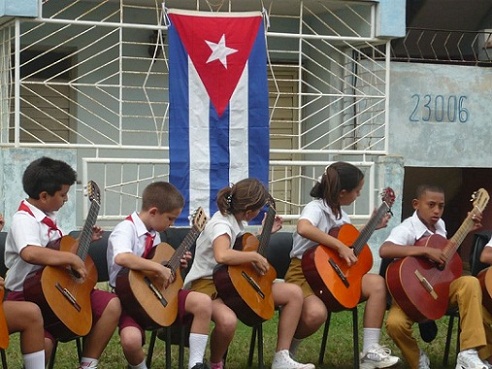
Due to the blockade regulations, materials required for teaching arts, such as music reading books, sheet music notebooks, saxophones, guitar strings, violins, cellos and double basses, are purchased at higher prices on the international market, though available at much more reasonable prices on the American market.
The growth of the Cuban film industry has also been affected by the conditions imposed by the blockade, such as the Animation Studios of the Cuban Institute for Cinematographic Art and Industry (ICAIC, by its Spanish acronyms) not having access to software licenses essential for their production processes and being unable to directly access the most important international film event (American Film Market).
Permanent Mission of Cuba to the United Nations.